


Introduction: The Convergence of Structure and Synthesis
In the high-velocity world of modern software engineering, a persistent tension exists between the need for rigorous architectural documentation and the demand for rapid, intelligent automation. For years, industry discourse has framed Unified Modeling Language (UML) and Artificial Intelligence (AI) as opposing forces: one representing the static, manual rigor of traditional engineering, and the other embodying the dynamic, automated future of code generation. However, this binary view overlooks a critical evolution in how complex systems are built.
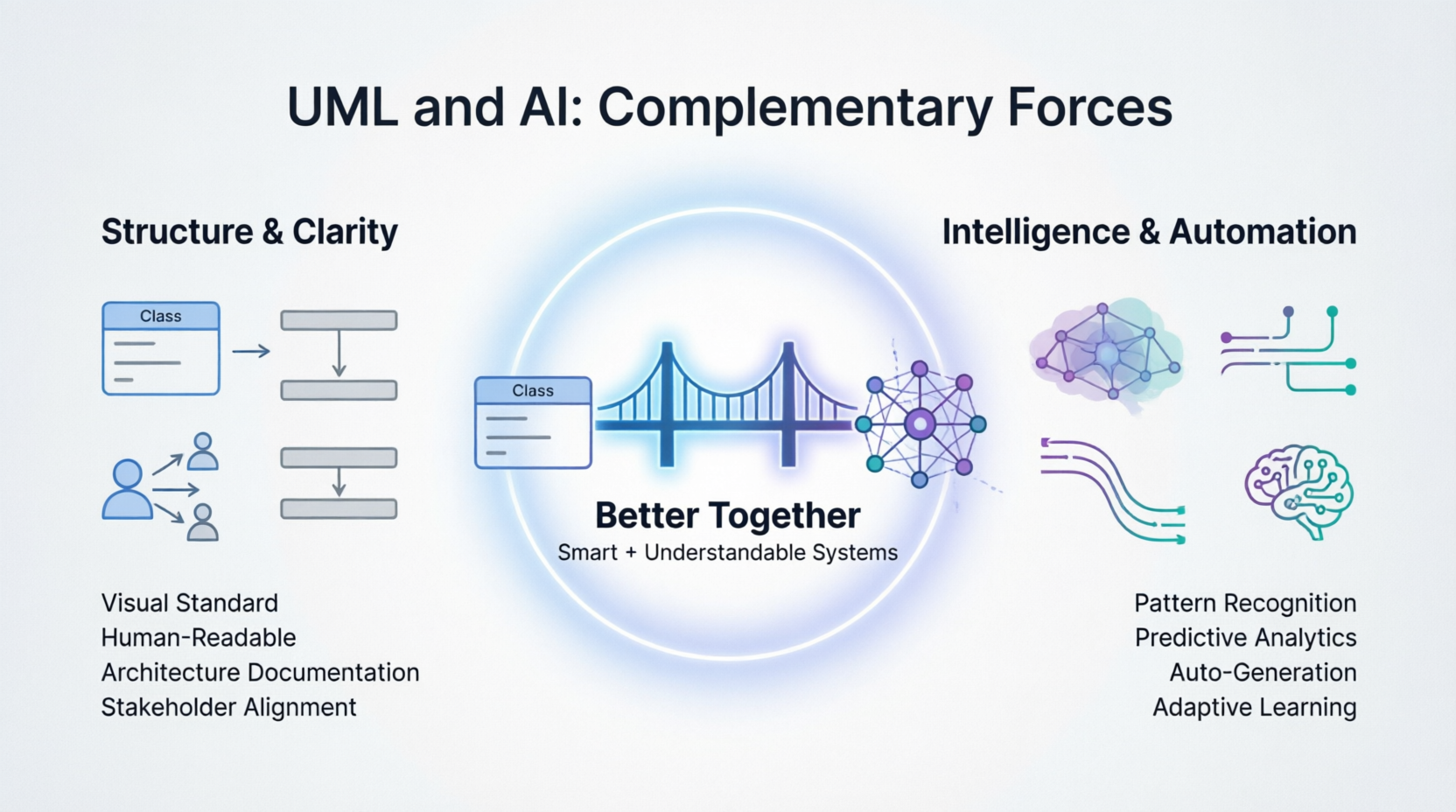
As we move deeper into an era defined by distributed microservices, machine learning pipelines, and regulatory scrutiny, the most successful engineering teams are not choosing between UML and AI. Instead, they are integrating them. UML provides the essential “architectural skeleton”—a shared visual vocabulary that ensures alignment among stakeholders, documents intent, and maintains long-term maintainability. AI acts as the “nervous system,” injecting adaptive learning, predictive analytics, and automation into these static models.
This case study explores the symbiotic relationship between these two disciplines. It demonstrates how AI can breathe life into UML diagrams by automating their creation and maintenance, while UML provides the necessary structure to make opaque AI systems explainable, auditable, and compliant. For product leaders, architects, and engineers, mastering this convergence is no longer optional; it is the key to building systems that are not only intelligent but also understandable and human-centered.
Understanding the Core Differences
To understand how these technologies complement each other, we must first recognize their distinct roles in the development lifecycle.
UML: The Visual Language of Structure
-
Purpose: A standardized visual notation for specifying, visualizing, constructing, and documenting software artifacts.
-
Strengths: Human-readable diagrams, industry-standard semantics, captures high-level architecture and behavioral logic.
-
Limitations: Traditionally static, requires manual maintenance, does not execute or predict runtime behavior.
AI: The Engine of Intelligence
-
Purpose: Systems capable of learning, reasoning, and making decisions based on data patterns.
-
Strengths: Pattern recognition, predictive capabilities, automation of repetitive tasks, adaptability to changing inputs.
-
Limitations: Often operates as a “black box,” requires significant data infrastructure, and lacks inherent explainability without additional tooling.
Why They Are Complementary
The integration of UML and AI creates a feedback loop where structure enables intelligence, and intelligence enhances structure.
1. AI Enhances UML Creation and Maintenance
Scenario: A large enterprise managing hundreds of microservices.
Example:
-
An AI-powered tool analyzes code repositories to automatically generate and update UML class and sequence diagrams.
-
When developers modify code, AI detects changes and suggests corresponding updates to the UML diagrams, ensuring documentation never falls out of sync with reality.
-
Natural Language Processing (NLP) converts textual requirements into initial UML use case diagrams, accelerating the design phase.
Real-world application: Tools like PlantUML with AI assistants can generate diagrams from text descriptions, while reverse-engineering tools use machine learning to infer relationships from legacy codebases.
2. UML Provides Structure for AI Systems
Scenario: Building a complex AI-driven recommendation engine.
Example:
-
Use UML component diagrams to map out the AI pipeline: data ingestion → preprocessing → model training → inference → feedback loop.
-
Sequence diagrams clarify interactions between AI services and traditional backend systems.
-
State machine diagrams model the lifecycle of ML models (training, validation, deployment, monitoring, retraining).
Benefit: UML makes AI system architecture understandable to stakeholders who are not machine learning experts, bridging the gap between data science and engineering.
3. Explainable AI Through Visualization
Scenario: A healthcare AI system making diagnostic recommendations.
Example:
-
UML activity diagrams visualize the decision flow of an AI model.
-
Class diagrams show how different features contribute to predictions.
-
Combined with SHAP/LIME explanations, UML provides a structured way to document why AI made certain decisions.
Impact: Regulatory compliance (such as GDPR or HIPAA) requires explainability. UML bridges the gap between complex AI algorithms and human understanding, facilitating audits.
4. AI-Powered UML Analysis and Optimization
Scenario: Legacy system modernization.
Example:
-
AI analyzes thousands of UML diagrams across projects to identify architectural patterns and anti-patterns.
-
Machine learning predicts which components are likely to cause bottlenecks based on historical UML models and performance data.
-
NLP extracts requirements from documents and validates them against existing UML models for consistency.
Practical Integration Scenarios
Scenario 1: Agile Product Development
Challenge: Rapidly evolving product with multiple AI features.
Solution:
-
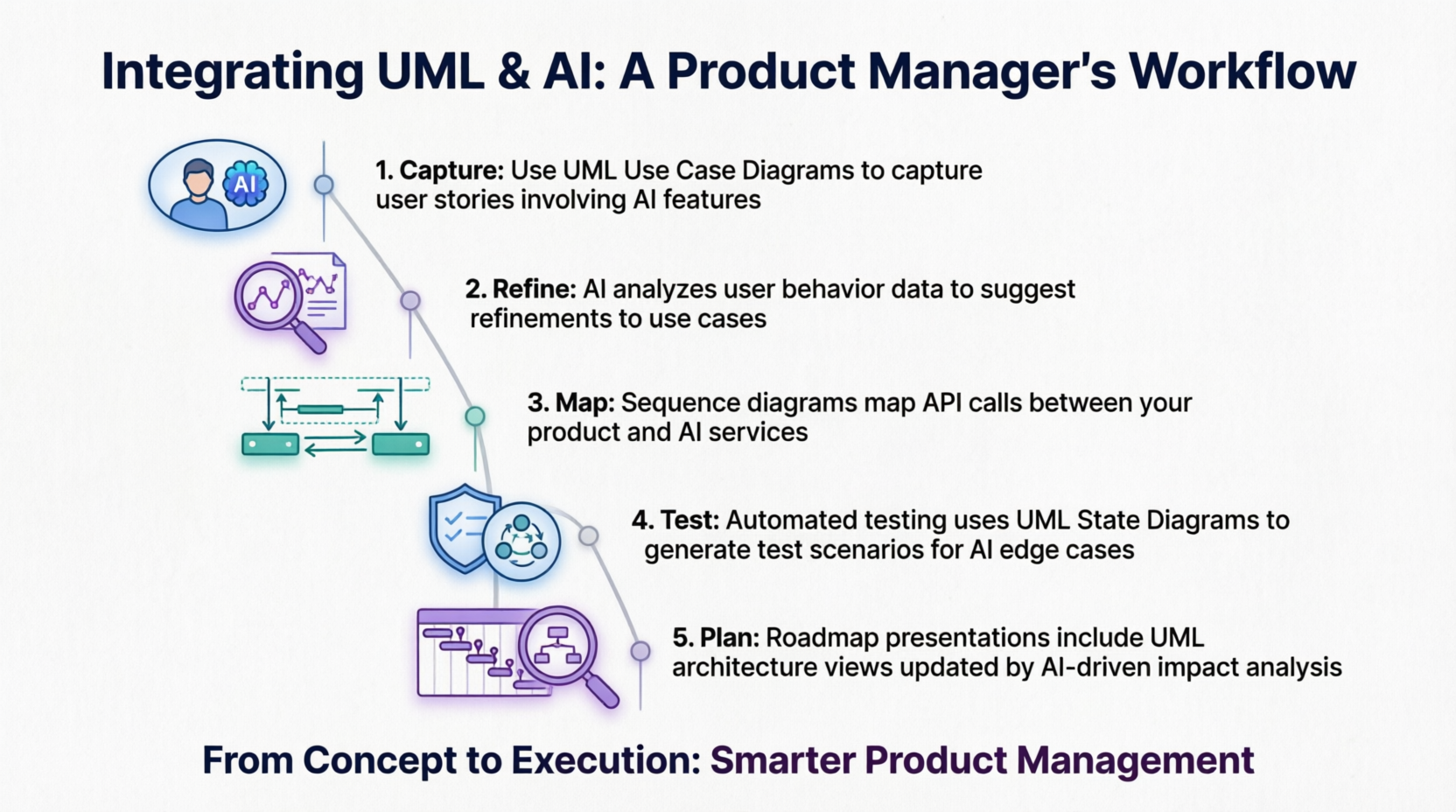
Use UML use case diagrams to capture user stories involving AI features.
-
AI analyzes user behavior data to suggest refinements to use cases.
-
Sequence diagrams map API calls between your product and AI services.
-
Automated testing uses UML state diagrams to generate test scenarios for AI edge cases.
-
Roadmap presentations include UML architecture views updated by AI-driven impact analysis.
Advantage: This approach leverages AI insights while using UML to communicate findings clearly to engineering teams, ensuring alignment between business goals and technical implementation.
Scenario 2: Enterprise Architecture Management
Challenge: Managing complexity in cloud-native architectures with AI components.
Solution:
-
Deployment diagrams show where AI models run (edge vs. cloud).
-
Component diagrams illustrate microservices interacting with AI APIs.
-
AI monitors system metrics and alerts when actual behavior diverges from UML specifications.
-
Predictive maintenance: AI forecasts when architecture needs refactoring based on UML complexity metrics.
Scenario 3: Regulatory Compliance in AI Systems
Challenge: A financial services company must document AI decision-making processes.
Solution:
| UML Artifacts | AI Contribution |
|---|---|
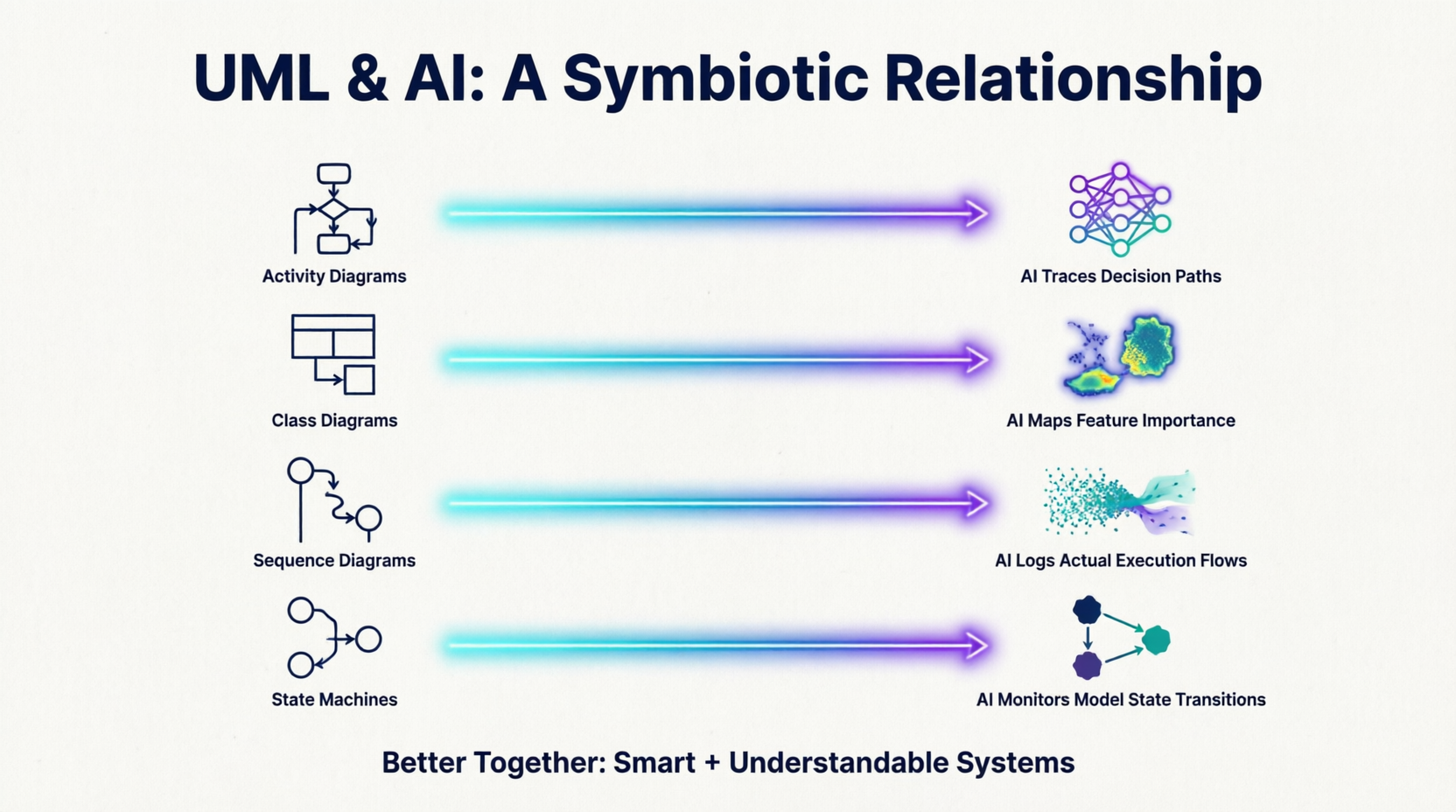
| Activity Diagrams | AI traces decision paths |
| Class Diagrams | AI maps feature importance |
| Sequence Diagrams | AI logs actual execution flows |
| State Machines | AI monitors model state transitions |
Outcome: Auditable, visual documentation that satisfies regulators while remaining technically accurate.
When to Use Each (and Both)
| Situation | Primary Tool | Rationale |
|---|---|---|
| Initial system design | UML | Establishes shared understanding |
| Code generation from design | Both | UML provides structure, AI generates code |
| Debugging AI behavior | Both | UML shows expected flow, AI shows actual patterns |
| Stakeholder communication | UML | Visual, standardized, accessible |
| Predicting system failures | AI | Learns from historical data |
| Documenting AI architecture | UML | Makes complex AI systems comprehensible |
| Optimizing database schemas | Both | UML ER diagrams + AI performance predictions |
| Requirements validation | Both | UML models requirements, AI checks consistency |
Future Predictions (2026-2030)
1. AI-Native UML Tools
-
Real-time collaborative UML editing with AI co-pilots.
-
Automatic inconsistency detection between diagrams.
-
Voice-to-UML: Commands like “Show me the authentication flow” generate sequence diagrams instantly.
2. Executable UML Meets AI
-
UML models become directly executable with AI optimization.
-
Simulations predict system behavior before implementation.
-
AI suggests architectural improvements based on UML model analysis.
3. Conversational System Design
-
Natural language conversations with AI generate and refine UML diagrams.
-
“What if we add a caching layer?” prompts AI to update diagrams and predict performance impact.
-
Particularly valuable for Product Managers bridging business and technical teams.
4. Self-Documenting AI Systems
-
AI systems automatically generate and maintain their own UML documentation.
-
Continuous synchronization between running systems and architectural models.
-
Reduced documentation debt in fast-moving AI projects.
5. Hybrid Intelligence Workflows
Human Designer ←→ UML Models ←→ AI Analyzer ←→ Recommendations ←→ Human Review
-
Humans provide strategic direction and domain expertise via UML.
-
AI handles pattern detection, optimization suggestions, and routine updates.
-
Iterative refinement loop improves both design quality and AI accuracy.
Potential Risks of Exclusive Use
Using Only UML (No AI)
-
❌ Manual diagram maintenance becomes unsustainable at scale.
-
❌ Missed optimization opportunities hidden in data.
-
❌ Slow response to changing requirements.
-
❌ Limited ability to predict system behavior.
Using Only AI (No UML)
-
❌ “Black box” systems difficult to audit or explain.
-
❌ Poor communication with non-technical stakeholders.
-
❌ Lack of intentional architecture leads to technical debt.
-
❌ Difficult to onboard new team members.
-
❌ Regulatory compliance challenges.
Best Practices for Integration
For Product Managers
-
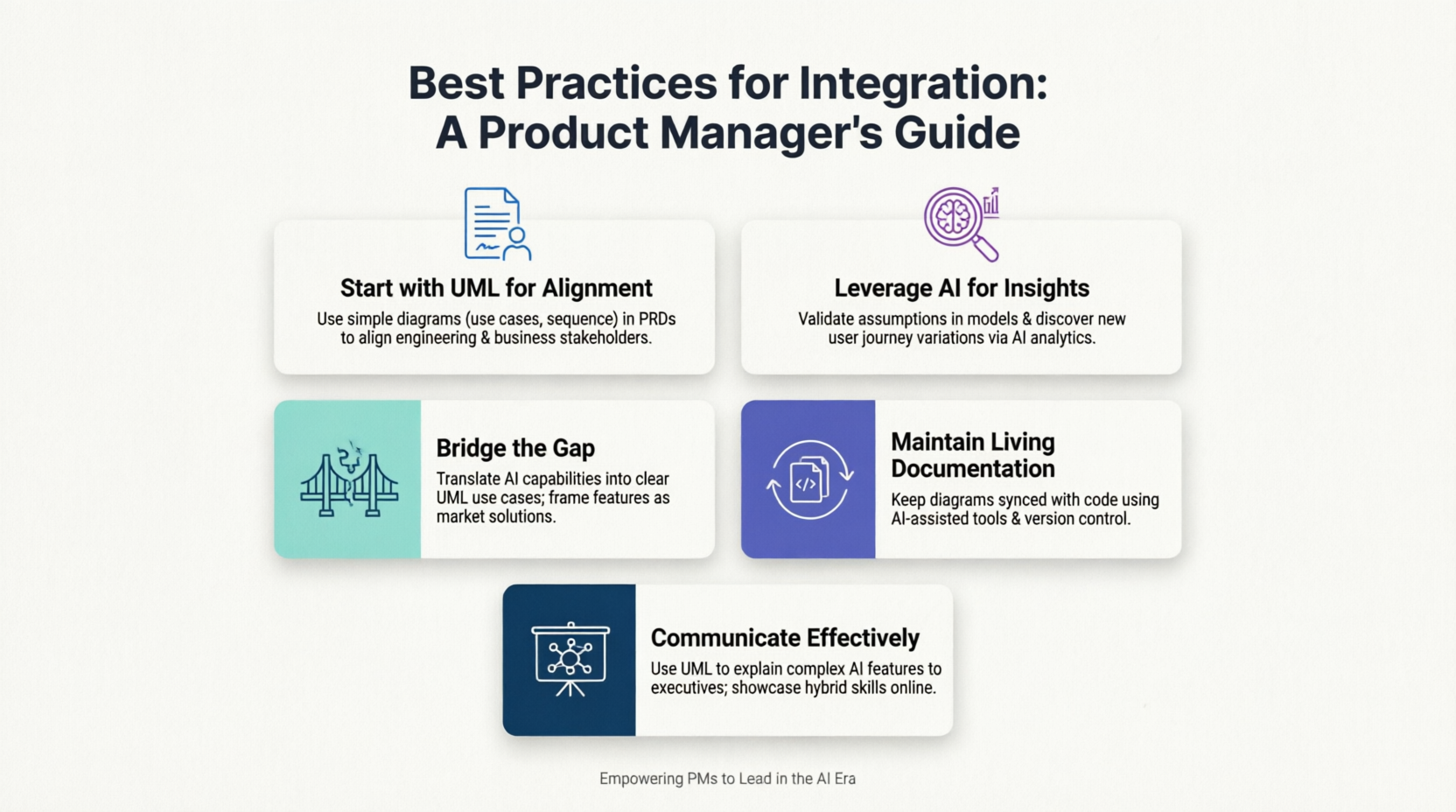
Start with UML for Alignment: Use simple UML diagrams (use cases, basic sequence) in product requirement documents to ensure engineering and business stakeholders share mental models.
-
Leverage AI for Insights: Use AI analytics to validate assumptions in your UML models and let AI suggest user journey variations you hadn’t considered.
-
Bridge the Gap: Translate AI capabilities into UML use cases for clarity. Frame AI features in terms of market problems and user value.
-
Maintain Living Documentation: Keep UML diagrams updated with AI-assisted tools and version control your diagrams alongside code.
-
Communicate Effectively: Use UML to explain AI features to executives and showcase this hybrid approach in professional networks.
For Technical Teams
-
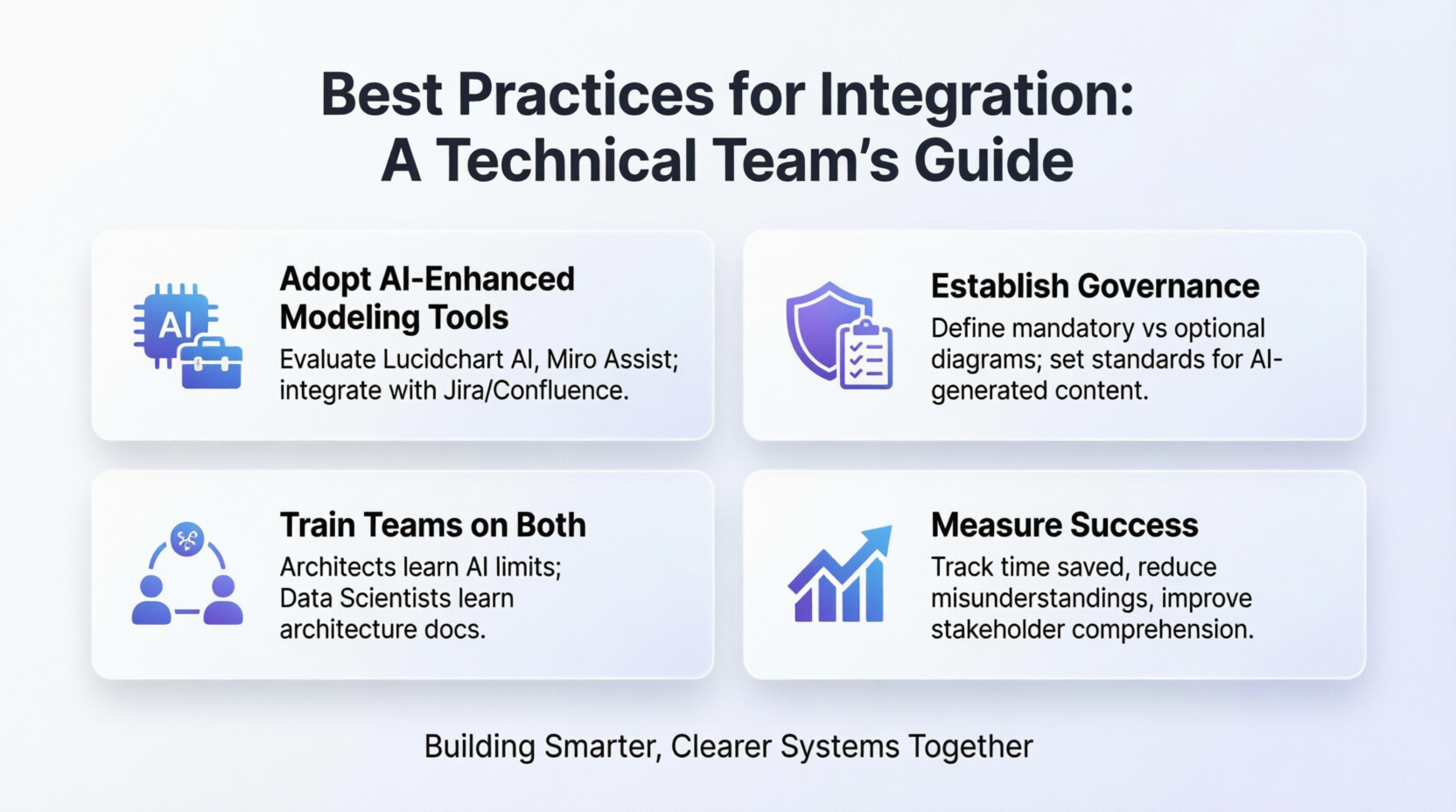
Adopt AI-Enhanced Modeling Tools: Evaluate tools like Lucidchart with AI, Miro Assist, or specialized UML-AI platforms. Integrate them with existing workflows (Jira, Confluence, etc.).
-
Establish Governance: Define which diagrams are mandatory vs. optional and set standards for AI-generated vs. human-created content.
-
Train Teams on Both: Ensure architects understand AI limitations and data scientists understand architectural documentation.
-
Measure Success: Track time saved in diagram creation/maintenance, monitor reduction in architectural misunderstandings, and measure stakeholder comprehension improvements.
Concrete Examples
Example 1: E-Commerce Recommendation System
UML Components:
-
Class diagram: User, Product, RecommendationEngine, FeedbackLoop.
-
Sequence diagram: User browses → Request sent → AI processes → Recommendations returned.
-
Activity diagram: A/B testing workflow for different recommendation algorithms.
AI Contributions:
-
Analyzes clickstream data to optimize recommendation algorithm selection.
-
Predicts which UML-modeled user journeys have highest conversion.
-
Automatically detects when actual user behavior diverges from modeled sequences.
Outcome: 23% increase in conversion, clear documentation for compliance, faster iteration cycles.
Example 2: Autonomous Vehicle Software
UML Components:
-
State machine: Vehicle states (parked, driving, emergency stop).
-
Component diagram: Sensor fusion, perception, planning, control modules.
-
Deployment diagram: Edge computing vs. cloud processing.
AI Contributions:
-
Computer vision models process sensor data.
-
Reinforcement learning optimizes driving policies.
-
Anomaly detection identifies when real-world behavior doesn’t match UML state transitions.
Outcome: Safety-critical system with auditable architecture and adaptive intelligence.
Example 3: Healthcare Diagnostic Assistant
UML Components:
-
Use case diagram: Doctor requests diagnosis, system provides recommendations.
-
Sequence diagram: Data privacy checks → Model inference → Explanation generation.
-
Activity diagram: Escalation workflow when AI confidence is low.
AI Contributions:
-
Deep learning models analyze medical images.
-
NLP extracts relevant patient history.
-
Explainable AI generates human-readable rationales mapped to UML activities.
Outcome: FDA-compliant system with transparent decision-making and improved diagnostic accuracy.
Conclusion
The future of software design is not a choice between structure and intelligence, but a synthesis of both. UML and AI are symbiotic partners: UML provides the necessary framework for communication, intentional design, and regulatory compliance, while AI brings the power of automation, prediction, and adaptation.
For organizations aiming to build robust, scalable, and intelligent systems, the integration of these technologies offers a competitive advantage. By leveraging UML for clarity and AI for efficiency, teams can create products that are not only smart but also transparent and maintainable. As we look toward the next decade, the most successful engineers and product leaders will be those who can fluently speak both languages—using diagrams to define the “what” and “why,” and AI to optimize the “how.”
References
- Visual Paradigm Features: Overview of Visual Paradigm’s comprehensive suite of system architecture, enterprise modeling, and code engineering tools.
- UML Tool Solution: Detailed information on Visual Paradigm’s support for UML 2.x specifications and modeling capabilities.
- Visual Paradigm: A Comprehensive UML Modeling Solution: Blog post discussing the breadth of Visual Paradigm’s modeling solutions.
- Overview of the 14 UML Diagram Types: Guide explaining the structural and behavioral diagrams supported by Visual Paradigm.
- Visual Paradigm User Guide: Diagram Types: Official documentation on the specific diagram types available in the platform.
- Generate UML Class Diagrams with AI: Article detailing how AI can be used to automatically generate class diagrams.
- UML Deployment Diagram: A Definitive Guide: Guide on creating deployment diagrams with AI assistance.
- Visual Paradigm Standard Edition: Information on the Standard Edition features and availability.
- Visual Paradigm User Guide: Enterprise Features: Documentation on advanced enterprise modeling features.
- Eclipse UML to Java Tutorial: Tutorial on forward engineering from UML to Java code.
- Unlock Your Creative Potential with Visual Paradigm Community Edition: Guide to the free Community Edition for non-commercial use.
- Visual Paradigm Gallery: Showcase of diagrams and models created with Visual Paradigm.
- Capture Requirements Solution: Details on tools for capturing and managing requirements.
- Use Case Driven Agile Approach: Methodology for integrating use cases into agile development.
- Unlock the Power of SysML Modeling: Guide to Systems Modeling Language support.
- UML Class Diagram Tutorial: Tutorial on creating effective class diagrams.
- Enhanced AI Composite Structure Diagram Generation: Release notes on AI enhancements for composite structure diagrams.
- A Comprehensive Case Study of Visual Paradigm’s Free UML Modeling Tiers: Case study on the capabilities of the free tiers.
- BPMN and UML Integration: Information on integrating Business Process Model and Notation with UML.
- Free Web-Based UML Software: Details on the online web-based version of the tool.
This post is also available in Deutsch, Español, فارسی, Français, English, Bahasa Indonesia, 日本語, Polski, Portuguese, Ру́сский, Việt Nam, 简体中文 and 繁體中文.
Related posts:
 Comprehensive Guide: From Problem Statement to Class Diagram, ERD, and Database Modeling with Visual Paradigm
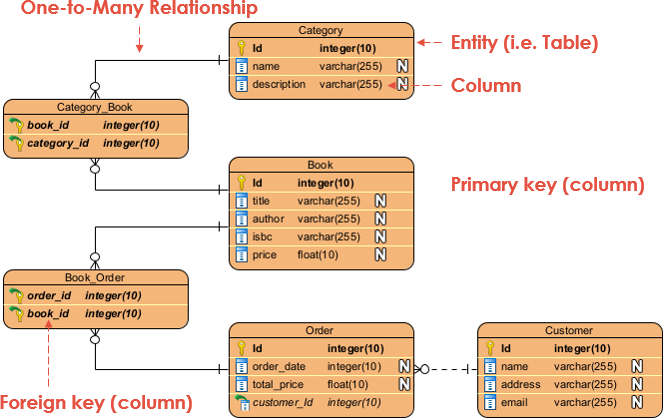 Visual Paradigm’s AI‑Powered ERD Generator
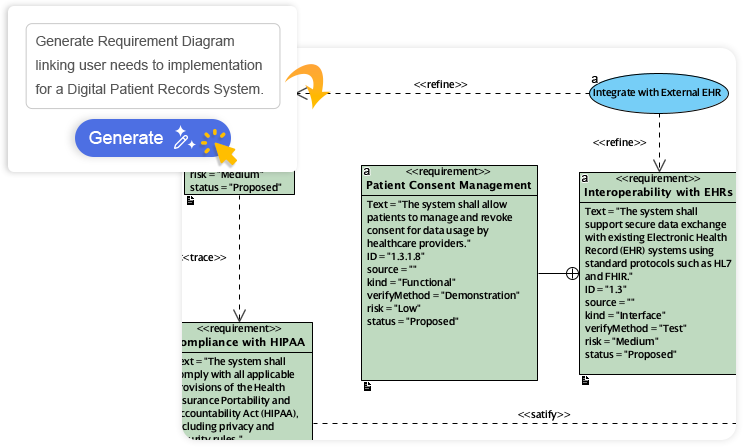 How Visual Paradigm’s AI Diagram Generation Turns Your Ideas into Professional UML & BPMN Diagrams in Seconds
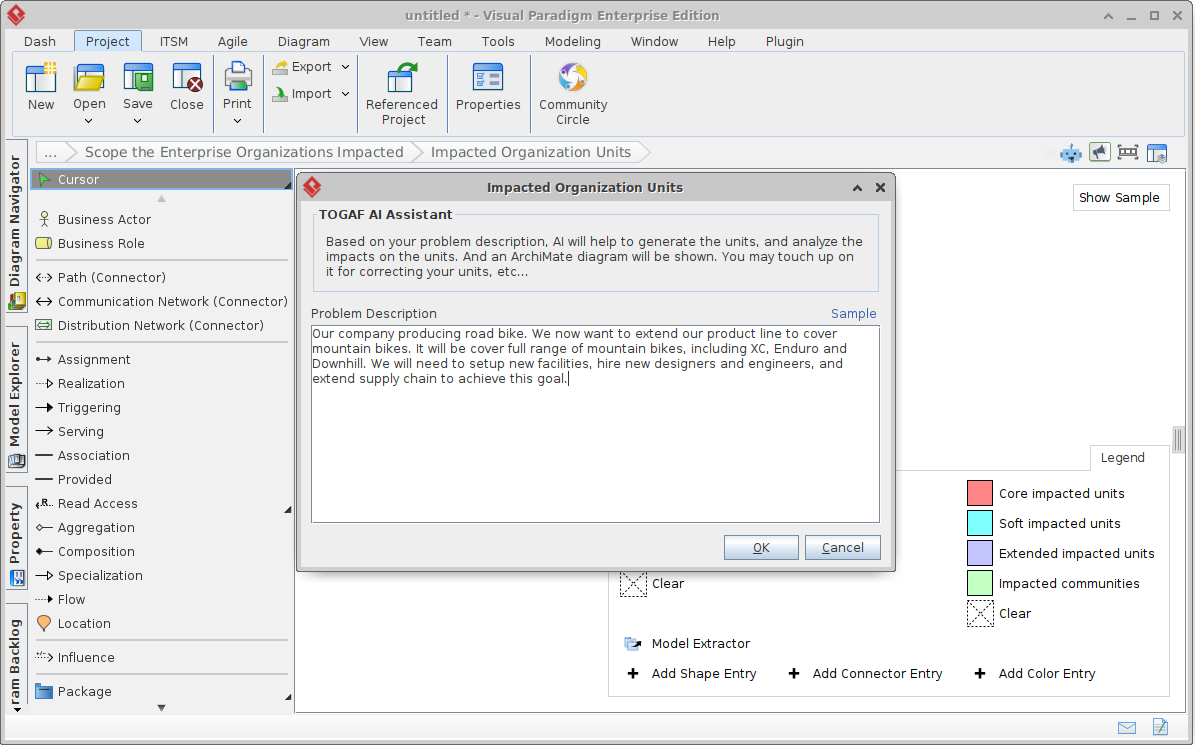 Why Teams Are Switching to Visual Paradigm: Powerful Modeling Meets Cutting-Edge AI