Introduction
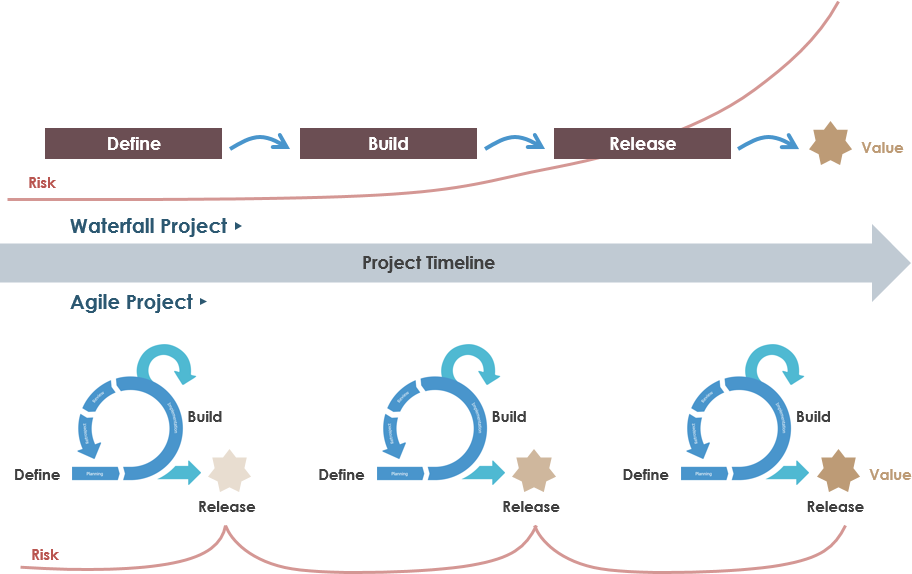
In today’s rapidly evolving technology landscape, organizations face increasing pressure to deliver high-quality software products faster while maintaining flexibility and responsiveness to changing market demands. Traditional project management methodologies often struggle to keep pace with these requirements, leading to missed deadlines, budget overruns, and dissatisfied stakeholders. The Agile Scrum framework has emerged as a powerful solution to these challenges, offering a structured yet adaptable approach to software development that emphasizes collaboration, iterative progress, and continuous improvement.
This comprehensive guide explores the fundamental principles of Agile Scrum and presents a detailed case study demonstrating how organizations can successfully implement this framework to transform their development processes and achieve measurable business outcomes.
Understanding the Agile Scrum Framework
The Agile Scrum framework represents a paradigm shift in how teams approach project management and software development. At its core, Scrum is built on the principles of transparency, inspection, and adaptation, enabling teams to deliver value incrementally through structured work cycles called sprints. This methodology breaks down complex projects into manageable chunks, allowing teams to respond quickly to feedback, adjust priorities, and continuously improve their processes.
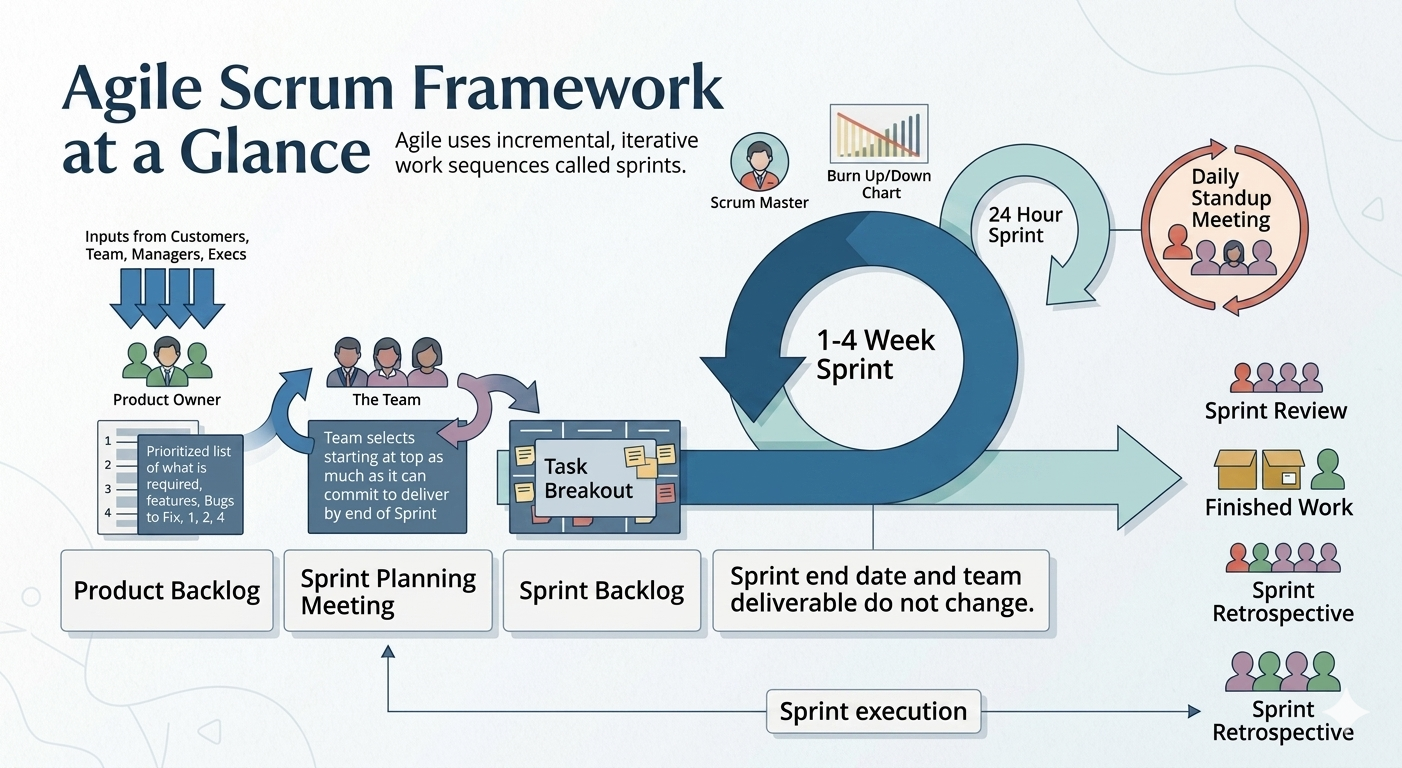
The framework’s strength lies in its simplicity and clarity. By defining specific roles, events, and artifacts, Scrum creates a predictable rhythm that helps teams maintain focus while remaining adaptable to change. The visual representation above illustrates how these components work together in a cohesive cycle, from initial planning through execution to review and reflection.
Key Components and Processes
Roles and Responsibilities
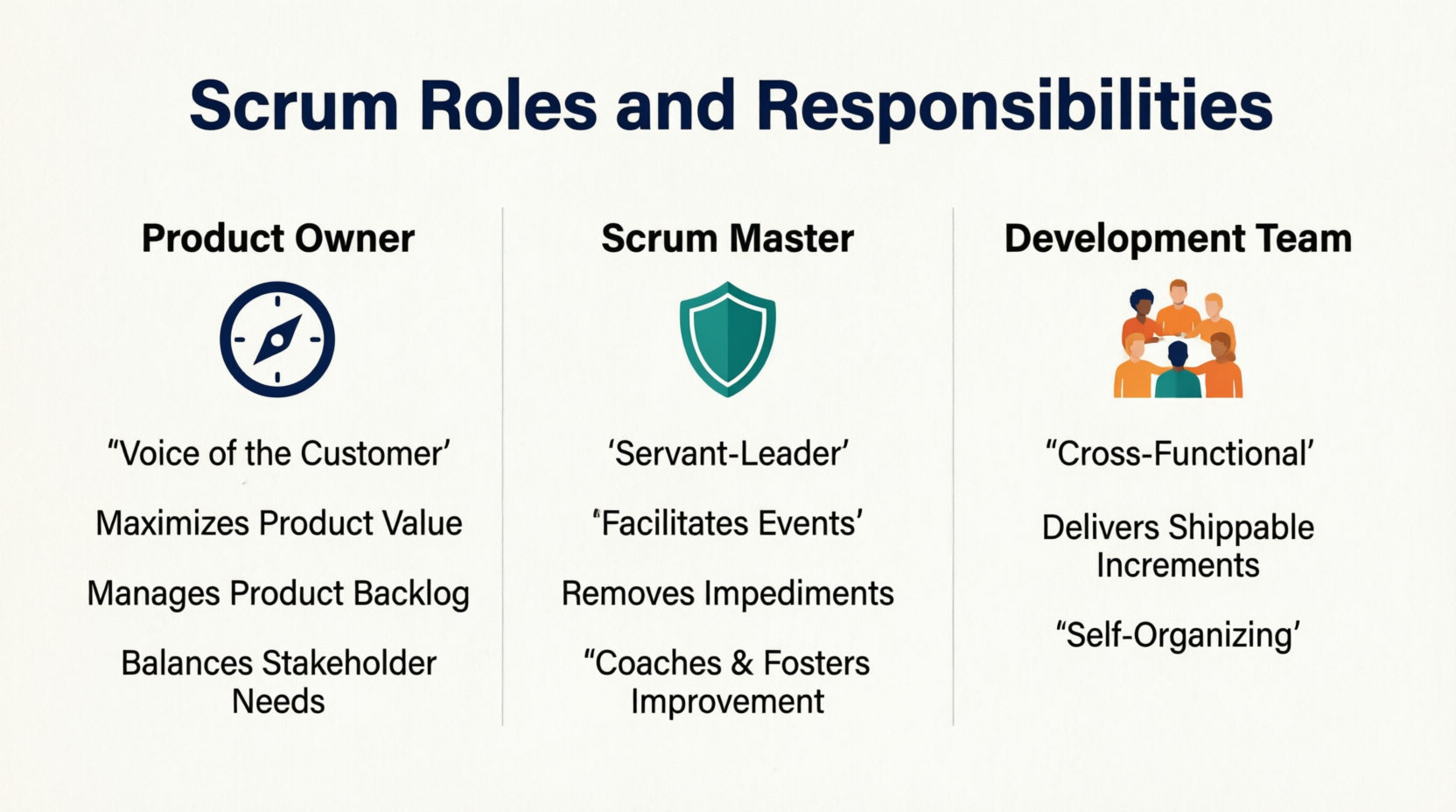
Product Owner The Product Owner serves as the voice of the customer and stakeholders, responsible for maximizing the value of the product. This role involves maintaining the Product Backlog, a dynamic prioritized list of features, bug fixes, technical improvements, and requirements. The Product Owner must constantly balance stakeholder needs, market demands, and technical constraints to ensure the team works on the most valuable items.
Scrum Master The Scrum Master acts as a servant-leader for the team, facilitating Scrum events, removing impediments, and ensuring the team adheres to Scrum principles and practices. This role focuses on coaching the team in self-organization and cross-functionality while fostering an environment of continuous improvement.
The Development Team The team consists of cross-functional professionals who collectively possess all the skills necessary to deliver potentially shippable product increments. Unlike traditional hierarchical structures, Scrum teams are self-organizing, meaning they determine how best to accomplish their work rather than being directed by others outside the team.
Core Artifacts
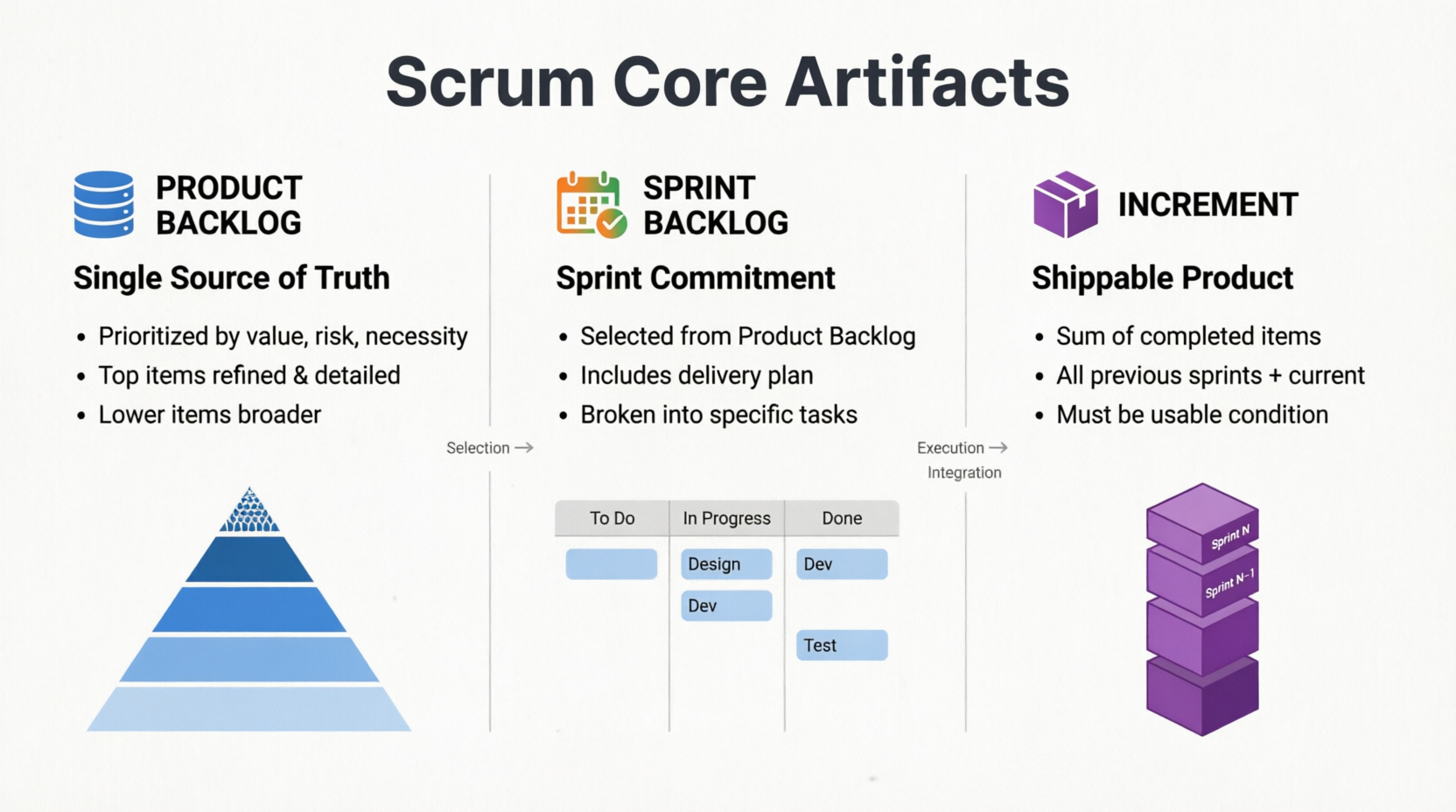
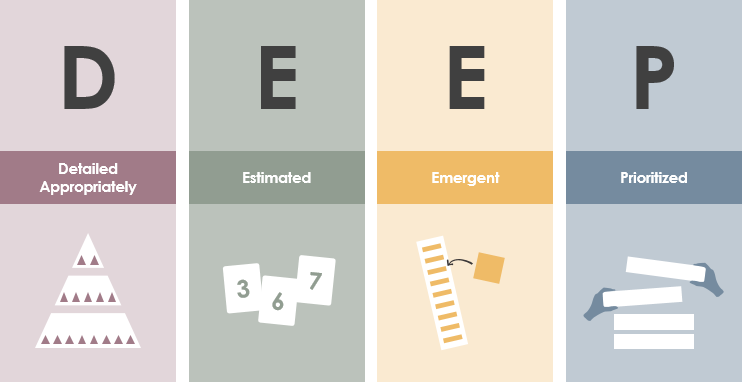
Product Backlog The Product Backlog is the single source of truth for what needs to be built. It contains everything required in the product, ordered by priority, value, risk, and necessity. Items at the top of the backlog are refined and detailed, while those further down remain broader and less defined until they approach the top.
Sprint Backlog During Sprint Planning, the team selects items from the Product Backlog and creates the Sprint Backlog, which represents their commitment for the upcoming sprint. This includes not only the selected features but also the plan for delivering them, broken down into specific tasks.
Increment The Increment is the sum of all Product Backlog items completed during a sprint combined with the value of all previous sprints. At the end of each sprint, the Increment must be in a usable condition, regardless of whether the Product Owner decides to release it.
Ceremonies and Events
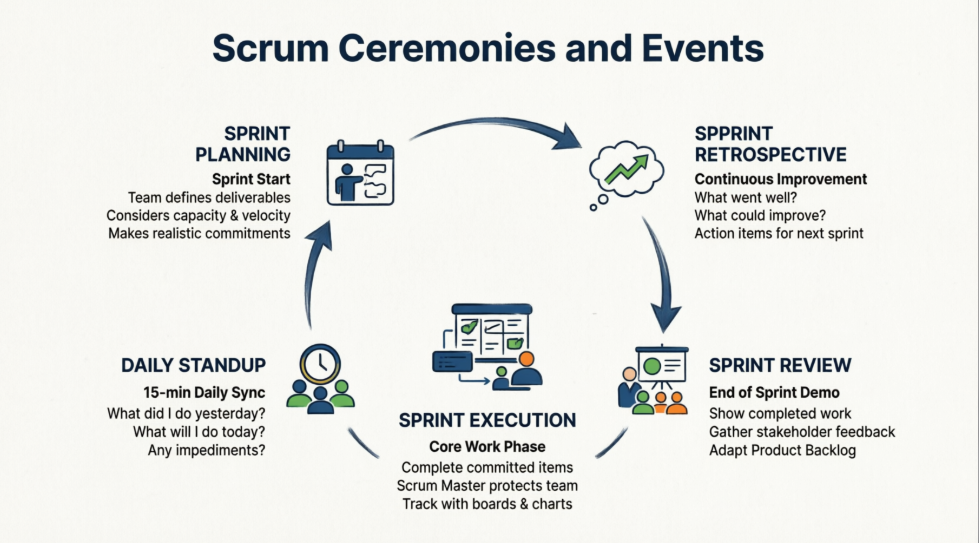
Sprint Planning This collaborative event marks the beginning of each sprint. The entire Scrum team works together to define what can be delivered in the sprint and how that work will be achieved. The team considers their capacity, historical velocity, and the priority of backlog items to make realistic commitments.
Daily Standup Meeting Also known as the Daily Scrum, this 15-minute time-boxed event occurs at the same time and place each day. Team members synchronize their activities and create a plan for the next 24 hours by answering three key questions: What did I do yesterday? What will I do today? Are there any impediments in my way?
Sprint Execution During the sprint, the team works to complete the committed backlog items. The Scrum Master protects the team from external interruptions, while the team self-organizes to manage their work. Progress is tracked visually, often using task boards and burn-down charts.
Sprint Review Held at the end of each sprint, this informal meeting allows the team to demonstrate the completed work to stakeholders. It’s an opportunity to gather feedback, discuss what was accomplished, and adapt the Product Backlog based on new insights or changing priorities.
Sprint Retrospective Following the Sprint Review, the team reflects on the past sprint to identify what went well, what could be improved, and what actions they will take to enhance their process. This continuous improvement mechanism is crucial for team growth and effectiveness.
Tracking and Visualization
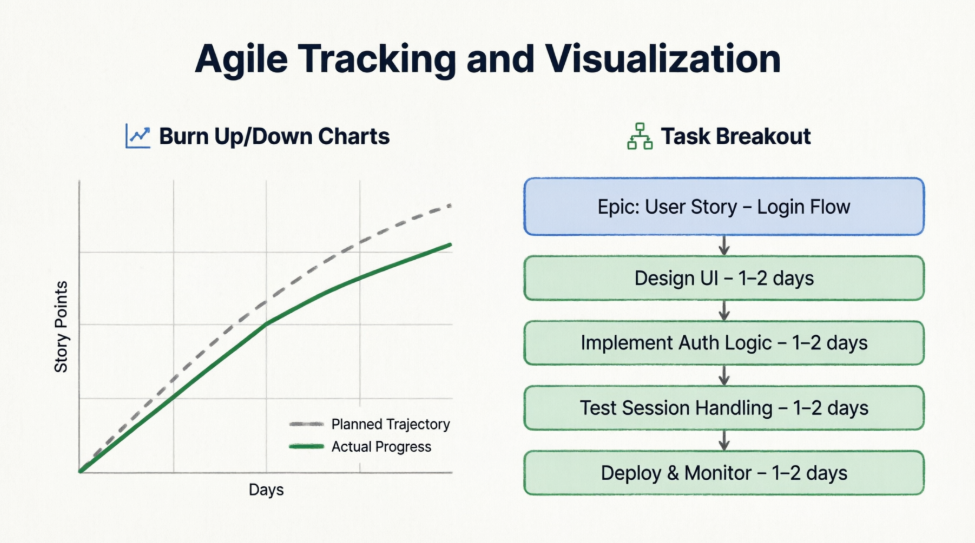
Burn Up/Down Charts These visual tools track progress throughout the sprint, showing completed work against the planned trajectory. They provide immediate visibility into whether the team is on track to meet their sprint goal and help identify potential issues early.
Task Breakout During planning, large backlog items are broken down into smaller, manageable tasks that can be completed within a day or two. This granular approach improves estimation accuracy and makes progress more visible.
Case Study: Digital Solutions Inc. – A Scrum Transformation Journey
Organizational Background
Digital Solutions Inc., a mid-sized web development company with approximately 80 employees, specialized in creating custom e-commerce platforms and enterprise web applications for clients in the retail and financial services sectors. Despite having talented developers and a strong client base, the company faced significant challenges that threatened its growth and reputation.
The organization operated under a traditional waterfall methodology, where projects moved sequentially through requirements gathering, design, development, testing, and deployment phases. This approach resulted in several critical issues:
- Missed Deadlines: Projects consistently ran 40-60% over their estimated timelines
- Poor Communication: Silos existed between product management, development, and quality assurance teams
- Scope Creep: Requirements changes mid-project caused significant rework and delays
- Low Morale: Developers felt disconnected from business outcomes and frustrated by constant fire-fighting
- Client Dissatisfaction: Stakeholders rarely saw working software until late in the development cycle, leading to misaligned expectations
The Decision to Change
In early 2023, after losing two major clients due to delivery failures, the executive team recognized the need for fundamental change. The Chief Technology Officer, Sarah Mitchell, championed the adoption of Agile Scrum after researching various frameworks and visiting companies successfully using the methodology.
The leadership team identified three pilot projects for the Scrum transformation:
- A mobile banking application for a regional credit union
- An inventory management system for a retail chain
- A customer portal for an insurance provider
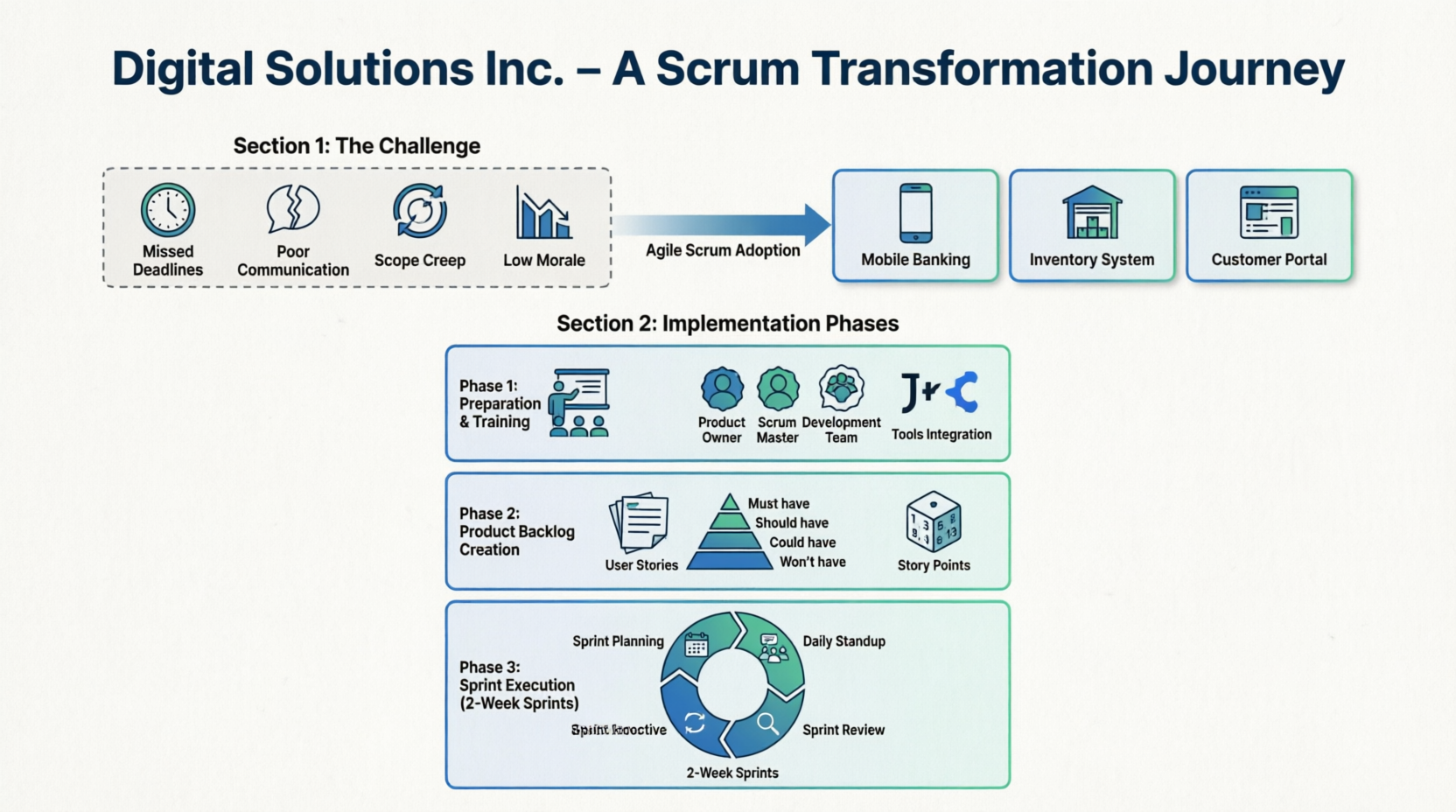
These projects were selected because they had moderate complexity, engaged stakeholders, and teams willing to experiment with new approaches.
Implementation Strategy
Phase 1: Preparation and Training (Weeks 1-4)
Before launching the pilot sprints, Digital Solutions invested heavily in preparation:
- Scrum Training: All team members, product owners, and stakeholders attended a two-day Certified Scrum workshop led by an external trainer
- Role Definition: Clear job descriptions were created for Product Owners and Scrum Masters, with three senior developers transitioning to full-time Scrum Master roles
- Tool Selection: The company adopted Jira for backlog management and Confluence for documentation, integrating them with their existing Git repository
- Physical Workspace: Dedicated team areas were created with whiteboards, sticky notes, and space for task boards, even though some team members worked remotely
Phase 2: Product Backlog Creation (Week 5)
For each pilot project, the newly appointed Product Owners worked intensively with stakeholders to:
- Conduct stakeholder interviews to understand business objectives and user needs
- Document epics (large bodies of work) and break them into user stories
- Prioritize backlog items using the MoSCoW method (Must have, Should have, Could have, Won’t have)
- Define acceptance criteria for each story
- Estimate initial backlog items using story points and planning poker
The mobile banking project backlog, for example, contained 127 user stories ranging from “As a customer, I want to view my account balance” to “As a user, I want to transfer funds between accounts securely.”
Phase 3: Sprint Planning and Execution (Weeks 6-25)
The teams adopted two-week sprints, finding this duration optimal for maintaining momentum while allowing meaningful progress. Here’s how a typical sprint unfolded:
Sprint Planning (Day 1 – 4 hours)
The mobile banking team’s first sprint planning session set the tone for the transformation. The Product Owner presented the top-priority backlog items, explaining the business value of each. The development team asked clarifying questions, discussed technical approaches, and ultimately committed to completing:
- User authentication with multi-factor authentication
- Account balance viewing
- Transaction history display
- Basic navigation structure
Using their collective experience and the story point estimates, the team determined they could realistically complete 34 story points in the two-week sprint, establishing their initial velocity baseline.
Daily Standup Meetings (Days 2-9 – 15 minutes each)
Every morning at 9:30 AM, the team gathered around their physical task board (with remote members joining via video conference). Each member answered the three standard questions:
Example from Day 3:
- Developer 1: “Yesterday I completed the login API integration. Today I’ll work on the session management. No blockers.”
- Developer 2: “Yesterday I started the account balance UI. Today I’ll finish it and begin the transaction list. I’m blocked waiting for the API endpoint from the backend team.”
- Scrum Master: “I’ll connect you with the backend team immediately after this meeting to resolve that blocker.”
These brief meetings proved invaluable for identifying issues early. The Scrum Master maintained an impediment backlog and worked aggressively to remove obstacles, ensuring the team could maintain focus on development work.
Sprint Execution and Tracking
Throughout the sprint, the team used multiple visualization tools:
- Task Board: Columns for “To Do,” “In Progress,” “Code Review,” “Testing,” and “Done” provided real-time status visibility
- Burn-down Chart: Updated daily, this showed the team was slightly behind on Day 5 but caught up by Day 7 after resolving the API blocker
- Definition of Done: The team established clear criteria: code completed, unit tests written, code reviewed, integrated, and acceptance tests passed
The Product Owner remained available throughout the sprint to answer questions and clarify requirements, preventing the team from making incorrect assumptions.
Sprint Review (Day 10 – 2 hours)
At the end of Sprint 1, the mobile banking team invited stakeholders from the credit union to review their progress. The demonstration included:
- Live demo of the working application on tablets and phones
- Walkthrough of completed user stories with acceptance criteria validation
- Discussion of what was not completed and why
- Presentation of the updated product backlog and proposed priorities for Sprint 2
The stakeholders provided immediate feedback: “The multi-factor authentication is excellent, but we need to add fingerprint login as an option.” This feedback was captured and prioritized in the backlog for future sprints.
Sprint Retrospective (Day 10 – 1.5 hours)
Following the review, the team held their first retrospective in a private room. Using the “Start, Stop, Continue” format, they identified:
Start:
- Pair programming for complex features
- Earlier involvement of QA in sprint planning
- Automated testing for regression prevention
Stop:
- Last-minute requirement clarifications
- Unplanned meetings during focused development time
- Manual deployment processes
Continue:
- Daily standups at the same time
- Collaborative problem-solving
- Frequent code reviews
The team committed to implementing two action items in the next sprint: introducing pair programming for authentication features and automating the deployment pipeline.
Challenges and Solutions
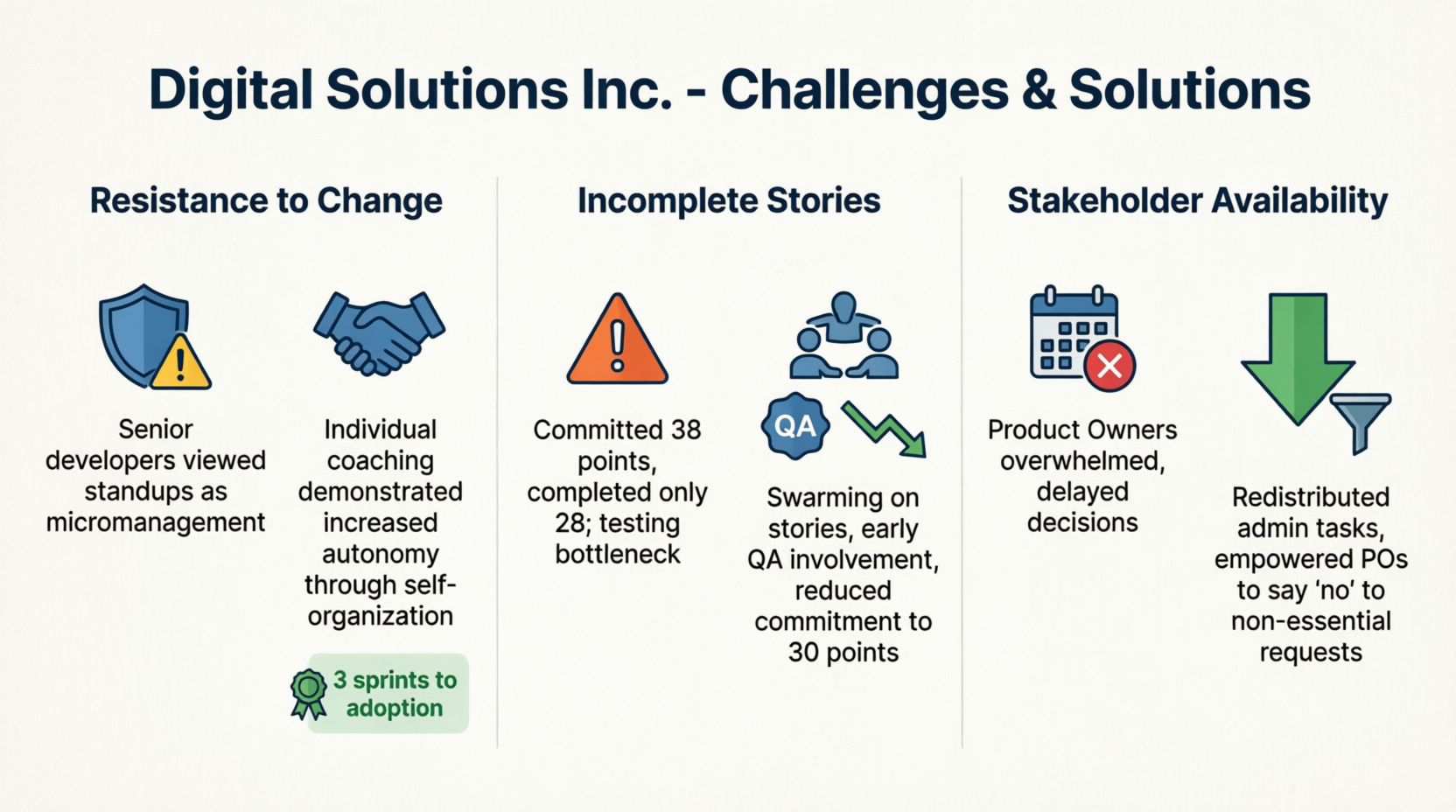
Challenge 1: Resistance to Change
Some senior developers initially resisted the Scrum framework, viewing daily standups as micromanagement and sprint planning as unnecessary overhead.
Solution: The Scrum Master worked individually with skeptics, addressing concerns and demonstrating how Scrum actually increased autonomy by empowering the team to self-organize. Within three sprints, even the most resistant team members acknowledged improved workflow and reduced stress.
Challenge 2: Incomplete Stories
In Sprint 2, the team committed to 38 story points but only completed 28, with several stories stuck in testing.
Solution: The retrospective revealed that testing was bottlenecked at the end of the sprint. The team adjusted by:
- Swarming on stories to get them fully complete before starting new work
- Involving QA earlier in the development process
- Reducing sprint commitment to 30 points until velocity stabilized
Challenge 3: Stakeholder Availability
Product Owners struggled to balance Scrum duties with their existing responsibilities, leading to delayed decisions and unclear requirements.
Solution: Leadership recognized that effective Product Ownership required dedicated time. They redistributed administrative tasks and empowered Product Owners to say “no” to non-essential requests, ensuring they could focus on backlog refinement and stakeholder engagement.
Measurable Outcomes
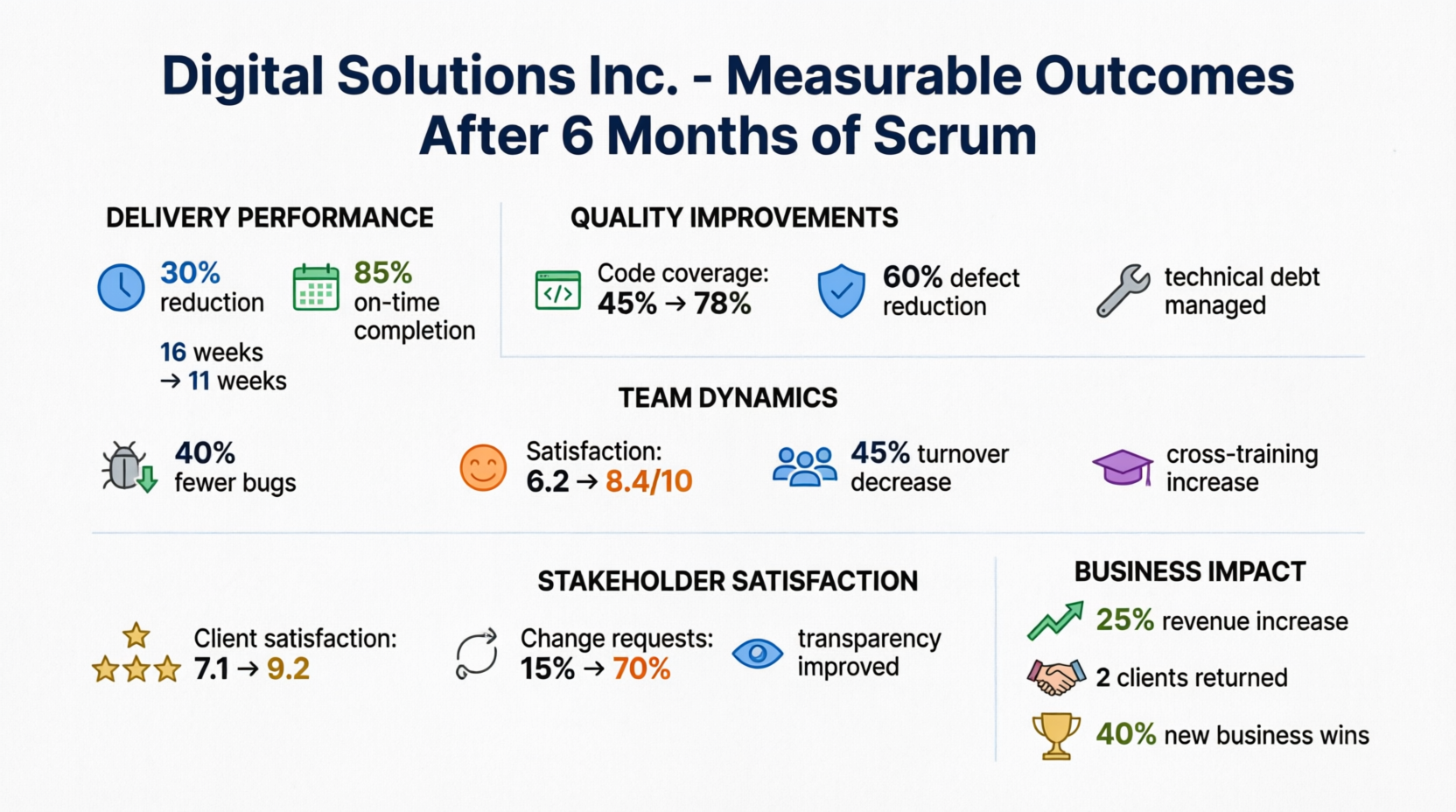
After six months of Scrum implementation across the three pilot projects, Digital Solutions Inc. achieved remarkable results:
Delivery Performance:
- 30% reduction in feature delivery time: Average time from requirement to production deployment decreased from 16 weeks to 11 weeks
- 85% on-time sprint completion: Teams consistently met their sprint commitments after the initial learning curve
- 40% decrease in critical bugs: Early and continuous testing caught issues before they reached production
Quality Improvements:
- Code coverage increased from 45% to 78% through test-driven development practices
- Customer-reported defects dropped by 60% compared to waterfall projects
- Technical debt was actively managed through dedicated refactoring stories in each sprint
Team Dynamics:
- Employee satisfaction scores rose from 6.2 to 8.4 (out of 10)
- Voluntary turnover decreased by 45% as developers felt more engaged and empowered
- Cross-training increased as team members collaborated more closely
Stakeholder Satisfaction:
- Client satisfaction scores improved from 7.1 to 9.2
- Change request accommodation increased from 15% to 70% of requested changes could be incorporated in the next sprint
- Transparency improved dramatically with stakeholders having visibility into progress every two weeks
Business Impact:
- Revenue from pilot project clients increased by 25% due to faster time-to-market for new features
- Two previously lost clients returned after seeing the improved delivery capabilities
- New business wins increased by 40% as the company could confidently commit to aggressive timelines
Scaling and Organizational Adoption
Based on the pilot success, Digital Solutions developed a phased rollout plan:
Phase 1 (Months 7-9): Expand Scrum to five additional development teams, using pilot team members as coaches and mentors.
Phase 2 (Months 10-12): Implement Scrum across all development teams, establishing a community of practice for Scrum Masters and Product Owners.
Phase 3 (Year 2): Introduce scaled Agile frameworks (SAFe) for coordinating multiple teams working on large enterprise programs.
The company also invested in:
- Creating an internal Agile Center of Excellence
- Developing career paths for Scrum Masters and Product Owners
- Integrating Agile metrics into performance management systems
- Establishing partnerships with Agile training organizations for ongoing education
Lessons Learned and Best Practices
The transformation at Digital Solutions Inc. revealed several critical success factors:
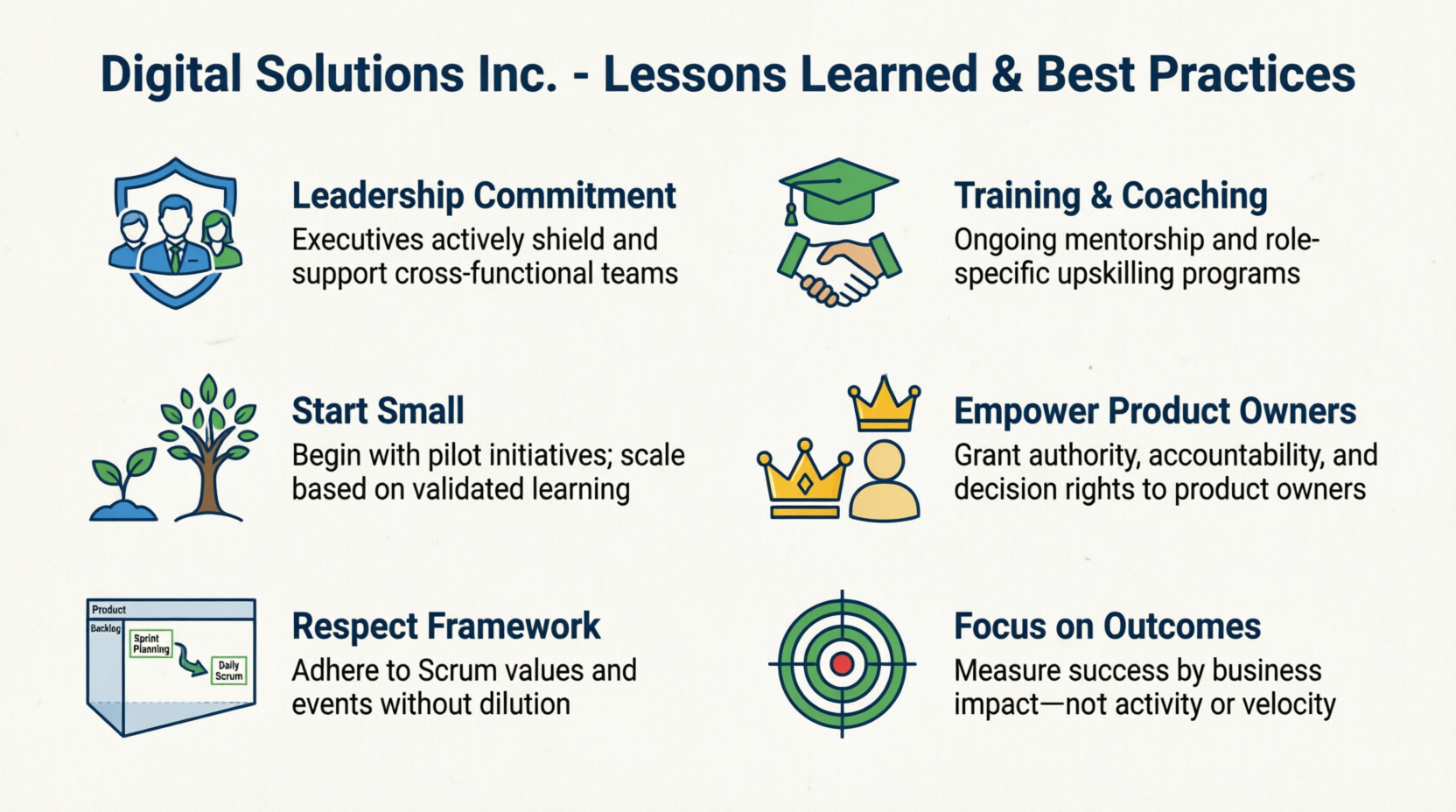
Leadership Commitment is Essential Executive support went beyond verbal approval. Leaders actively participated in training, protected teams from organizational interference, and celebrated Agile wins publicly.
Invest in Training and Coaching The initial two-day workshop was just the beginning. Ongoing coaching, especially in the first six months, helped teams navigate challenges and avoid common pitfalls.
Start Small and Scale Thoughtfully Beginning with pilot projects allowed the organization to learn and adapt before enterprise-wide rollout. Success stories from pilots built momentum and addressed skepticism.
Empower Product Owners Giving Product Owners the authority and time to do their jobs effectively proved crucial. Half-hearted Product Ownership led to confused priorities and frustrated teams.
Respect the Framework Teams that tried to customize Scrum too early (“Scrumbut” – “We do Scrum, but we skip retrospectives”) struggled. Mastering the basics before adapting yielded better results.
Focus on Outcomes, Not Outputs Shifting the conversation from “how many story points” to “what value delivered” kept teams focused on business outcomes rather than gaming metrics.
Conclusion
The Agile Scrum framework represents more than just a project management methodology—it embodies a fundamental shift in how organizations approach software development, team collaboration, and value delivery. As demonstrated through the comprehensive case study of Digital Solutions Inc., successful Scrum implementation requires commitment, patience, and a willingness to embrace change at all organizational levels.
The transformation journey is rarely smooth. Teams will face resistance, make mistakes, and encounter setbacks. However, the structured yet flexible nature of Scrum provides the scaffolding needed to navigate these challenges while continuously improving. The measurable outcomes achieved—30% faster delivery, 60% fewer defects, and dramatically improved stakeholder satisfaction—illustrate the tangible business value that Agile Scrum can deliver when implemented thoughtfully.
For organizations considering this transformation, the key takeaway is clear: Agile Scrum is not a quick fix or a set of practices to be mechanically applied. It is a cultural shift that requires investing in people, empowering teams, and maintaining relentless focus on delivering customer value. Those who commit to this journey, as Digital Solutions Inc. did, position themselves to thrive in an increasingly competitive and rapidly changing marketplace.
The framework’s emphasis on transparency, inspection, and adaptation creates a learning organization capable of responding to market shifts, technological changes, and evolving customer needs. In an era where software has become a critical differentiator for businesses across all industries, the ability to deliver high-quality software quickly and reliably is not just advantageous—it is essential for survival and growth.
As you consider implementing Agile Scrum in your organization, remember that the journey begins with a single sprint. Start small, learn continuously, celebrate progress, and remain committed to the principles of collaboration, customer focus, and continuous improvement. The results, as evidenced by countless success stories including the one detailed here, will far exceed the investment required to make the transformation.
References
- What is Agile Software Development? [Quick Guide]: Quick agile learning guide that provides you with everything you need to know about agile. It’s simple, yet comprehensive.
- Agile Tool with AI | Visual Paradigm: The ultimate Agile Tool ecosystem. Choose Visual Paradigm Desktop for comprehensive user story mapping and framework support, or VP Online for a suite of AI-powered cloud-based agile tools.
- Agile User Story Mapping Software | Visual Paradigm: Visual Paradigm’s easy-to-use User Story Mapping software helps you visualize and manage product backlogs effectively. Estimate user stories with Affinity Table, plan sprints, and streamline development activities.
- What is Agile Project Management?: Free Agile guide that talks about what Agile Project Management is. It provides a detailed explanation on the various Agile Scrum frameworks such as Large-Scale AScrum, Nexus, SAFe, etc.
- What is Agile Software Development?: Free scrum learning guide for all scrum teams. Learn about agile software development. More free scrum resources are available.
- The Top 7 Popular Agile Development Approaches: Learn about the top 7 Agile Development Approaches – Scrum, Extreme programming, DSDM, RAD, Unified Process, Lean Approach and Kanban. Manage your project with pro. Agile software.
- Easy Use Case Tool for both Use Case Driven or Agile Approach: Easy-to-Use Use Case Tool tailored for AGILE teams. Featuring scenario editor and sequence diagram generation. Integrated with user story map.
- How does Visual Paradigm supports agile project development? – Agile & Scrum – Discuss the Visual Paradigm: I wanna know more about how VP supports agile projects. Can someone provide me with some ideas?
This post is also available in Deutsch, Español, فارسی, Français, English, Bahasa Indonesia, 日本語, Polski, Portuguese, Ру́сский, Việt Nam, 简体中文 and 繁體中文.