


Enterprise architecture is the backbone of modern organizational strategy. It connects high-level business goals with the technical reality of systems and infrastructure. To communicate this complex landscape effectively, a standardized language is essential. ArchiMate serves this purpose. It is an open and independent architecture description language. This guide provides a structured overview for architects who need to understand the framework quickly. We will cover the core layers, relationships, and views without getting bogged down in unnecessary details. Let us dive into the essentials.
What is ArchiMate? 🤔
ArchiMate is a modeling language for enterprise architecture. It provides a common vocabulary for describing, analyzing, and visualizing architecture. It is vendor-neutral, meaning it does not depend on specific tools or vendors. This neutrality allows different teams to collaborate without confusion. The language defines concepts, relationships, and rules. It helps architects create consistent models that stakeholders can understand.
The framework was developed by The Open Group. It is widely adopted across various industries. Organizations use it to align IT strategy with business needs. It helps in managing complexity and risk. By using a standard language, teams reduce miscommunication. This leads to better decision-making and more efficient projects.
Key Benefits of Using ArchiMate
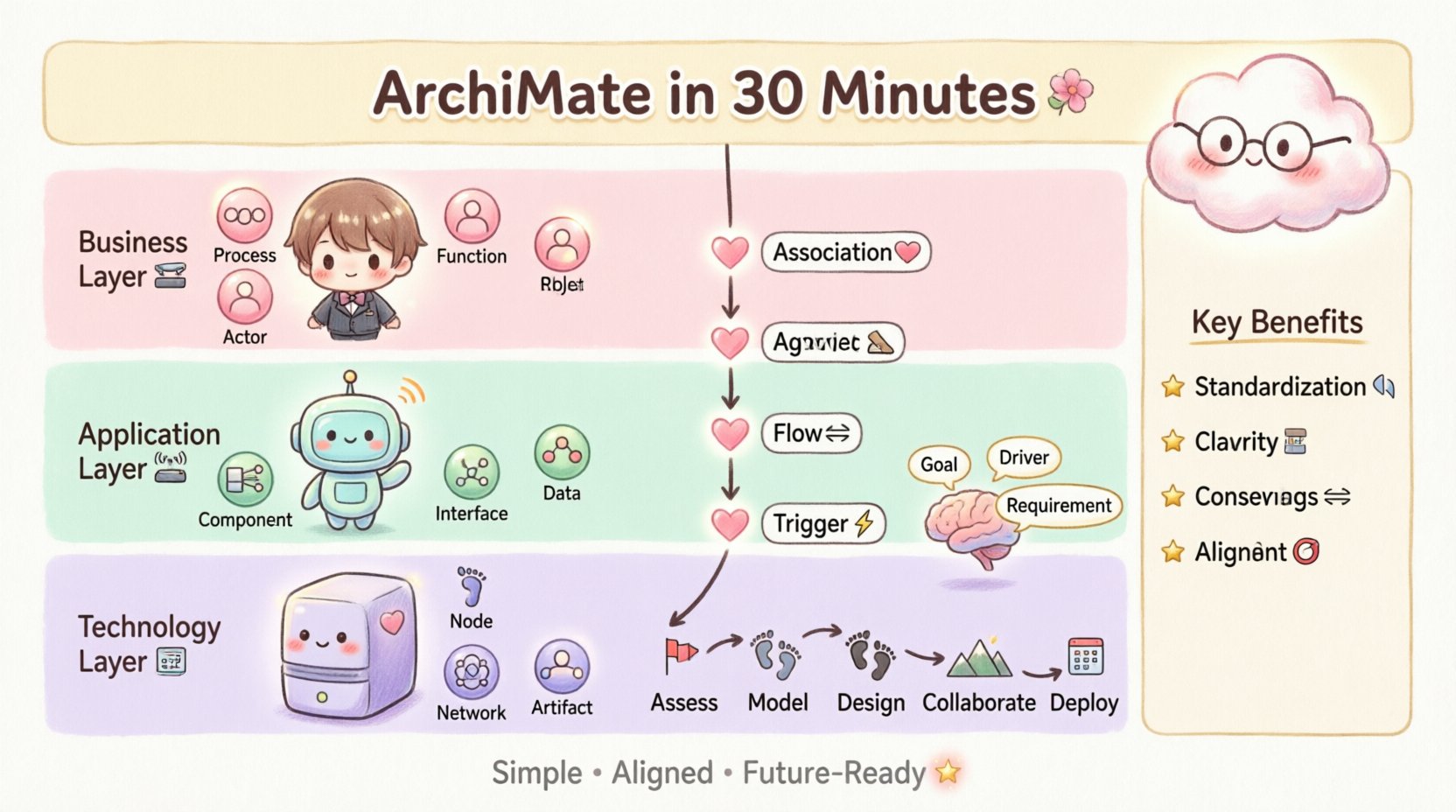
- Standardization: Everyone speaks the same language. 🗣️
- Clarity: Complex systems become easier to visualize. 📊
- Consistency: Models remain consistent across the organization. 🔄
- Alignment: Business and IT goals stay aligned. 🎯
The Three Core Layers 🧱
ArchiMate organizes architecture into three main layers. These layers represent different aspects of the enterprise. Understanding them is fundamental to creating accurate models. Each layer has specific concepts and focuses.
1. Business Layer 👔
The Business layer describes the core activities of the organization. It focuses on how the company operates. This layer includes processes, roles, and organizational structures. It answers the question: What does the business do?
- Business Process: A set of activities performed to achieve a business goal. ⚙️
- Business Actor: An entity that performs a role. This could be a person or a group. 🧑💼
- Business Function: A set of responsibilities that an organization must fulfill. 📋
- Business Role: A set of responsibilities in the business. 🎭
- Business Object: A description of a business entity. 📦
When modeling the Business layer, focus on value creation. Map out how products or services are delivered. Identify the key actors involved. Ensure that processes are logical and efficient.
2. Application Layer 💻
The Application layer describes the software systems that support the business. It focuses on the functionality provided by applications. This layer acts as a bridge between business requirements and technical implementation. It answers the question: What software supports the business?
- Application Component: A modular part of an application. 🧩
- Application Interface: A point of interaction for the application. 🔌
- Application Service: A set of functionality provided by an application. 🛠️
- Data Object: Data used by an application. 💾
Architects use this layer to identify dependencies between software. It helps in understanding where specific business functions are supported. Changes in this layer often require updates to the Business layer above it.
3. Technology Layer 🖥️
The Technology layer describes the hardware and network infrastructure. It supports the applications in the layer above. This layer focuses on the physical and logical resources. It answers the question: What hardware runs the software?
- Node: A computational resource. 🖥️
- Device: A hardware component. 📱
- System Software: Software that manages hardware resources. ⚙️
- Network: A communication infrastructure. 🌐
- Artifact: A physical representation of a software item. 📄
This layer is crucial for understanding performance and capacity. It helps in planning infrastructure upgrades. It ensures that the technical environment can support the application needs.
Relationships and Connections 🔗
Concepts within ArchiMate are not isolated. They are connected through relationships. These relationships define how elements interact. Understanding these connections is vital for accurate modeling. There are several types of relationships.
Structural Relationships
Structural relationships describe the static structure of the architecture.
- Association: A generic relationship between two elements. 🤝
- Aggregation: A whole-part relationship. 🧱
- Composition: A strong whole-part relationship. 🔗
- Specialization: A subclass of another element. 🌳
- Realization: A concept implements another concept. 🛠️
Behavioral Relationships
Behavioral relationships describe the flow of activities and data.
- Flow: A sequence of events or data movement. 🔄
- Access: Accessing data or services. 👁️
- Trigger: An event that causes another to happen. ⚡
- Serving: Providing a service to another element. 🏃♂️
Views and Perspectives 👁️
Not every stakeholder needs to see the entire architecture. Views allow architects to present specific aspects of the model. A view is tailored to a specific audience or concern. Perspectives define the focus of the view.
Common Views
| View Name | Focus Area | Target Audience |
|---|---|---|
| Business View | Processes and Roles | Business Stakeholders |
| Application View | Software Functions | Developers |
| Technology View | Infrastructure | IT Operations |
| Migration View | Transition States | Project Managers |
| Implementation View | Deployment | Engineers |
Using views prevents information overload. It ensures that stakeholders see what is relevant to them. This improves communication and engagement.
Implementation Steps 🚀
Introducing ArchiMate into an organization requires a structured approach. It is not just about drawing diagrams. It is about changing how architecture is managed. Here are the steps to follow.
1. Define Scope and Goals
- Identify the business drivers for architecture. 🚩
- Determine the boundaries of the model. 🚧
- Set clear objectives for the initiative. 🎯
2. Select Concepts
- Choose the relevant concepts for the scope. 🧩
- Avoid using every concept in the language. 🚫
- Keep the model simple and understandable. 🧘
3. Create Initial Models
- Start with high-level views. 🏔️
- Refine the models as understanding grows. 🔍
- Ensure consistency across layers. 🧱
4. Validate and Review
- Review models with stakeholders. 👥
- Check for accuracy and completeness. ✅
- Update based on feedback. 🔄
5. Maintain and Evolve
- Keep models up to date. 📅
- Integrate changes into the workflow. 📝
- Measure the value of the architecture. 📈
Common Pitfalls to Avoid ⚠️
Even experienced architects can make mistakes. Being aware of common pitfalls helps in avoiding them. It saves time and resources. Here are issues to watch out for.
1. Over-Modeling
Trying to model everything is a mistake. It creates unnecessary complexity. Focus on the relevant parts. Simple models are often more effective. Do not include every detail.
2. Ignoring Stakeholders
Architecture is a communication tool. If stakeholders do not understand it, it fails. Engage them early. Ask for their input. Ensure the model meets their needs.
3. Inconsistent Notation
Using symbols inconsistently causes confusion. Stick to the standard conventions. Define naming rules. Train the team on the language.
4. Lack of Context
Models without context are hard to interpret. Explain the purpose of each view. Link the model to business goals. Show how it supports the strategy.
The Motivation Layer 🧠
ArchiMate includes a Motivation layer. This layer is often overlooked. It describes why the architecture exists. It captures goals, drivers, and requirements.
- Goal: Something to achieve. 🏆
- Driver: Something that motivates action. 🚀
- Requirement: A condition to be met. 📋
- Assessment: An evaluation of value. 📊
Linking the Motivation layer to the core layers ensures alignment. It shows how technical decisions support business goals. This makes the architecture more relevant.
Best Practices for Success 🏆
To get the most out of ArchiMate, follow these recommendations. These practices help in building effective models.
- Start Small: Begin with a pilot project. 🌱
- Iterate: Improve models over time. 🔄
- Document: Keep records of decisions. 📝
- Collaborate: Work with cross-functional teams. 🤝
- Review: Regularly check model quality. 🔍
Consistency is key. Ensure that terminology is used correctly. Train new team members. Create a library of patterns. This reduces the learning curve.
Integration with Other Frameworks 🤝
ArchiMate does not exist in a vacuum. It is often used with other frameworks. It complements standards like TOGAF. It can also work with ITIL or COBIT.
- TOGAF: ArchiMate provides the notation for the architecture repository. 📚
- ITIL: Link architecture to service management. 🛠️
- COBIT: Align architecture with governance. ⚖️
This integration creates a comprehensive approach. It ensures that all aspects of the enterprise are covered. It avoids silos and duplication.
Future Trends in Enterprise Architecture 📈
The field of architecture is evolving. New trends are emerging. Staying informed is important.
- Cloud Native: Models must reflect cloud environments. ☁️
- Agile: Architecture must support rapid change. 🚀
- Data Driven: Data models are becoming central. 📊
- Automation: Tooling is becoming more automated. 🤖
ArchiMate adapts to these changes. New versions of the language address modern needs. It remains a robust standard.
Final Thoughts on Architecture 🏁
Enterprise architecture is a discipline of clarity. It brings order to complexity. ArchiMate provides the tools to achieve this. It allows architects to model the enterprise effectively. By understanding the layers and relationships, you can create value. Focus on communication and alignment. Keep models simple and relevant. This approach ensures success.
Remember that architecture is a journey. It requires continuous learning and adaptation. Use the framework as a guide. Do not let it become a barrier. The goal is to support the business. With the right approach, ArchiMate becomes a powerful asset. Start applying these concepts today. Build models that drive decisions. Create a future-ready organization.
This post is also available in Deutsch, Español, فارسی, Français, English, Bahasa Indonesia, 日本語, Polski, Portuguese, Ру́сский, Việt Nam, 简体中文 and 繁體中文.