


In the modern digital ecosystem, organizations face a persistent challenge: the sheer complexity of their technology environments. As businesses expand, they accumulate disparate systems, redundant applications, and intricate data flows that become difficult to navigate. Without a structured approach, IT landscapes transform into tangled webs where change becomes risky and alignment with business goals drifts. This is where a standardized modeling language proves essential. By adopting a unified framework, enterprises can visualize, analyze, and communicate their architecture with precision.
This guide explores the mechanics of ArchiMate, a modeling language designed to bridge the gap between business strategy and IT implementation. We will examine how it structures information, facilitates decision-making, and reduces the friction inherent in large-scale transformation projects. There is no need for speculation; the methodology offers a proven path to clarity.
🔍 What is ArchiMate? Defining the Standard
ArchiMate is an open and independent enterprise architecture modeling language. It provides a structured way to describe, analyze, and visualize the relationships between business processes, organizational structures, applications, and technology infrastructure. Unlike proprietary tools that lock users into specific vendors, this language remains neutral, allowing organizations to focus on the structure of their operations rather than the specific software used to manage it.
The language is built on a few core principles:
- Abstraction: It allows architects to view systems at different levels of detail, from high-level strategy down to physical hardware.
- Consistency: It provides a common vocabulary, ensuring that a business stakeholder and an IT engineer are discussing the same concepts.
- Interoperability: It supports the exchange of architectural data between different tools and platforms without losing context.
By standardizing how architecture is represented, organizations reduce ambiguity. When a change is proposed, the impact can be traced across layers, ensuring that a modification in technology does not inadvertently break a critical business process.
🧩 The Core Layers of the Framework
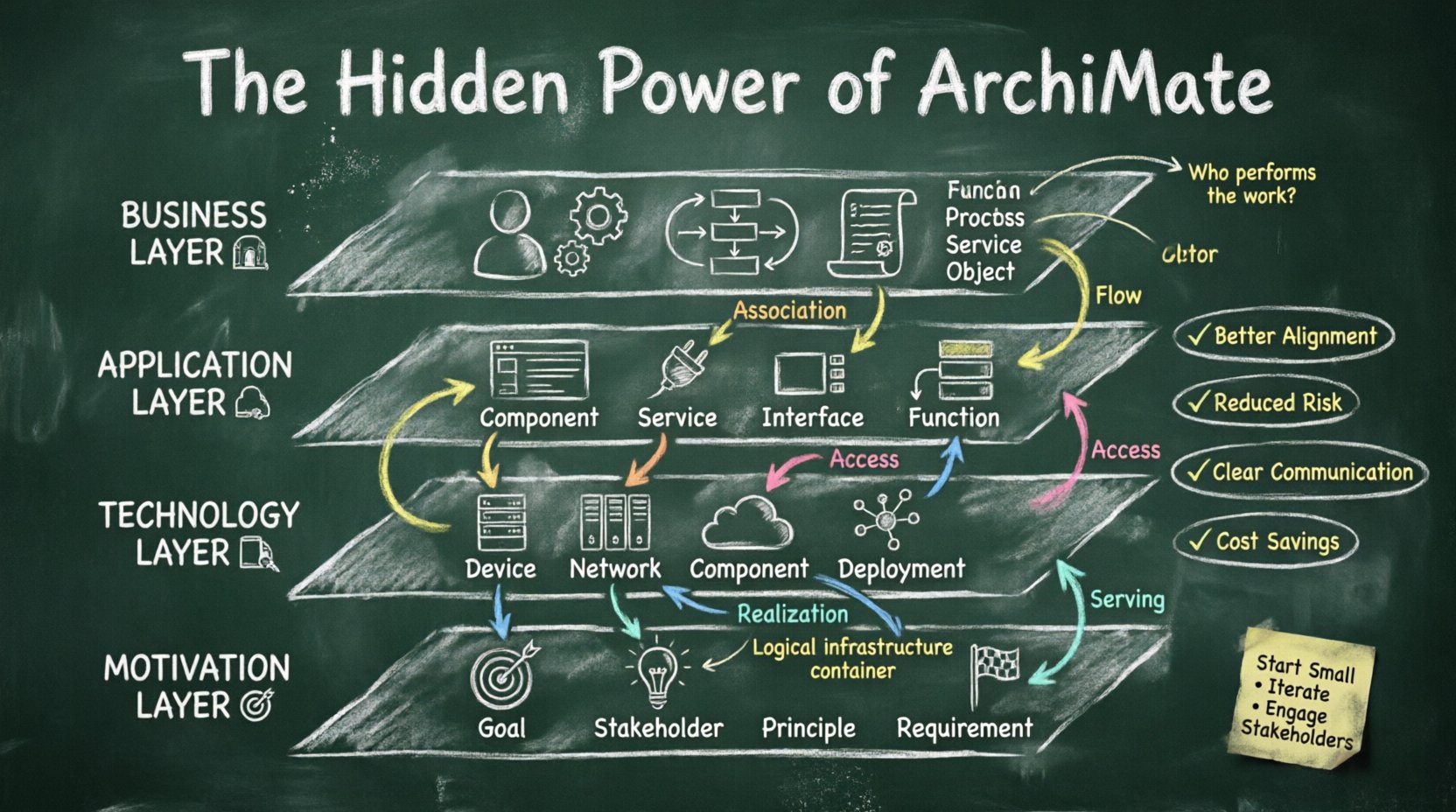
The heart of the language lies in its layered structure. This separation of concerns allows architects to isolate specific aspects of the organization while maintaining visibility into how they interact. The standard model defines four primary layers, each serving a distinct purpose in the architectural hierarchy.
1. The Business Layer 🏢
This layer focuses on the organization itself. It captures the elements that define how the company operates and delivers value to its customers. It is not about the technology used, but rather the logic of the operation.
- Business Actor: Represents an entity that performs a business function (e.g., a customer, a department, or a partner).
- Business Function: A set of business activities with a specific purpose (e.g., “Order Processing” or “Risk Management”).
- Business Process: A sequence of business activities that produce a specific result (e.g., “Ship Goods”).
- Business Service: A unit of functionality offered by the business to stakeholders.
- Business Object: A representation of key business information (e.g., “Invoice”, “Customer Account”).
2. The Application Layer 💻
This layer describes the software applications that support the business layer. It does not concern itself with the underlying code or the servers hosting the software, but rather the logical functions the software provides.
- Application Component: A modular part of an application that provides a set of services.
- Application Service: A unit of functionality provided by an application to the business layer.
- Application Interface: The point of interaction between an application component and another element.
- Application Function: A logical function performed by an application.
3. The Technology Layer 🖥️
This layer represents the physical and logical infrastructure that executes the application layer. It includes servers, networks, databases, and operating systems.
- Technology Component: A physical resource that performs the processing required by the application layer.
- Technology Function: A capability provided by a technology component.
- Device: A physical resource that provides processing capacity.
- Network: A set of nodes and links that provide communication services.
- Deployment Node: A physical or virtual location where components are deployed.
4. The Motivation Layer 🎯
Often overlooked, this layer connects the structural layers to the strategic drivers. It explains why the architecture is designed the way it is. It captures the needs, goals, and principles that drive decision-making.
- Stakeholder: An individual or group with an interest in the architecture.
- Goal: A desired state that the organization aims to achieve.
- Principle: A rule or guideline that influences design decisions.
- Requirement: A condition or capability that must be met.
Understanding these layers is critical for mapping dependencies. For instance, a new goal in the Motivation layer might require a new Business Process, which in turn demands a new Application Service, ultimately necessitating a Technology Component upgrade.
🔗 Understanding Relationships and Dependencies
Defining the layers is only half the battle. The true power emerges when defining how these elements relate to one another. The language specifies a set of relationships that describe flows of information, control, and physical connections.
These relationships ensure that the architecture is not just a static diagram, but a dynamic model of the organization.
Key Relationship Types
- Association: A non-directional link between two elements. It indicates a connection without specifying flow (e.g., a Business Actor is associated with a Business Process).
- Flow: Indicates the movement of something (like data or materials) from one element to another (e.g., Business Object flows to Business Process).
- Access: Describes how one element uses or interacts with another (e.g., Application Component accesses Database).
- Realization: Indicates that one element implements or specifies another (e.g., Application Service realizes a Business Service).
- Serving: Shows that an element provides service to another (e.g., Technology Component serves an Application Component).
By mapping these relationships, architects can perform impact analysis. If a server in the Technology layer fails, the model shows exactly which Application Services are affected and, consequently, which Business Services will suffer.
👁️ Views and Viewpoints: Tailoring Communication
A complex landscape cannot be understood by everyone at once. Different stakeholders require different perspectives. The language introduces the concept of Views and Viewpoints to address this.
- Viewpoint: The perspective from which an architecture is viewed. It defines the concerns of a specific stakeholder group (e.g., security, performance, cost).
- View: The actual representation of the architecture tailored to a specific Viewpoint. It is a subset of the full model relevant to that audience.
For example, a CIO might need a View focused on Technology Resources and Costs. A Business Unit Manager might need a View focused on Business Processes and Customer Journeys. An IT Security Officer requires a View focused on Access Control and Data Protection.
Creating specific views prevents information overload. It allows teams to focus on the details relevant to their role without being distracted by irrelevant technical implementation details. This targeted communication ensures that decisions are made based on the correct context.
📊 Comparison of Architecture Layers
To illustrate the distinct roles of each layer, consider the following comparison table.
| Layer | Primary Focus | Key Question | Example Element |
|---|---|---|---|
| Business | Organization & Operations | What do we do? | Order Fulfillment Process |
| Application | Software Functionality | How is it supported by software? | Order Management System |
| Technology | Infrastructure & Hardware | Where does it run? | Cloud Server Instance |
| Motivation | Strategy & Drivers | Why are we doing this? | Reduce Operational Costs |
🚀 Practical Benefits for Organizations
Adopting this structured approach yields tangible benefits for the enterprise. It moves architecture from an abstract exercise to a practical management tool.
1. Enhanced Alignment 🤝
One of the most significant challenges in IT is the disconnect between business goals and technical execution. By mapping Business Services to Application Services, organizations can verify that every piece of software serves a defined business purpose. If an application exists without a corresponding business service, it may be a candidate for retirement.
2. Risk Reduction 🛡️
Changes are inevitable in a growing organization. Whether it is a merger, a regulatory update, or a technology refresh, the risk of unintended consequences increases with complexity. A complete model allows teams to simulate changes before they are implemented. This proactive approach identifies potential bottlenecks or single points of failure.
3. Improved Communication 🗣️
Technical jargon often creates barriers between departments. A standardized language provides a neutral ground. When a business stakeholder and an architect discuss a “Business Process,” they share a common definition. This reduces misunderstandings and speeds up the approval process for projects.
4. Cost Optimization 💰
Visibility into the landscape reveals redundancies. Organizations often find multiple applications performing the same function across different departments. By identifying these overlaps, the organization can consolidate tools, negotiate better contracts, and reduce maintenance overhead.
📋 Benefits Matrix
The following table summarizes the value propositions of implementing this architecture framework.
| Benefit Area | Impact | Outcome |
|---|---|---|
| Strategic Planning | Clarity on capabilities | Alignment of IT investment with business strategy |
| Project Management | Scope definition | Reduced project scope creep and clearer deliverables |
| IT Operations | Dependency mapping | Faster root cause analysis during incidents |
| Compliance | Audit trails | Easier demonstration of control adherence to regulators |
🛠️ Implementation and Governance
Introducing this framework into an organization requires discipline. It is not a one-time activity but an ongoing governance process. To ensure success, organizations should establish a Center of Excellence for Enterprise Architecture.
Best Practices for Adoption
- Start Small: Do not attempt to model the entire enterprise immediately. Begin with a critical domain, such as Customer Onboarding or Financial Reporting.
- Engage Stakeholders: Involve business leaders early. Their input validates the Business Layer models and ensures the framework addresses real needs.
- Iterative Refinement: Models will evolve. Allow the architecture to grow organically as the organization changes. Avoid rigid structures that resist updates.
- Training: Ensure that architects and key stakeholders understand the semantics. Misuse of terms can lead to incorrect interpretations of the data.
- Integration: Connect the architecture repository with project management and IT service management tools. This keeps the model live and relevant.
🔄 Lifecycle Management
The architecture is not static. It must evolve alongside the enterprise. The lifecycle of an architectural element follows a path from conception to retirement.
- Definition: The element is identified and documented within the model.
- Approval: The design is reviewed and authorized by governance bodies.
- Implementation: The technical or business changes are executed.
- Operation: The element is in use and monitored for performance.
- Retirement: The element is phased out when no longer needed.
Maintaining this lifecycle ensures that the model reflects reality. An outdated model is worse than no model at all, as it creates a false sense of security regarding system stability.
🌐 Future Relevance
As technology trends shift towards cloud-native architectures, microservices, and AI integration, the complexity of IT landscapes will only increase. The need for a standardized modeling language becomes more critical, not less.
Frameworks that support complex system thinking provide a stable foundation for innovation. They allow organizations to experiment with new technologies without losing sight of the core business value. By maintaining a clear view of the dependencies, teams can adopt new tools with confidence.
The language also supports international standards, ensuring that architectural models can be shared across global teams. This is vital for multinational corporations that operate across different regulatory environments.
🔚 Summary
Complex IT landscapes are a barrier to agility. Without a structured approach, organizations struggle to understand the connections between their strategy and their systems. ArchiMate provides the structure needed to navigate this complexity. By defining layers, relationships, and views, it transforms abstract concepts into actionable models.
The benefits are clear: better alignment, reduced risk, optimized costs, and improved communication. However, the value is only realized when the model is maintained and integrated into the governance process. It is a tool for clarity, not just documentation. When used correctly, it empowers leaders to make informed decisions that drive sustainable growth.
For any organization serious about managing its technology assets, adopting this modeling language is a strategic imperative. It turns the chaos of digital transformation into a manageable, visible, and controllable process.
This post is also available in Deutsch, Español, فارسی, Français, English, Bahasa Indonesia, 日本語, Polski, Portuguese, Ру́сский, Việt Nam, 简体中文 and 繁體中文.