


Enterprise architecture (EA) is often shrouded in mystery. It is perceived as an abstract discipline reserved for large organizations with massive budgets and dedicated teams of analysts. Among the various frameworks available, ArchiMate stands out as a standardized modeling language designed to describe, analyze, and visualize business architecture, business processes, information structure, applications, technology infrastructure, and organizational structure. Despite its widespread adoption and open standard status, several persistent myths surround its application and effectiveness.
These misconceptions can hinder organizations from realizing the true value of enterprise architecture. When teams misunderstand the purpose of the framework, they often implement it incorrectly, leading to wasted resources and skepticism about the discipline itself. This guide aims to dismantle these common falsehoods and provide a clear, authoritative perspective on what enterprise modeling actually entails.
We will explore the reality behind the noise, focusing on how ArchiMate functions as a communication tool rather than just a documentation exercise. By clarifying these points, stakeholders can make informed decisions about integrating modeling into their strategic planning.
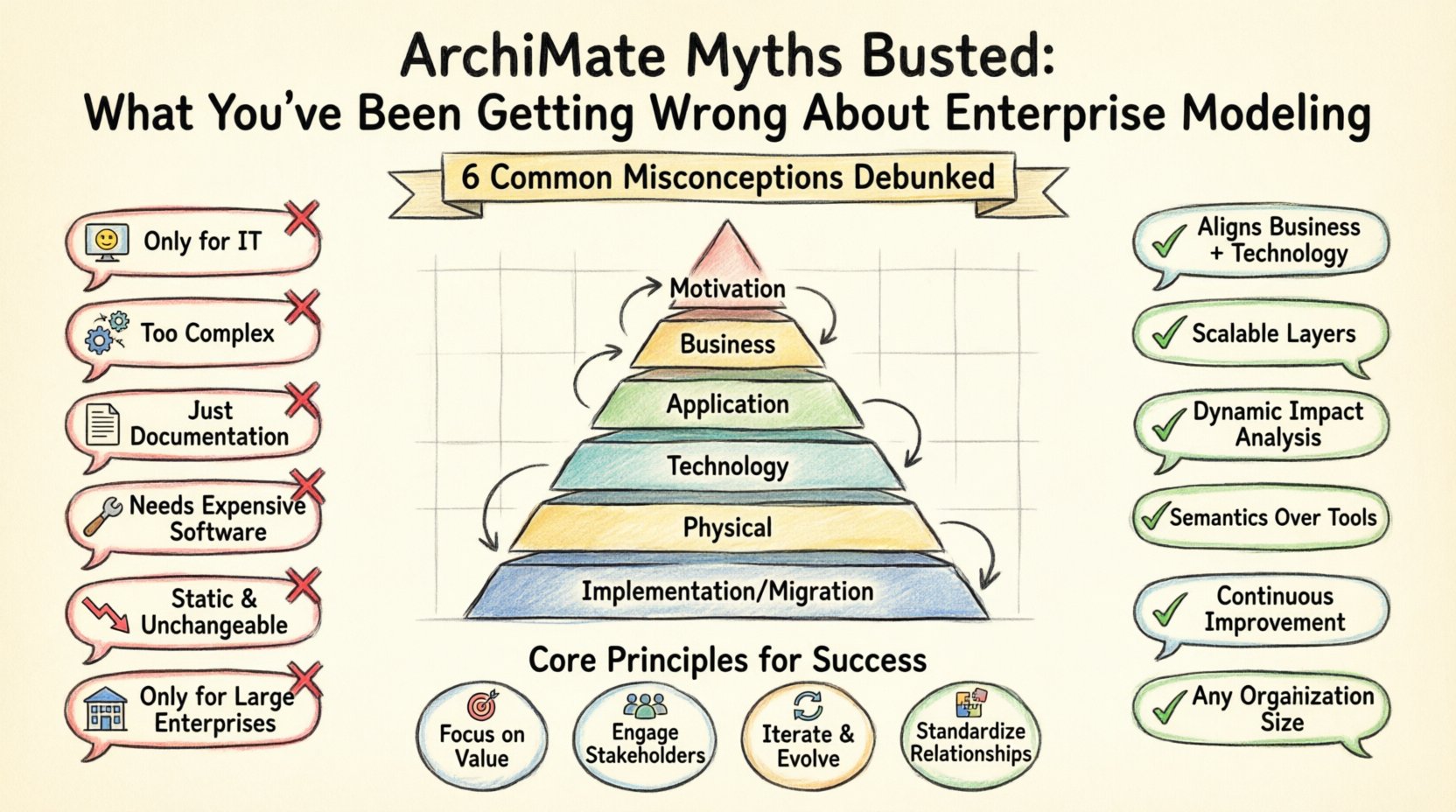
Myth 1: It Is Exclusively an IT Framework 🖥️
The most prevalent misconception is that ArchiMate is a tool for the Chief Information Officer (CIO) and IT departments alone. Many believe that because the framework includes layers for applications and technology, it is irrelevant to business leaders.
This view ignores the foundational purpose of the architecture. The framework explicitly structures the relationship between business and technology. If an organization models only the IT layer without connecting it to business capabilities, the model loses its strategic relevance. The Business Architecture layer is the starting point, defining the strategy, governance, organization, and business processes. The Application and Technology layers serve as supporting elements that enable the business layer.
Key realities regarding this myth include:
- Business First: The primary goal is to align business strategy with execution. IT is a means to an end, not the end itself.
- Shared Language: It provides a common vocabulary for business managers and IT professionals to discuss changes without ambiguity.
- Value Delivery: Business architects use the model to show how specific capabilities deliver value to customers, independent of the underlying software.
When business leaders engage with the modeling process, they gain visibility into how changes in the market or strategy ripple through the organization. This alignment ensures that technology investments directly support business objectives, rather than driving them in isolation.
Myth 2: It Is Too Complex for Practical Use 🧩
Complexity often scares away potential adopters. Critics argue that the notation, with its specific shapes and lines, is too difficult to learn and maintain. They fear that creating a model will take longer than the value it provides.
This perception stems from seeing overly detailed models rather than understanding the scalability of the framework. ArchiMate is designed to be layered. An organization does not need to model every single data element or application interface in the first phase.
The framework supports different levels of granularity:
- Strategic Viewpoint: High-level diagrams showing business capabilities and strategic goals. These are accessible to executives.
- Conceptual Viewpoint: Focuses on business processes and organizational units without technical details.
- Logical Viewpoint: Introduces applications and data structures.
- Physical Viewpoint: Details infrastructure, networks, and devices.
Teams can start with the strategic layer and expand as needed. This approach prevents analysis paralysis. The complexity is optional, not mandatory. A simplified model that communicates a key insight is infinitely more valuable than a comprehensive but unreadable diagram.
Myth 3: It Is Just for Documentation 📝
Many organizations treat modeling as a compliance exercise. They create diagrams to satisfy an audit requirement or to fulfill a project deliverable, then store them in a repository where they are never viewed again. This transforms the framework into a static record rather than a dynamic tool.
Enterprise architecture is not about drawing pictures; it is about reasoning. The relationships defined in the model allow architects to perform impact analysis. If a specific business process changes, the model can trace the dependency to the application and the technology infrastructure.
Effective modeling involves:
- Simulation: Using the model to test scenarios before implementation.
- Gap Analysis: Identifying the difference between the current state and the target state.
- Consistency Checks: Ensuring that the technology supports the business requirements defined at the top.
When treated as a living document, the architecture evolves alongside the organization. It becomes a source of truth that guides decision-making, rather than a museum exhibit of past decisions.
Myth 4: You Need Expensive Software to Model 🛠️
There is a belief that implementing ArchiMate requires proprietary, high-cost software suites. While commercial tools exist that offer advanced features like version control and collaboration, they are not a strict requirement to begin.
The standard defines the semantics, not the implementation. The core value lies in the concepts and relationships, not the canvas used to draw them. Teams can utilize open-source modeling tools, whiteboards, or even simple diagramming software to start the process.
Consider the following points on tooling:
- Focus on Semantics: Ensure the tool supports the correct notation (shapes and lines) regardless of the price point.
- Collaboration: Cloud-based or shared repository features are helpful but secondary to the modeling logic itself.
- Exportability: The ability to export diagrams for reporting is often more critical than advanced modeling features.
Organizations should invest in the knowledge of their architects before investing in expensive licenses. A skilled architect using a basic tool will produce better insights than a novice using a premium suite.
Myth 5: It Is Static and Unchangeable 📉
Another common error is viewing the architecture as a fixed blueprint. In reality, the business environment is fluid. Market conditions, regulations, and technology evolve rapidly. A static model becomes obsolete the moment it is finished.
ArchiMate includes specific layers for Implementation & Migration. This layer is designed to handle the transition from the current state to the target state. It allows architects to define projects and initiatives that bridge the gap.
Dynamic modeling practices include:
- Version Control: Tracking changes over time to understand the evolution of the architecture.
- Event-Driven Views: Modeling how the system reacts to triggers or events.
- Regular Reviews: Scheduling periodic audits of the architecture to ensure it remains relevant.
Architecture is a journey, not a destination. The framework supports this by allowing incremental updates. You do not need to rebuild the entire model when a small change occurs. You update the specific elements affected by the change.
Myth 6: Only Large Enterprises Benefit 🏢
Smaller organizations often dismiss enterprise architecture because they cannot afford a dedicated EA team. They assume that the complexity of the framework is unnecessary for their size.
However, small and medium-sized enterprises (SMEs) face the same challenges regarding alignment and change management, just on a smaller scale. Without a clear view of how their components interact, SMEs risk making inefficient technology purchases or duplicating efforts.
Benefits for smaller organizations include:
- Cost Efficiency: Identifying redundant applications early reduces licensing costs.
- Agility: A clear map allows for faster adaptation to market changes.
- Scalability: Building a structured foundation now prevents technical debt later.
Scaling down the scope of the model is the key. An SME might focus on a single business process or a specific application portfolio. The principles remain the same, but the volume of data is reduced.
Summary of Common Misconceptions
To visualize the differences between the myths and the reality, consider the following comparison table.
| Myth | Reality |
|---|---|
| Only for IT Departments | Aligns Business Strategy with Technology |
| Too Complex to Learn | Scalable from Strategic to Physical Layers |
| Static Documentation | Dynamic Tool for Impact Analysis |
| Requires Expensive Software | Tooling is Secondary to Semantics |
| Only for Large Companies | Applicable to Any Organization Size |
| One-Time Project | Continuous Improvement Process |
Core Principles for Success 🚀
Avoiding these myths requires adherence to core principles when deploying enterprise architecture. These practices ensure that the modeling effort yields tangible value rather than becoming a bureaucratic burden.
1. Focus on Value
Every diagram created should answer a specific question. Why are we modeling this? What decision will this inform? If a diagram does not support a decision, it should not be created. This discipline prevents the accumulation of unnecessary artifacts.
2. Engage Stakeholders
Architecture is a social activity. It requires input from business process owners, IT staff, and management. Collaboration ensures that the model reflects the actual state of the organization, not just the ideal state.
3. Iterate and Evolve
Do not aim for perfection in the first draft. Start with a rough approximation and refine it as you learn more. This iterative approach reduces resistance to change and allows for early wins.
4. Standardize Relationships
Consistency is key. Use the standard relationships defined in the framework, such as Flow, Access, Assignment, and Realization. Consistent notation allows anyone in the organization to read and understand the model without a legend.
Understanding the Layers and Views 🔍
To further clarify the structure, it is helpful to understand the core layers defined in the standard. This breakdown demonstrates how the framework connects different aspects of the enterprise.
- Business Layer: Represents business resources, processes, and actors. It is the top level where strategy resides.
- Application Layer: Describes the software applications that support the business processes. It acts as the bridge between business and technology.
- Technology Layer: Defines the hardware and software infrastructure required to run the applications.
- Physical Layer: Represents the actual physical devices and locations.
- Implementation & Migration Layer: Manages the projects and initiatives required to move from the current state to the target state.
- Motivation Layer: Captures the drivers, goals, and principles that influence the architecture.
These layers interact through specific relationships. For example, a Business Process in the Business Layer is realized by an Application Function in the Application Layer. This application function is supported by a Application Server in the Technology Layer. Tracing this chain allows an architect to understand the full impact of a change.
Common Pitfalls in Modeling 🔴
Even with the right mindset, teams often fall into traps. Being aware of these pitfalls helps in maintaining the quality of the architecture.
- Over-Modeling: Creating models for every minor detail. Focus on the critical paths and high-value areas.
- Under-Modeling: Skipping the business layer and jumping straight to technology. This leads to solutions that do not meet business needs.
- Inconsistent Naming: Using different names for the same concept (e.g., “Customer” vs. “Client”). This creates confusion and breaks the logic of the model.
- Lack of Governance: Allowing models to drift without oversight. Establish a governance board to review changes.
Conclusion
Enterprise architecture is a powerful discipline when applied correctly. ArchiMate provides the structure needed to navigate the complexity of modern organizations. By dispelling the myths that surround it, teams can focus on what truly matters: alignment, clarity, and value.
The framework is not a constraint but a facilitator. It enables communication across silos and provides a roadmap for transformation. Whether you are in a large corporation or a growing startup, the principles of modeling remain applicable. The key is to start with the business, embrace the iterative process, and keep the models relevant to the current reality.
As you move forward, remember that the goal is not to create a perfect model, but to create a useful one. Use the insights gained here to refine your approach. Avoid the traps of complexity and isolation. Instead, foster collaboration and focus on the strategic value that architecture brings to the organization.
By adopting these practices, you ensure that enterprise modeling serves its true purpose: enabling the organization to achieve its goals efficiently and effectively.
This post is also available in Deutsch, Español, فارسی, Français, English, Bahasa Indonesia, 日本語, Polski, Portuguese, Ру́сский, Việt Nam, 简体中文 and 繁體中文.