


In the modern landscape of software delivery, the gap between business requirements and technical implementation is often bridged by process modeling. Business Process Model and Notation (BPMN) serves as the lingua franca for this bridge, translating complex workflows into executable logic. However, when the precision of these models falters, the repercussions ripple through the entire development lifecycle. Accuracy in BPMN is not merely a matter of diagrammatic neatness; it is a fundamental determinant of operational stability, cost efficiency, and deployment velocity.
Many organizations invest heavily in automation infrastructure, yet they frequently overlook the quality of the blueprints driving that automation. A flawed process model can introduce latency, security vulnerabilities, and significant financial waste. This guide explores the tangible and intangible costs associated with inaccurate modeling and outlines the necessary steps to maintain rigor in DevOps environments.
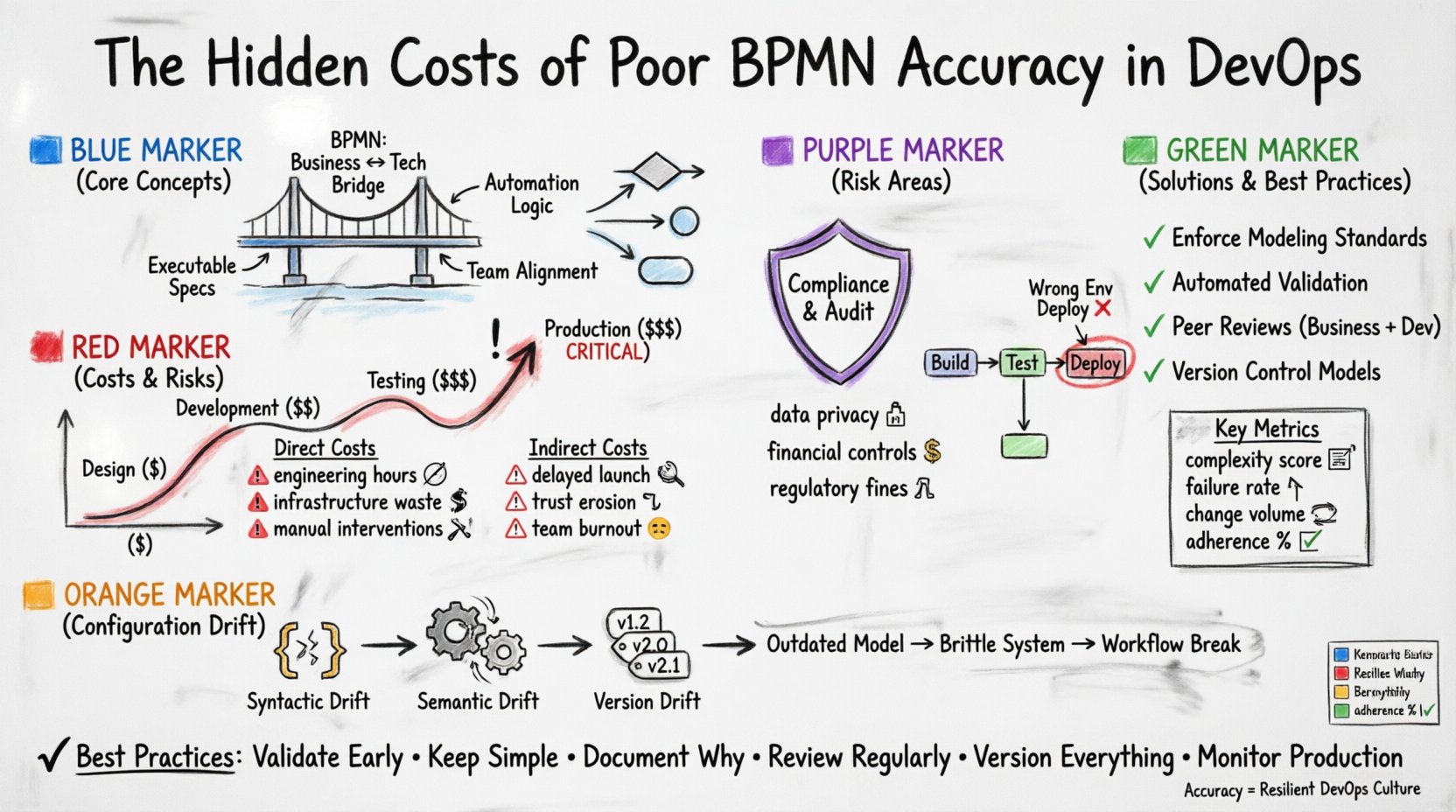
🧩 Understanding BPMN in the DevOps Context
Business Process Model and Notation provides a standardized graphical representation for specifying business processes in a workflow. In a traditional waterfall environment, these diagrams might serve as static documentation for handoff between phases. In a DevOps ecosystem, they function as living specifications that feed directly into automation engines.
- Executable Specifications: Unlike static flowcharts, BPMN diagrams in DevOps are often converted into code or configurations that drive Continuous Integration and Continuous Deployment (CI/CD) pipelines.
- Automation Logic: Decision gates, parallel paths, and event triggers defined in the model dictate how data moves through the system.
- Communication Artifact: They align technical teams with business stakeholders, ensuring everyone agrees on the rules of engagement before a single line of code is written.
When this alignment is broken due to poor modeling, the automation engine executes instructions that do not reflect business reality. This creates a state of technical debt that accumulates silently until it manifests as a critical failure.
💸 The Financial Impact of Modeling Errors
The cost of fixing a defect increases exponentially the later it is discovered in the software development lifecycle. This principle is particularly acute in process modeling. If a logic error exists in the design phase, it propagates into the code generation, testing, and production stages.
Direct Costs
- Engineering Hours: Developers spend time debugging issues that originated from ambiguous process definitions. This is time diverted from feature development to maintenance.
- Infrastructure Waste: Inefficient processes can lead to over-provisioning of cloud resources. If a workflow waits on a timeout that was incorrectly configured in the model, compute resources sit idle.
- Manual Interventions: Automated pipelines that fail due to modeling errors require manual triage. This disrupts the “flow” of DevOps and increases the risk of human error during recovery.
Indirect Costs
- Delayed Time-to-Market: Repeated pipeline failures due to process logic issues slow down the release cadence.
- Customer Trust: Frequent deployment failures or data inconsistencies erode confidence in the product.
- Employee Morale: Constant firefighting caused by flawed automation leads to burnout among engineering teams.
📊 Comparing Cost of Fixes Across Stages
| Stage | Cost Factor | Impact Description |
|---|---|---|
| Design Phase | Low | Changing a gateway logic in a diagram is quick and inexpensive. |
| Development Phase | Medium | Requires regeneration of artifacts and re-testing of integration points. |
| Testing Phase | High | Regression testing is required; QA cycles are delayed. |
| Production | Critical | Downtime, data corruption, and emergency hotfixes are required. |
🔧 Technical Debt and Configuration Drift
One of the most insidious risks of poor BPMN accuracy is configuration drift. As the business evolves, the process model must evolve with it. If the model is not updated rigorously, the automated system begins to execute outdated logic.
Types of Drift
- Syntactic Drift: The diagram no longer matches the syntax rules of the execution engine, causing deployment failures.
- Semantic Drift: The diagram looks correct but describes logic that no longer matches the business rules. For example, an approval step might be defined as “Manager” but the organization now requires “Director” approval.
- Version Drift: Multiple versions of the same process coexist without clear deprecation paths, leading to inconsistent behavior across the organization.
When drift occurs, the system becomes brittle. A minor change in one department can break a critical workflow in another, simply because the shared process model was not kept accurate.
🔒 Compliance and Risk Management
In regulated industries, process accuracy is not optional; it is a legal requirement. Financial institutions, healthcare providers, and government agencies must adhere to strict audit trails and control mechanisms.
Auditability
Automated workflows must be auditable. If the BPMN model is inaccurate, the audit trail it generates is also compromised. You cannot prove compliance if the underlying logic cannot be traced back to a verified specification.
Risk Exposure
- Data Privacy: Incorrect process flows might inadvertently route sensitive data through insecure channels.
- Financial Loss: A missing control gate in a payment process model can lead to unauthorized transactions.
- Regulatory Fines: Failure to demonstrate accurate process controls can result in significant penalties from regulatory bodies.
🔄 The Impact on CI/CD Pipelines
DevOps relies on the concept of automation to reduce friction between development and operations. BPMN models often orchestrate these pipelines, defining when code is built, tested, and deployed.
Build Failures
If the model dictates a dependency that does not exist in the repository, the build stage fails immediately. This halts the entire pipeline, blocking all other changes from being merged.
Deployment Failures
Incorrect logic in the deployment phase can lead to rolling out code to the wrong environment. For instance, a model might define a production deployment trigger that should only fire after a specific approval gate, but the gate is missing or misconfigured.
👥 The Human Factor in Automation
Even with perfect automation, humans are involved in the loop for approvals, exceptions, and monitoring. Poor modeling obscures these human interactions.
Clarity of Responsibility
A well-constructed model clearly assigns tasks to specific roles. If the model is vague, it is unclear who is responsible for a task. This leads to the “bystander effect,” where no one takes action because they assume someone else is handling it.
Training and Onboarding
New team members rely on process documentation to understand how the system works. If the BPMN diagrams are inaccurate or confusing, the learning curve steepens. Employees spend time deciphering workflows rather than executing them effectively.
🛡️ Strategies for Precision and Accuracy
Achieving high accuracy requires a disciplined approach to modeling. It is not a one-time task but a continuous practice integrated into the development culture.
1. Enforce Modeling Standards
- Define a clear set of rules for how processes should be drawn.
- Standardize naming conventions for events, gateways, and tasks.
- Ensure consistent use of colors and symbols to denote status and priority.
2. Implement Model Validation
Before a model is deployed, it should undergo automated validation. Tools can check for syntax errors, orphaned paths, and unreachable states. This acts as a safety net to catch errors before they reach the execution engine.
3. Peer Review Processes
- Require a second pair of eyes for all process changes.
- Involve business stakeholders in the review to ensure semantic accuracy.
- Involve developers to ensure technical feasibility.
4. Version Control for Models
Just as code is stored in version control, process models should be treated as code. This allows for:
- Tracking changes over time.
- Rolling back to previous versions if issues arise.
- Merging changes from different teams without conflict.
📏 Measuring Model Integrity
You cannot improve what you do not measure. Establishing key performance indicators (KPIs) for your process models helps maintain quality.
Key Metrics
- Model Complexity: High complexity scores often indicate a need for refactoring. Keep models readable and maintainable.
- Execution Failure Rate: Monitor how often processes fail at runtime. A high rate suggests modeling errors.
- Change Request Volume: If a specific process requires frequent updates, the initial design may have been flawed.
- Adherence Rate: Percentage of workflows that execute exactly as modeled. Deviations indicate drift.
🚀 Integrating Quality into the Culture
Technical accuracy is a team effort. It requires a shift in mindset where process modeling is viewed as a core engineering discipline, not an administrative afterthought.
- Education: Provide training on BPMN standards for both business and technical staff.
- Incentives: Recognize teams that maintain high-quality models and stable pipelines.
- Feedback Loops: Create channels for operators to report modeling issues that they encounter in production.
🛑 Common Pitfalls to Avoid
Awareness of common mistakes helps prevent them.
- Over-Engineering: Creating models that are too detailed for the execution engine. Keep it simple.
- Ignoring Exception Paths: Focusing only on the “happy path” and ignoring error handling.
- Static Documentation: Treating the model as a picture rather than a living specification.
- Lack of Context: Failing to document the business rules that drive the logic.
📈 The Long-Term Value of Accuracy
Investing in accurate BPMN yields compounding benefits. As the system matures, the cost of change decreases because the foundation is solid. Teams move faster because they trust the automation. Stakeholders have confidence because the processes are transparent and reliable.
The hidden costs of poor modeling are often invisible until a crisis occurs. By addressing accuracy proactively, organizations protect their infrastructure, their finances, and their reputation. Precision in process design is the bedrock of a resilient DevOps culture.
🎯 Summary of Best Practices
- Validate Early: Catch errors in the design phase.
- Keep it Simple: Avoid unnecessary complexity.
- Document Logic: Explain the “why” behind the flow.
- Review Regularly: Audit models against business reality.
- Version Everything: Treat models like source code.
- Monitor Production: Use runtime data to inform model updates.
The path to efficient DevOps is paved with accurate specifications. By prioritizing the integrity of your process models, you ensure that your automation works as intended, delivering value consistently and reliably.
This post is also available in Deutsch, Español, فارسی, Français, English, Bahasa Indonesia, 日本語, Polski, Portuguese, Ру́сский, Việt Nam, 简体中文 and 繁體中文.