


What is BPMN?
BPMN, which stands for Business Process Model and Notation, is a standardized graphical modeling language used to represent and visualize business processes. It is a widely adopted industry standard for modeling and documenting business processes, as it provides a consistent and easy-to-understand visual representation of a process.
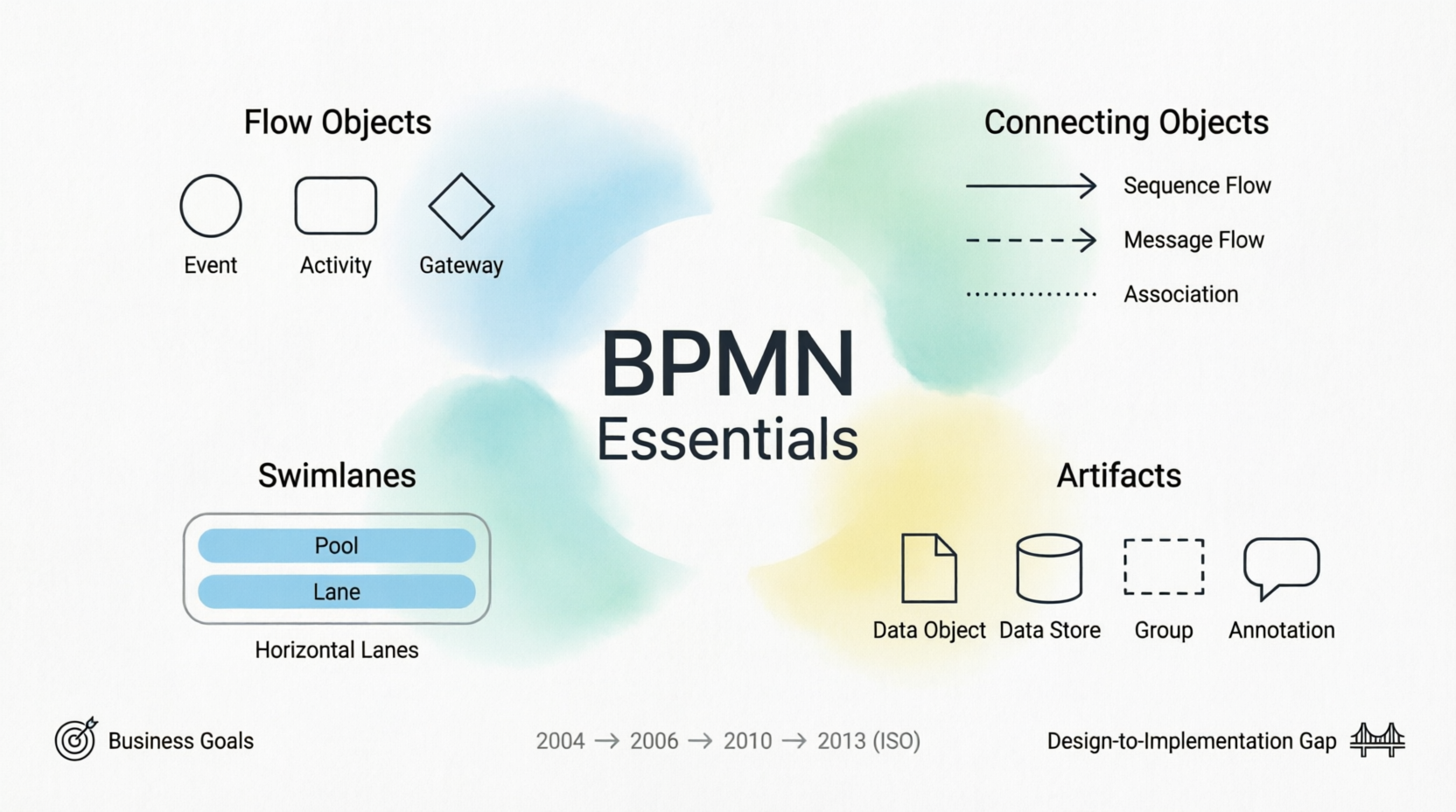
BPMN enables organizations to capture and document their business processes in a clear and consistent manner, ensuring that relevant stakeholders such as process owners and business users are involved in the process. This allows the team to effectively respond to any issues identified in the processes. BPMN provides comprehensive and rich notations that can be easily understood by both technical and non-technical stakeholders.
Key Characteristics of BPMN:
-
Standardized notation developed by the OMG (Object Management Group) consortium
-
Visual representation using intuitive symbols and shapes
-
Bridge communication between business and technical teams
-
Vendor-neutral with wide tool support
-
Scalable from simple to complex process modeling

Why Use BPMN? The Benefits
BPMN offers several compelling benefits to organizations:
✅ Clear Communication: Provides a standard notation readily understandable by all business stakeholders, helping to bridge the communication gap between business process design and implementation.
✅ Process Analysis & Optimization: A powerful tool for process analysis, design, and optimization, enabling organizations to identify inefficiencies and improvement opportunities.
✅ Universal Understanding: Simple to learn yet powerful enough to depict the potential complexities of a business process.
✅ Tool Compatibility: Vendor-neutral with wide tools support, making it a versatile and flexible option for organizations of all sizes and industries.
✅ Improved Performance: By utilizing BPMN, companies can streamline their processes, reduce inefficiencies, and improve communication and collaboration between teams, resulting in improved overall performance and outcomes.
About This BPMN Guide
This guide introduces the Business Process Model and Notation (BPMN) and is structured into four parts covering:
-
Fundamentals of BPMN notation
-
Various graphical objects and their usage in Business Process Diagrams
-
Step-by-step guidance on creating BPMN diagrams using Visual Paradigm
Basic Constructs: The Five Core Categories
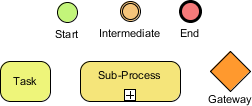
BPMN elements are organized into five basic categories, each representing a unique aspect of a business process.
1. Swimlanes
Swimlanes are graphical containers that represent participants in a process. They help organize activities by responsibility or role.
-
Pools: Represent major participants (e.g., organizations, departments, or external entities)
-
Lanes: Subdivisions within a pool that further categorize responsibilities (e.g., roles, teams, or systems)
Detailed coverage in Part II of this tutorial series.
2. Flow Elements
Flow elements are the primary components that connect to form business workflows and define process behavior.
| Element | Description | Symbol |
|---|---|---|
| Events | Something that happens during a process (start, intermediate, end) | Circle |
| Activities | Work performed in a process (tasks, sub-processes) | Rounded rectangle |
| Gateways | Decision points that control branching and merging of flows | Diamond |
Detailed coverage in Part III of this tutorial series.
3. Connecting Objects
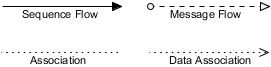
Connecting objects link flow elements to create coherent process flows.
| Connector | Purpose | Visual Style |
|---|---|---|
| Sequence Flow | Shows order of activities within a process | Solid line with arrow |
| Message Flow | Represents communication between pools/participants | Dashed line with arrow |
| Association | Links artifacts or data to flow elements | Dotted line |
| Data Association | Connects data elements to activities | Dotted line with arrow |
Detailed coverage in Part III of this tutorial series.
4. Data
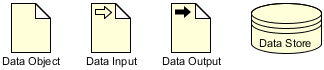
Data elements represent the information needed or produced when executing a business process.
-
Data Objects: Information used or created during process execution
-
Data Inputs: Information required to start an activity
-
Data Outputs: Information produced by an activity
-
Data Stores: Repositories where data is persisted (e.g., databases, files)
Detailed coverage in Part IV of this tutorial series.
5. Artifacts
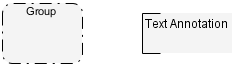
Artifacts provide additional contextual information to enhance process understanding without affecting flow logic.
-
Groups: Visual containers to categorize elements for documentation purposes
-
Text Annotations: Descriptive notes that clarify process elements or decisions
Detailed coverage in Part IV of this tutorial series.
Key Concepts & Best Practices
Process Modeling Principles
-
Start with the big picture: Define process boundaries and major participants first
-
Use consistent naming: Apply clear, action-oriented labels to activities
-
Maintain logical flow: Ensure sequence flows represent actual business logic
-
Document decisions: Use gateways and annotations to clarify branching logic
-
Validate with stakeholders: Review diagrams with both business and technical teams
Common BPMN Patterns
-
Sequential Flow: Activities executed one after another
-
Parallel Processing: Multiple activities executed simultaneously
-
Exclusive Decision: Only one path taken based on a condition
-
Inclusive Decision: One or more paths taken based on conditions
-
Event-Based Gateway: Path selection triggered by events rather than conditions
Implementation Considerations
-
BPMN diagrams can be executable (directly interpreted by workflow engines) or descriptive (for documentation and analysis)
-
Ensure alignment between BPMN models and actual system implementations
-
Use sub-processes to manage complexity and promote reusability
-
Leverage BPMN 2.0 extensions for industry-specific requirements
Reference List
- Introduction to BPMN Part I: Comprehensive introduction to Business Process Model and Notation covering fundamentals, benefits, and basic constructs including swimlanes, flow elements, connecting objects, data, and artifacts.
- BPMN Part II: Swimlanes Deep Dive: Detailed exploration of pools and lanes for organizing process participants and responsibilities.
- BPMN Part III: Flow Elements & Connecting Objects: In-depth coverage of events, activities, gateways, and the connectors that link them to form complete process flows.
- BPMN Part IV: Data & Artifacts: Examination of data elements and artifacts that enrich BPMN diagrams with contextual information.
- Visual Paradigm Enterprise Edition: Advanced BPMN modeling capabilities for large-scale enterprise process management and collaboration.
- Visual Paradigm Professional Edition: Comprehensive BPMN tooling for professional business analysts and process architects.
- Visual Paradigm Standard Edition: Core BPMN modeling features for standard business process documentation needs.
- Visual Paradigm Modeler Edition: Lightweight BPMN modeling solution focused on diagram creation and visualization.
BPMN is a standardized graphical language for modeling business processes that enables clear communication between technical and non-technical stakeholders through intuitive visual notation; its five core element categories—swimlanes, flow elements, connecting objects, data, and artifacts—work together to create comprehensive, analyzable process diagrams that drive organizational efficiency, alignment, and continuous improvement.
This post is also available in Deutsch, Español, فارسی, Français, English, Bahasa Indonesia, 日本語, Polski, Portuguese, Ру́сский, Việt Nam, 简体中文 and 繁體中文.
Related posts:
 How Project Managers Can Use Business Process Model and Notation to Reduce Scope Creep
 Avoiding the “Spaghetti Diagram”: How to Keep Business Process Model and Notation Readable at Scale
 Business Process Model and Notation in Agile Teams: Integrating Models into Sprint Planning and Retrospectives
 Business Process Model and Notation: A Guide to Handling Exception Flows Without Breaking Logic