


Visual Paradigm has undergone a transformative evolution, redefining the landscape of software modeling by deeply integrating artificial intelligence (AI) into its core platform. As of early 2026, the tool has transitioned from a traditional UML modeling environment to a next-generation, AI-driven visual modeling platform, designed to empower software architects, analysts, developers, and enterprise designers with intelligent automation, real-time assistance, and seamless integration across the development lifecycle.
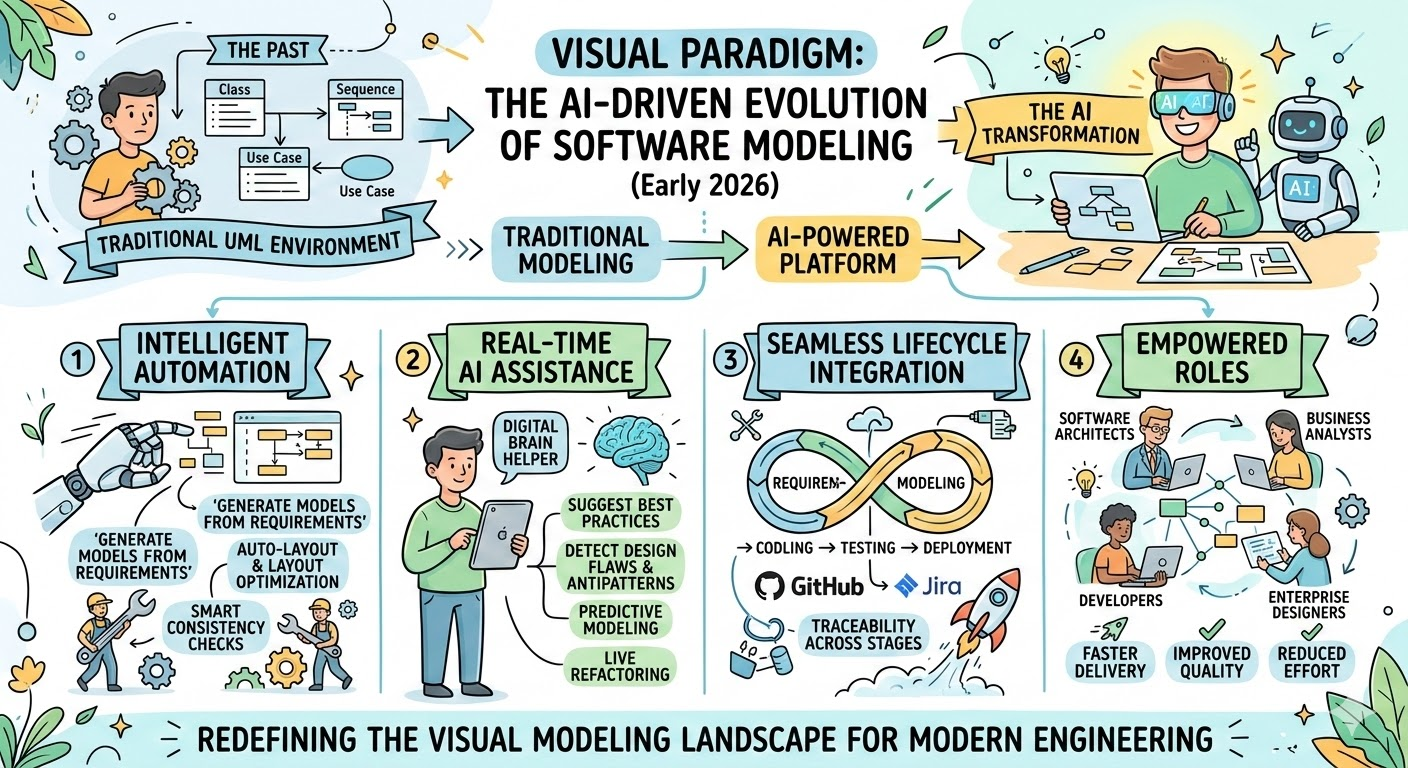
This comprehensive guide explores the full scope of Visual Paradigm’s AI capabilities, highlights key 2025–2026 feature updates, examines the strategic benefits of AI integration, and provides essential insights for professionals leveraging this ecosystem.
1. Vision: From Modeling Tool to AI Co-Pilot
Visual Paradigm’s strategic shift centers on positioning AI not as a peripheral feature, but as a central co-pilot in the modeling process. The platform now functions as a smart assistant that understands natural language, interprets system requirements, generates accurate diagrams, suggests architectural improvements, and even writes code—all while maintaining full compliance with industry standards such as UML, SysML, ArchiMate, and C4.
“Visual Paradigm’s AI now acts as a modeling co-pilot, designed for software architects and analysts to significantly reduce the time spent on manual diagram layout and creation.” — [12]
This evolution enables faster iteration, improved accuracy, enhanced collaboration, and reduced cognitive load—making it ideal for agile teams, enterprise architects, and technical product owners.
2. Core AI-Powered Features (2025–2026)
2.1 AI-Powered Text-to-Diagram Generation
One of the most groundbreaking advancements is the ability to generate complex UML diagrams directly from natural language. Users can describe system behavior, user workflows, or functional requirements in plain English, and Visual Paradigm’s AI transforms them into fully editable, standards-compliant diagrams.
- Supported Diagram Types: Class Diagrams, Sequence Diagrams, Use Case Diagrams, Activity Diagrams, State Machine Diagrams, Component Diagrams, Deployment Diagrams, and more.
- Use Case Example:
“A user logs in, views their dashboard, and updates their profile. Show the sequence of interactions and error handling.”
→ AI generates a detailed Sequence Diagram with lifelines, messages, and optional error branches.
This feature dramatically reduces the time required for initial modeling and is especially valuable during early-stage requirement gathering.
2.2 Smart Modeling Assistance & Real-Time Validation
The AI continuously analyzes diagrams for structural integrity, best practices, and UML compliance. It offers real-time feedback, including:
- Detection of missing associations or incorrect multiplicities.
- Suggestions for refactoring overly complex class hierarchies.
- Recommendations for improving diagram readability and layout.
- Identification of potential design anti-patterns.
This ensures that models remain clean, maintainable, and aligned with software engineering best practices.
2.3 AI-Driven Code Generation
Visual Paradigm bridges the gap between design and implementation through AI-powered code generation. Once a UML model is created or refined, the platform can generate high-quality, syntactically correct code in multiple languages (Java, C#, Python, TypeScript, etc.).
- Features:
- Automatic generation of classes, methods, and relationships.
- Inheritance and interface implementation based on class diagrams.
- Integration with IDEs like IntelliJ IDEA and Visual Studio (via plugins).
- Benefits:
- Reduces manual coding errors.
- Accelerates prototyping and development cycles.
- Ensures consistency between design models and actual source code.
“The system supports generating code directly from AI-enhanced UML models, improving accuracy and reducing the gap between design and implementation.” — [1, 2]
2.4 AI Analysis of Requirements & User Stories
The platform’s AI can ingest text-based requirements, user stories, or product specifications and automatically extract and generate corresponding UML Use Cases and User Stories.
- How it works:
- Input: “As a customer, I want to reset my password via email.”
- Output: A fully structured Use Case with:
- Name: Reset Password
- Actor: Customer
- Preconditions: User is logged out
- Main Flow: Request reset → Email sent → Link clicked → Password updated
- Postconditions: Password changed, session invalidated
- Alternative flows: Email not received, invalid token
This feature streamlines requirements analysis and traceability, enabling teams to move quickly from idea to documentation.
2.5 Chatbot-Based Design Assistance (AI Chatbot for Modelers)
The Visual Paradigm AI Chatbot serves as a conversational interface for creating, editing, and refining models. Users can ask questions like:
- “How do I model a state machine for a payment processing system?”
- “Show me how to represent a fork and join in an Activity Diagram.”
- “Suggest improvements to this Class Diagram.”
The chatbot leverages context-aware AI to deliver precise, actionable responses—supporting multiple languages and enabling iterative refinement of diagrams.
“The AI chatbot received a major update for Component Diagrams, featuring an overhauled layout engine that produces cleaner, more professional, and less cluttered diagrams.” — [16]
3. Major 2025–2026 Feature Updates
Below is a detailed overview of the most significant enhancements released between 2025 and early 2026.
| Feature | Release Date | Key Enhancements |
|---|---|---|
| AI Activity Diagram Generation | February 2026 | Full support for generating complex Activity Diagrams with actions, decisions, forks, joins, and control flows from natural language. Ideal for workflow and business process modeling. |
| Enhanced AI State Machine Diagrams | February 2026 | Major upgrade to the AI chatbot allows for richer, logically clustered state machines with better hierarchy and naming conventions. Supports complex lifecycle modeling. |
| AI-Powered Use Case Modeling Studio | January 2026 | A dedicated studio for requirements analysis that automatically generates detailed use cases with preconditions, postconditions, and flow descriptions. Integrates with user stories and traceability matrices. |
| AI Component Diagram Upgrades | December 2025 | Overhauled layout engine produces cleaner, less cluttered diagrams. AI suggests optimal component grouping and interface definitions. |
| C4 Model Support | December 2025 | Full support for all six C4 model diagrams: Context, Containers, Components, Code, and Relationships. Enables architectural documentation aligned with modern software architecture practices. |
| AI-Powered Deployment Diagrams | March 2026 | Enhanced AI capabilities to generate deployment diagrams from descriptions of servers, services, networks, and cloud environments. Supports AWS, Azure, and on-premises configurations. |
| AI Strategy & Process Tools | 2025–2026 | Expanded beyond UML to include AI-powered Brainstorming, Fishbone (Ishikawa) Diagrams, SWOT Analysis, and Mind Maps—ideal for strategic planning and problem-solving. |
These updates reflect Visual Paradigm’s commitment to expanding AI beyond modeling into broader systems thinking and enterprise architecture.
4. Advanced Capabilities & Standards Support
4.1 Support for ArchiMate 4 (February 2026)
Visual Paradigm became the first vendor to offer full support for ArchiMate 4, the latest version of the enterprise architecture modeling standard.
- Enables modeling of:
- Business, application, and technology layers.
- Strategic goals, capabilities, and value flows.
- Stakeholder concerns and architecture viewpoints.
- Facilitates alignment between IT strategy and business objectives.
- Integrates with C4 and UML models for end-to-end enterprise architecture documentation.
“Visual Paradigm is the first vendor to provide support for ArchiMate 4.” — [1]
This milestone positions Visual Paradigm as a leader in enterprise architecture tooling.
4.2 Multi-Standard Diagram Support
The AI Diagram Generator supports 13 diagram types, including:
- UML (Class, Sequence, Use Case, Activity, State Machine, Component, Deployment, etc.)
- BPMN (Business Process Model and Notation)
- ERD (Entity-Relationship Diagrams)
- Data Flow Diagrams (DFD)
- C4 Model Diagrams
- ArchiMate 4 Diagrams
- Fishbone, SWOT, Mind Maps, and more
All outputs are fully editable, standards-compliant, and exportable to PDF, PNG, SVG, and other formats.
5. Integration, Traceability & Professional Output
Visual Paradigm ensures that AI-generated models are not just visually appealing but also actionable and traceable within real-world projects.
5.1 Traceability & Linking
- AI-generated diagrams can be linked directly to requirements, user stories, test cases, and source code.
- Enables bidirectional traceability: changes in requirements automatically update related diagrams, and vice versa.
- Supports integration with Jira, Confluence, GitHub, and other DevOps tools.
5.2 Professional, Editable Output
Unlike generic AI image generators, Visual Paradigm’s output is:
- Fully editable (nodes, connections, labels).
- Semantically rich (models contain metadata, constraints, and documentation).
- Standards-compliant (UML, SysML, ArchiMate, C4).
- Version-controlled within the platform’s cloud or desktop workspace.
This ensures that AI is not replacing human expertise but augmenting it.
6. Licensing & Access Model (January 2026)
To sustain the infrastructure costs of AI features, Visual Paradigm introduced a new licensing model effective January 2026:
- AI-powered features require:
- Active Software Maintenance subscription.
- A qualifying edition: Professional or higher (Standard edition does not include AI features).
- This ensures access to:
- AI Chatbot
- Text-to-diagram generation
- Code generation
- Advanced analytics and reporting
“To support the infrastructure costs, AI-powered features now require active software maintenance and a qualifying edition (Professional or higher).” — [6, 25, 26]
This model prioritizes sustainability while maintaining high-quality service for enterprise users.
7. Benefits of Visual Paradigm’s AI Ecosystem
| Benefit | Impact |
|---|---|
| Increased Speed | Reduces manual diagramming time by up to 70% in early-stage modeling. |
| Improved Accuracy | AI ensures adherence to UML and other standards, minimizing errors. |
| Enhanced Collaboration | Facilitates faster feedback loops between business analysts, architects, and developers. |
| Better Documentation Quality | AI-generated models are consistent, well-structured, and ready for review. |
| Scalability | Handles complex, multi-layered systems with ease, from microservices to enterprise architectures. |
| Cross-Functional Use | Supports not only software teams but also business analysts, product managers, and enterprise architects. |
8. Best Practices & Warnings
While AI greatly enhances productivity, users should remain vigilant:
- AI can make mistakes: Always review generated diagrams for logical consistency, correct relationships, and accurate semantics.
- Avoid over-reliance: Use AI as a starting point, not a final solution. Manual validation and expert judgment are essential.
- Refine iteratively: Use the AI chatbot to suggest improvements, then manually adjust for clarity and precision.
- Leverage traceability: Ensure that all AI-generated elements are linked to source requirements or code.
“AI can make mistakes, so double-check responses.” — [1]
9. Conclusion: The Future of Visual Modeling
Visual Paradigm’s 2025–2026 evolution marks a paradigm shift in software and enterprise modeling. By embedding generative AI directly into the modeling workflow, the platform has become more than a diagramming tool—it’s a strategic design partner that accelerates innovation, improves quality, and unifies stakeholders across the development lifecycle.
With support for ArchiMate 4, C4, multi-language AI chatbots, and cross-standard modeling, Visual Paradigm is setting a new benchmark for intelligent modeling platforms.
For software architects, business analysts, and technical teams, embracing Visual Paradigm’s AI ecosystem is no longer optional—it’s essential for staying competitive in an era of rapid development and complex system design.
Reference List (Markdown Format)
- AI Activity Diagram Generation – Visual Paradigm: Official release notes detailing the introduction of AI-powered Activity Diagram generation in February 2026.
- Enhanced AI State Machine Diagram Generation – Visual Paradigm: Comprehensive overview of the AI upgrade for State Machine Diagrams, including improved state clustering and logical structure.
- Use Case Modeling Studio – Visual Paradigm: An in-depth look at Visual Paradigm’s Use Case Modeling Studio, highlighting its role in creating, managing, and generating use cases with AI assistance.
- AI-Powered Use Case Modeling Studio – Visual Paradigm: Release announcement for the January 2026 update, focusing on automated generation of use case details.
- AI Component Diagram Upgrades – Visual Paradigm: Details the layout engine overhaul and improved component diagram generation.
- C4 Model Support – Visual Paradigm: Official announcement of full C4 model diagram support, including Context, Containers, Components, and Code diagrams.
- AI-Powered Deployment Diagrams – Visual Paradigm: Highlights enhanced AI capabilities for generating deployment diagrams from natural language.
- AI Strategy & Process Tools – Visual Paradigm: Overview of AI-powered tools beyond UML, including Brainstorming, Fishbone, and SWOT analysis.
- AI Features & Software Maintenance Requirement – Visual Paradigm: Official statement on the new licensing model requiring active maintenance and Professional+ editions.
- Support for ArchiMate 4 – Visual Paradigm: Announcement of Visual Paradigm as the first vendor to support ArchiMate 4.
- AI Diagram Generator – Visual Paradigm: Summary of the expanded AI Diagram Generator, supporting 13 diagram types across UML, BPMN, ERD, and more.
- AI Chatbot for Modelers – Visual Paradigm: User guide introducing the AI chatbot, its capabilities, and how to use it for diagram creation and refinement.
- Visual Paradigm AI Ecosystem – Guide: Detailed guide on using AI to generate state machine diagrams with lifecycle support.
- Best AI Diagram Generator – Visual Paradigm Ecosystem: Comparative analysis of AI diagram tools, positioning Visual Paradigm as a leader in intelligent, editable modeling.
- Visual Paradigm Overview – Official Website: The official website of Visual Paradigm, providing access to all products, features, and documentation.
- What is UML? – Visual Paradigm: Foundational guide explaining UML and its importance in software development.
- Visual Paradigm AI Chatbot – Multi-Language Support: Release notes on enhanced multilingual support for the AI chatbot.
- Harnessing Visual Paradigm’s AI for Diagram Generation – Archimetric: In-depth article analyzing the 2026 AI advancements and their impact on enterprise architecture.
- Visual Paradigm Integration with IntelliJ IDEA: Technical guide for integrating Visual Paradigm with popular IDEs for seamless code generation and synchronization.
Note: All URLs provided are official updates and documentation from Visual Paradigm’s website and related technical resources. They are current as of early 2026 and reflect the latest state of the platform’s AI capabilities.
This post is also available in Deutsch, Español, فارسی, Français, English, Bahasa Indonesia, 日本語, Polski, Portuguese, Ру́сский, Việt Nam, 简体中文 and 繁體中文.
Related posts:
 Visual Paradigm AI: Generate Professional UML Use Case Diagrams from Text in Seconds
 GourmetReserve Development Simplified: Transforming Requirements with the Best AI-Powered Use Case Modeling Studio
 The Best AI-Powered Database Modeling Tool for Designing Hospital Systems: Visual Paradigm Online
 Automating Student Record System Analysis: From Raw Text to Class Models with Visual Paradigm