


A Step-by-Step Case Study, Key Concepts, and Strategic Guidelines
Executive Summary
Uber’s rise from a simple ride-hailing app to a global mobility empire is a textbook example of how strategic business model innovation—anchored in the Business Model Canvas (BMC)—can transform a startup into a billion-dollar enterprise. This case study explores how Uber leveraged the BMC not just as a planning tool, but as a dynamic framework to pivot, scale, and dominate a fragmented industry. We walk through the evolution of Uber’s BMC, analyze key strategic decisions, and extract actionable guidelines for entrepreneurs and innovators.
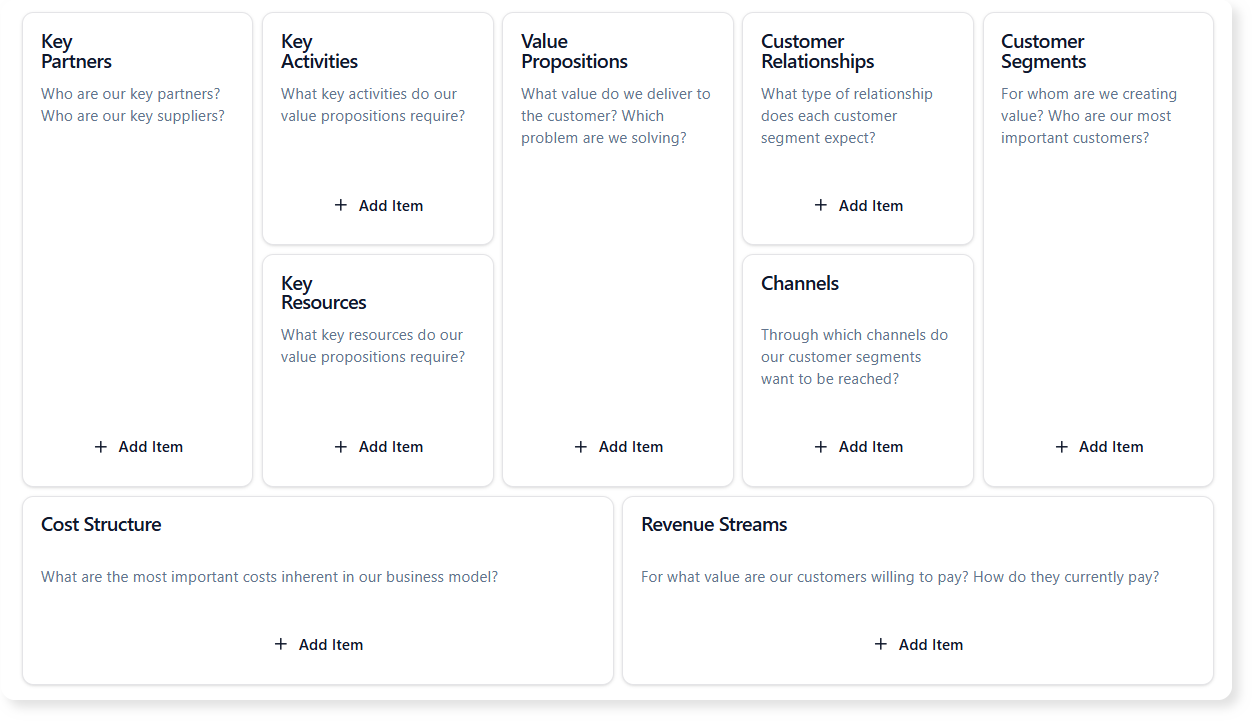
Step-by-Step Case Study: Uber’s BMC Evolution
Step 1: Foundational Phase – The Original Business Model Canvas (2009–2012)
Context: Uber was founded in 2009 by Travis Kalanick and Garrett Camp as a premium black-car service in San Francisco. The initial idea was to solve the problem of unreliable, expensive taxi services.
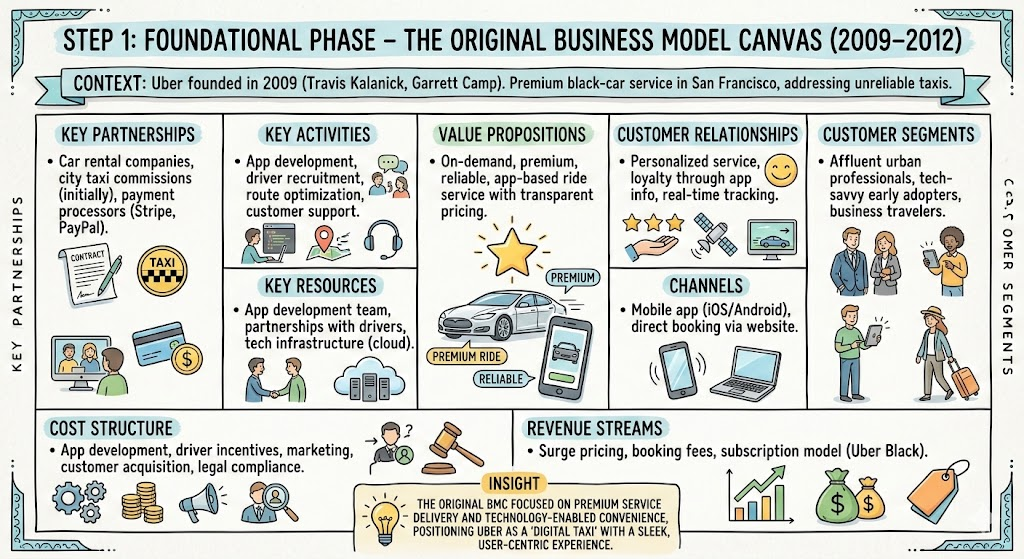
| Business Model Canvas Element | Uber’s Initial Version (2009–2012) |
|---|---|
| Customer Segments | Affluent urban professionals, tech-savvy early adopters, business travelers |
| Value Propositions | On-demand, premium, reliable, app-based ride service with transparent pricing |
| Channels | Mobile app (iOS/Android), direct booking via website |
| Customer Relationships | Personalized service, loyalty through app integration, real-time tracking |
| Revenue Streams | Surge pricing, booking fees, subscription model (Uber Black) |
| Key Resources | App development team, partnerships with drivers, tech infrastructure (cloud) |
| Key Activities | App development, driver recruitment, route optimization, customer support |
| Key Partnerships | Car rental companies, city taxi commissions (initially), payment processors (Stripe, PayPal) |
| Cost Structure | App development, driver incentives, marketing, customer acquisition, legal compliance |
Insight: The original BMC focused on premium service delivery and technology-enabled convenience, positioning Uber as a “digital taxi” with a sleek, user-centric experience.
Step 2: Expansion Phase – Scaling the Model (2013–2015)
Shift: Uber pivoted from a niche luxury service to a mass-market platform. The BMC evolved to support rapid global expansion.
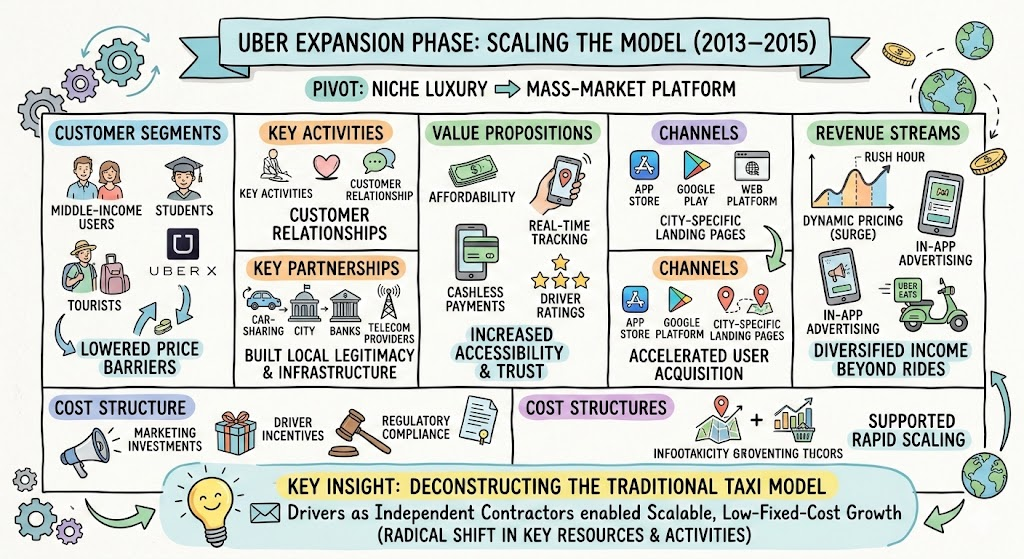
| Key Changes in the BMC | Strategic Rationale |
|---|---|
| Customer Segments: Expanded to include middle-income users, students, tourists | Lowered price barriers to entry (e.g., UberX) |
| Value Propositions: Added affordability, real-time tracking, cashless payments, driver ratings | Increased accessibility and trust |
| Channels: App store, Google Play, web platform, city-specific landing pages | Accelerated user acquisition |
| Revenue Streams: Added dynamic pricing (surge), in-app advertising, and delivery services (Uber Eats) | Diversified income beyond rides |
| Key Partnerships: Expanded to include car-sharing firms, city governments, banks, telecom providers | Built local legitimacy and infrastructure |
| Cost Structure: Increased investment in marketing, driver incentives, and regulatory compliance | Supported rapid scaling |
Insight: Uber deconstructed the traditional taxi model by treating drivers as independent contractors (a radical shift in the BMC’s “Key Resources” and “Key Activities”), enabling scalable, low-fixed-cost growth.
Step 3: Diversification & Platformization (2016–2020)
Evolution: Uber transformed from a ride-hailing app into a mobility platform, leveraging its core BMC to launch new verticals.
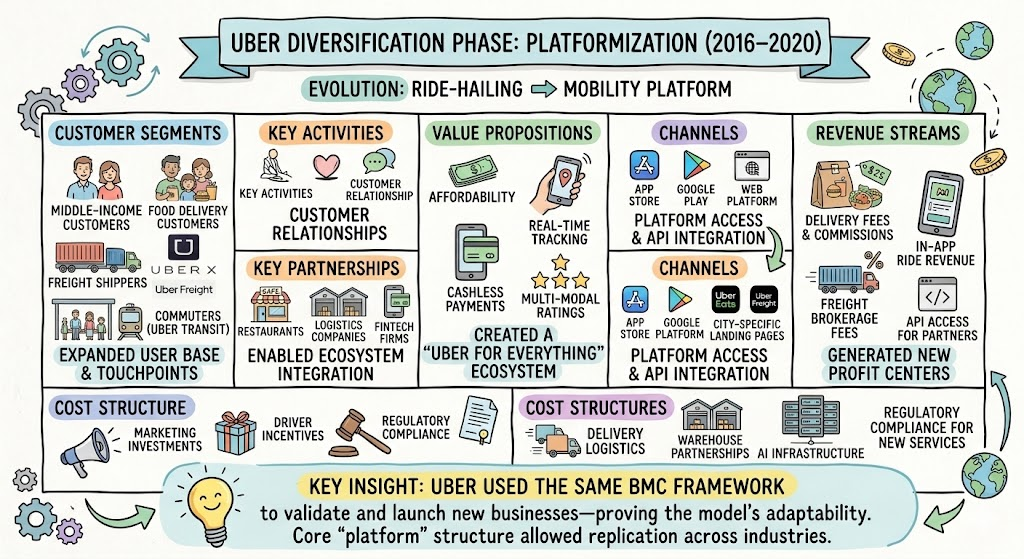
| New Elements in the BMC | Strategic Impact |
|---|---|
| New Customer Segments: Food delivery customers (Uber Eats), freight shippers (Uber Freight), commuters (Uber Transit) | Expanded user base and touchpoints |
| New Value Propositions: On-demand food delivery, real-time freight logistics, multi-modal transit planning | Created a “Uber for Everything” ecosystem |
| New Revenue Streams: Delivery fees, delivery commissions, freight brokerage fees, API access for partners | Generated new profit centers |
| New Key Activities: Supply chain logistics, AI-driven routing, real-time demand forecasting | Enhanced operational efficiency |
| New Key Partnerships: Restaurants, logistics companies, public transit agencies, fintech firms | Enabled ecosystem integration |
| New Cost Structure: Delivery logistics, warehouse partnerships, AI infrastructure, regulatory compliance for new services | Increased complexity but higher scalability |
Insight: Uber used the same BMC framework to validate and launch new businesses—proving the model’s adaptability. The core “platform” structure allowed replication across industries.
Step 4: Maturity & Strategic Refocusing (2021–Present)
Reality Check: Post-pandemic, Uber faced challenges: driver attrition, regulatory battles, and profit pressure. The BMC was re-evaluated for sustainability and profitability.
| Revised BMC Focus | Strategic Shift |
|---|---|
| Customer Segments: Prioritized high-LTV (lifetime value) users, corporate clients, and frequent riders | Improved retention and monetization |
| Value Propositions: Emphasized reliability, driver availability, safety features, and corporate billing | Strengthened B2B and enterprise offerings |
| Revenue Streams: Shifted focus to platform fees, subscription models (Uber One), and data monetization (anonymized) | Reduced reliance on surge pricing |
| Key Resources: Invested in AI, data analytics, and autonomous vehicle R&D (via Uber Advanced Technologies Group) | Built long-term competitive moat |
| Cost Structure: Optimized driver incentives, reduced marketing spend, improved operational efficiency | Improved EBITDA margins |
Insight: Uber’s BMC evolved from growth-at-all-costs to sustainable scalability, balancing innovation with profitability.
Key Concepts: Why the Business Model Canvas Was Uber’s Secret Weapon
-
Strategic Flexibility
The BMC allowed Uber to test, iterate, and pivot rapidly. Each new service (Eats, Freight, Transit) was validated using the same 9-part framework—ensuring alignment with core business logic. -
Platform Thinking
Uber treated its app not just as a product, but as a digital marketplace connecting supply (drivers) and demand (riders). The BMC made this platform model visible and replicable. -
Scalability Through Decoupling
By classifying drivers as independent contractors, Uber reduced fixed costs and avoided the capital burden of owning vehicles—making global expansion feasible. -
Data as a Core Resource
Uber’s BMC evolved to include data collection and analytics as a key resource. Real-time data enabled surge pricing, dynamic routing, and predictive demand modeling. -
Ecosystem Expansion
The BMC helped Uber visualize how adjacent markets (food, freight, transit) could be served using the same underlying infrastructure—creating network effects across verticals.
Guidelines: How to Apply Uber’s BMC Strategy in Your Own Venture
✅ 1. Start with a Lean BMC – Validate Your Core Value
-
Use the BMC to map your customer segments, value propositions, and revenue streams.
-
Test assumptions with minimum viable products (MVPs) before scaling.
✅ 2. Embrace the Platform Mindset
-
Ask: “Can I connect two or more groups (supply/demand) via a digital platform?”
-
Design your BMC to reflect network effects—the more users, the more valuable the service.
✅ 3. Decouple Fixed Costs for Scalability
-
Avoid heavy asset ownership. Use independent contractors or third-party partners to reduce fixed costs.
-
Example: Uber didn’t own cars—drivers did.
✅ 4. Iterate Using the BMC as a Living Document
-
Revisit your BMC every 3–6 months.
-
Update based on feedback, market shifts, or new opportunities.
✅ 5. Expand Vertically Using the Same Framework
-
When entering a new market (e.g., food delivery), reuse the BMC—adjust only the customer segments and value propositions.
-
This ensures strategic consistency and faster execution.
✅ 6. Prioritize Data & Technology as Key Resources
-
Build your BMC around data-driven decision-making, AI, and real-time analytics.
-
Treat data not just as a byproduct, but as a strategic asset.
✅ 7. Balance Growth with Profitability
-
In mature phases, shift focus from user acquisition to retention, LTV, and operational efficiency.
-
Refine your cost structure and explore diversified revenue streams.
Conclusion: The Uber Lesson – From App to Empire
Uber didn’t just build an app. It reinvented an industry by using the Business Model Canvas as a strategic compass. The BMC allowed Uber to:
-
Visualize and validate its disruptive model,
-
Scale rapidly across 70+ countries,
-
Pivot into new markets with confidence,
-
And maintain agility even at massive scale.
Final Insight: The most powerful tool in a startup’s arsenal isn’t funding or talent—it’s a clear, adaptable, and dynamic business model. Uber proved that when you map it out with the BMC, even the most ambitious dreams can be built—one canvas at a time.
Bonus: Uber’s Business Model Canvas (2023 Snapshot)
(Simplified for Clarity)
| Element | Uber’s 2023 Version |
|---|---|
| Customer Segments | Individual riders, corporate clients, food delivery users, freight shippers |
| Value Propositions | On-demand mobility, reliable delivery, real-time tracking, safe rides, corporate billing, subscription benefits (Uber One) |
| Channels | Mobile app, web, API integrations, partner apps (e.g., Postmates, transit apps) |
| Customer Relationships | In-app support, loyalty programs, driver/rider ratings, corporate accounts |
| Revenue Streams | Ride fares, delivery fees, subscription (Uber One), freight brokerage, API access, advertising |
| Key Resources | App platform, AI & data analytics, driver network, global infrastructure, brand |
| Key Activities | App development, demand forecasting, driver onboarding, logistics management, regulatory compliance |
| Key Partnerships | Car rental firms, restaurants, logistics companies, public transit agencies, fintechs |
| Cost Structure | Technology, driver incentives, marketing, legal & compliance, R&D (AI, AVs) |
Final Thought:
“Innovation is not about building a better app. It’s about building a better business model. Uber didn’t disrupt transportation—it redefined it through the power of the Business Model Canvas.” – Inspired by Travis Kalanick & Alexander Osterwalder
📌 For Entrepreneurs:
Use the BMC not just to plan—but to challenge assumptions, test hypotheses, and scale with purpose. The future belongs to those who can think in models, not just ideas.
- Complete Guide to the Business Model Canvas (BMC) – Visual Paradigm: This thorough guide explains the nine building blocks of the framework and provides real-world examples for business innovation.
- Business Model Canvas Guide with Examples – Visual Paradigm: A practical resource featuring step-by-step instructions and expert tips for effective business planning.
- What Is the Business Model Canvas? Why Use Visual Paradigms & AI Tools: This article details the core components of the canvas and how AI-powered tools enhance strategic planning.
- AI-Powered Business Model Canvas Builder – Instant Strategy Design: This automated tool leverages machine intelligence to generate canvases and provide strategic insights instantly.
- Comprehensive Tutorial: Visual Paradigm Model Canvas Tool: A step-by-step technical guide for mastering the tool for effective modeling and innovation planning.
- Business Model Canvas Software – Visual Paradigm Online: A cloud-based platform designed for visualizing strategy with real-time collaboration features.
- Business Model Canvas Tool – Visual Paradigm: A structured framework that enables teams to design, analyze, and iterate on business models visually.
- Business Model Canvas Templates – Visual Paradigm Online: A library of professionally designed templates created to accelerate strategy development for startups and enterprises.
- Visual Paradigm Canvas – Collaborative Strategy Tool: A modern web-based platform for creating and sharing canvases and lean startup frameworks in real time.
- Mastering the Business Model Canvas with AI: Step-by-Step Guide: This guide demonstrates how to use AI capabilities to optimize and customize canvases efficiently.
This post is also available in Deutsch, Español, فارسی, Français, English, Bahasa Indonesia, 日本語, Polski, Portuguese, Ру́сский, Việt Nam, 简体中文 and 繁體中文.