


Introduction: Why Netflix Matters in Business Innovation
Netflix began as a DVD rental company but transformed into a global streaming giant. This case study explores how Netflix disrupted the entertainment industry by pivoting from physical DVDs to streaming—using the Business Model Canvas (BMC) framework. This is ideal for beginners learning about business models, innovation, and disruption.
🎯 Step 1: Key Concepts – What You Need to Know
Before diving into the case study, understand these foundational business concepts:
1. Business Model Canvas (BMC)
A strategic tool that visually maps out the 9 core components of a business:
-
Customer Segments
-
Value Propositions
-
Channels
-
Customer Relationships
-
Revenue Streams
-
Key Resources
-
Key Activities
-
Key Partnerships
-
Cost Structure
Used by startups and corporations to design, analyze, and innovate business models.
2. Disruption (Disruptive Innovation)
-
Coined by Clayton Christensen.
-
A new product or service that starts in a niche market and gradually takes over the mainstream.
-
Often disrupts established players (like Blockbuster vs. Netflix).
3. Pivot
-
A strategic shift in business direction based on market feedback.
-
Netflix pivoted from DVD rentals to streaming—this was a bold pivot.
4. Subscription Model
-
Customers pay a recurring fee (e.g., monthly) for access to content.
-
Key to Netflix’s success and scalability.
📌 Step 2: The Netflix Story – A Timeline of Disruption
| Year | Event |
|---|---|
| 1997 | Netflix founded by Reed Hastings and Marc Randolph. |
| 1999 | Launches DVD-by-mail service (no late fees). |
| 2007 | Introduces streaming video (initially as a free perk). |
| 2011 | Separates DVD and streaming services (Qwikster fiasco). |
| 2013 | Focuses entirely on streaming and original content. |
| 2020s | Global streaming leader with original hits like Stranger Things, The Crown. |
🔍 Key Insight: Netflix didn’t just add streaming—it replaced its core business model.
🧩 Step 3: Netflix’s Business Model Canvas – Before & After Streaming
✅ Before Streaming (DVD Rental Era – ~2007)
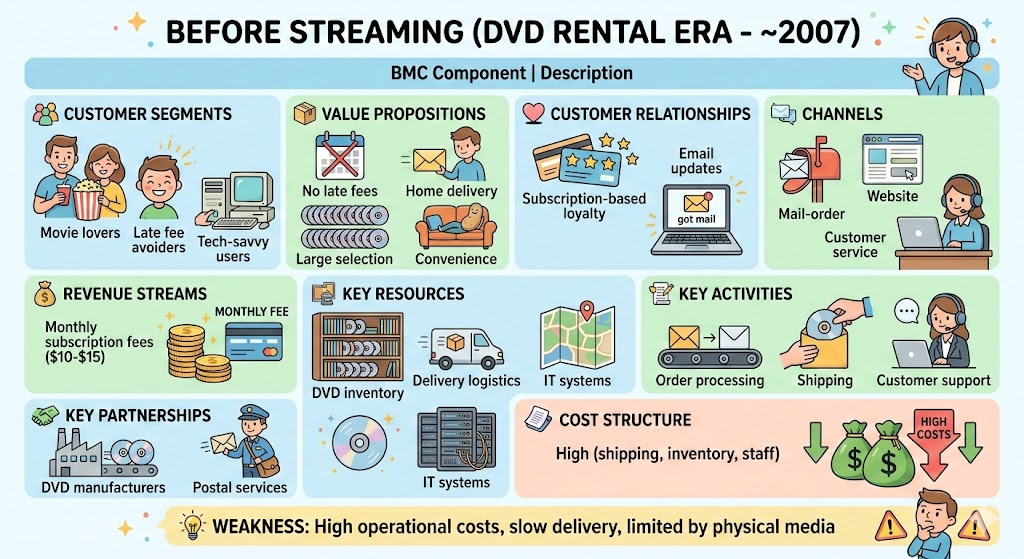
| BMC Component | Description |
|---|---|
| Customer Segments | Movie lovers, late fee avoiders, tech-savvy users |
| Value Propositions | No late fees, home delivery, large selection, convenience |
| Channels | Mail-order, website, customer service |
| Customer Relationships | Subscription-based loyalty, email updates |
| Revenue Streams | Monthly subscription fees ($10–$15) |
| Key Resources | DVD inventory, delivery logistics, IT systems |
| Key Activities | Order processing, shipping, customer support |
| Key Partnerships | DVD manufacturers, postal services |
| Cost Structure | High (shipping, inventory, staff) |
💡 Weakness: High operational costs, slow delivery, limited by physical media.
✨ After Streaming (Post-2007 – Present)
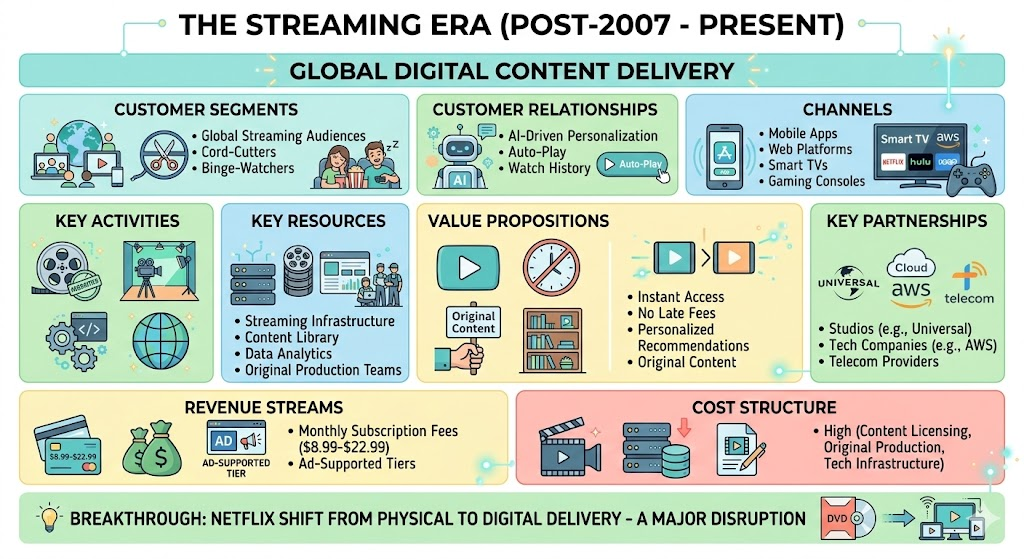
| BMC Component | Description |
|---|---|
| Customer Segments | Global streaming audiences, cord-cutters, binge-watchers |
| Value Propositions | Instant access, no late fees, personalized recommendations, original content |
| Channels | Mobile apps, web platforms, smart TVs, gaming consoles |
| Customer Relationships | AI-driven personalization, auto-play, watch history |
| Revenue Streams | Monthly subscription fees ($8.99–$22.99), ad-supported tiers |
| Key Resources | Streaming infrastructure, content library, data analytics, original production teams |
| Key Activities | Content acquisition, original content production, tech development, global expansion |
| Key Partnerships | Studios (e.g., Universal), tech companies (e.g., AWS), telecom providers |
| Cost Structure | High (content licensing, original production, tech infrastructure) |
💡 Breakthrough: Netflix shifted from physical product delivery to digital content delivery—a major disruption.
🔍 Step 4: How Netflix Disrupted the Industry
🔄 The Pivot: From DVD to Streaming
-
Problem: DVD rentals required shipping, had delivery delays, and limited selection.
-
Solution: Offer streaming as a free add-on → became core product.
-
Why it worked: No physical delivery, instant access, scalable infrastructure.
📈 Disruption of Blockbuster
-
Blockbuster relied on physical stores and late fees.
-
Netflix’s no-late-fee, mail-order model undermined Blockbuster’s business.
-
When Blockbuster failed to innovate, Netflix replaced it.
🌍 Global Expansion & Original Content
-
Netflix invested heavily in original shows (House of Cards, Orange is the New Black).
-
This created exclusive content, reduced reliance on third-party studios.
-
Turned Netflix into a content creator—no longer just a distributor.
🛠️ Step 5: Guidelines for Beginners – How to Apply This Case
✅ Use the BMC to Analyze Any Business
-
Draw the 9-box canvas.
-
Fill in each box based on research or observation.
-
Compare old vs. new models to spot pivots or disruptions.
✅ Ask Critical Questions
-
What problem was the company solving?
-
How did the business model change?
-
Who were the new customers?
-
What resources enabled the shift?
-
Why did the old model fail?
✅ Spot Disruption Using These Clues
-
Starts small or in a niche.
-
Offers convenience, lower cost, or better experience.
-
Uses new technology or business models.
-
Eventually replaces established players.
✅ Learn from Netflix’s Mistakes
-
Qwikster Fiasco (2011): Splitting DVD and streaming into two brands confused customers.
-
Lesson: Don’t disrupt your own brand without clear communication.
-
🎓 Final Takeaways for Beginners
-
Disruption isn’t just innovation—it’s replacing an old model with a better one.
-
Pivoting is strategic, not reactive. Netflix planned its shift to streaming over years.
-
The Business Model Canvas is a powerful tool to visualize, compare, and innovate.
-
Technology enables disruption. Streaming required cloud infrastructure and fast internet.
-
Content is king. Netflix didn’t just stream—it created its own hit shows.
📚 Further Reading & Resources
-
The Innovator’s Dilemma by Clayton Christensen (read Chapter 1)
-
Business Model Canvas Template (downloadable from strategyzerocanvas.com)
-
Netflix’s 2023 Annual Report (for real-world data)
-
TED Talk: “How Netflix Reinvented HR” by Reed Hastings
✅ Summary: Netflix’s Disruptive Journey in a Nutshell
Netflix started as a DVD rental service.
It pivoted to streaming.
It became a content creator.
It disrupted Blockbuster and redefined entertainment.
All using the power of the Business Model Canvas to guide its transformation.
🎯 You’re Ready to Analyze Your Own Disruptive Idea!
Use the BMC. Ask “What if?” questions. Be bold. Innovate.
Because the future belongs to those who pivot—strategically. 🚀
This post is also available in Deutsch, Español, فارسی, Français, English, Bahasa Indonesia, 日本語, Polski, Portuguese, Ру́сский, Việt Nam, 简体中文 and 繁體中文.