


Introduction
Running a successful business isn’t just about having a great idea—it’s about understanding how that idea creates value, who it serves, and how you’ll make money. That’s where the Business Model Canvas (BMC) comes in.
Developed by Alexander Osterwalder and Yves Pigneur in their 2010 book Business Model Generation, the Business Model Canvas is a strategic tool that helps entrepreneurs and startups visualize, design, and reconfigure business models. It’s simple, visual, and incredibly powerful—even for beginners.
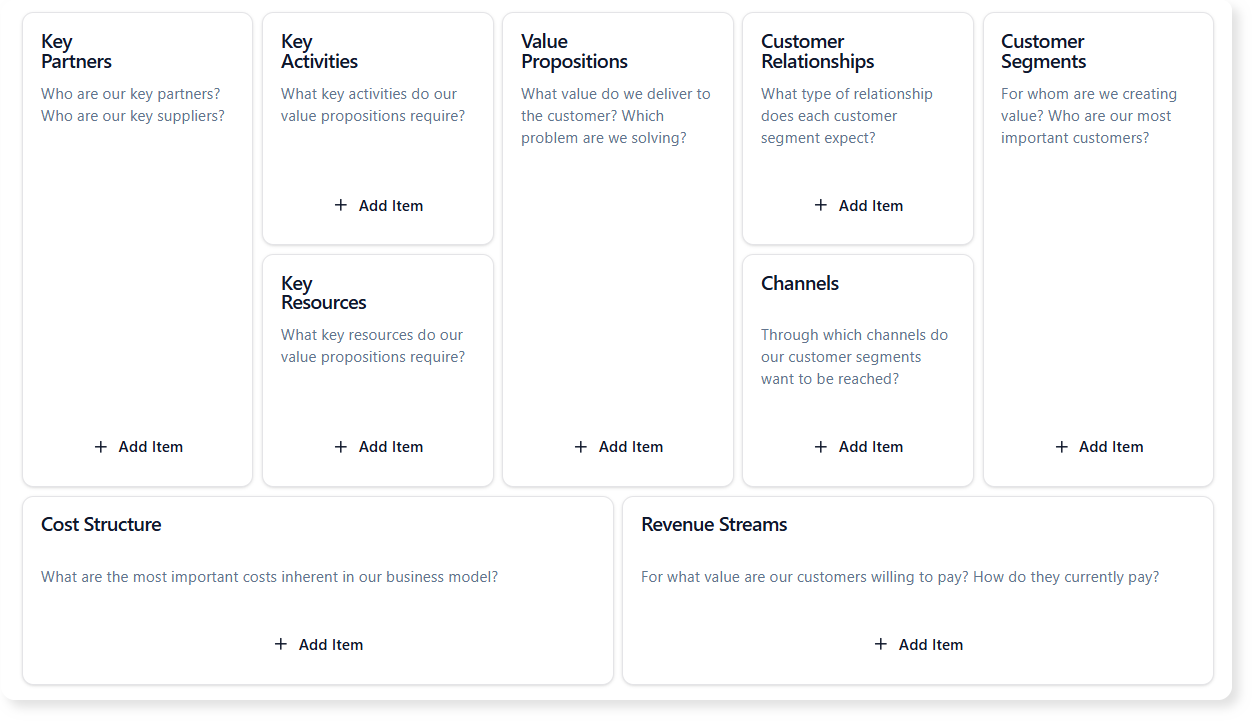
In this guide, you’ll learn the nine building blocks of the BMC, understand how they connect, and see them applied through a real-world case study of a fictional startup: GreenCycle – A Sustainable Packaging Startup.
What is the Business Model Canvas?
The Business Model Canvas is a one-page visual framework that breaks down a business into nine essential components. It allows you to map out your business strategy clearly and efficiently, making it perfect for startups, small businesses, and even large companies testing new ventures.
✅ Ideal for:
Startups
Entrepreneurs
Product managers
Innovation teams
Students learning business strategy
The 9 Building Blocks of the Business Model Canvas
Let’s explore each of the nine components with simple definitions and beginner-friendly explanations.
1. Customer Segments (Who are you serving?)
Definition: Who are your customers? Identify the different groups of people or organizations you aim to serve.
Key Questions:
-
Who are your target customers?
-
Are they individuals, businesses, governments?
-
Do they have specific needs or pain points?
📌 Tip: You can have multiple customer segments (e.g., eco-conscious consumers and B2B retailers).
2. Value Propositions (Why do they choose you?)
Definition: What unique value do you offer to your customers? This is the core of your business—your solution to their problems or needs.
Key Questions:
-
What problem are you solving?
-
What benefits do you deliver?
-
Are you cheaper, faster, better, or more sustainable?
📌 Tip: Focus on specific benefits—don’t just say “good quality.” Instead, say “100% compostable packaging that breaks down in 90 days.”
3. Channels (How do you reach your customers?)
Definition: Through which channels do you deliver your value proposition to your customers?
Key Questions:
-
Do you sell online, in stores, through distributors?
-
Do you use social media, email, or direct sales?
-
Is your customer journey digital, physical, or hybrid?
📌 Tip: Channels should match your customer segments. Eco-conscious millennials may prefer Instagram and e-commerce, while B2B clients may prefer direct sales.
4. Customer Relationships (How do you keep them?)
Definition: What kind of relationship do you build with your customers?
Key Questions:
-
Do you offer support, personalization, community?
-
Is it self-service, dedicated service, or automated?
-
How do you retain customers?
📌 Tip: Strong relationships = higher customer lifetime value. Think loyalty programs, excellent support, and regular communication.
5. Revenue Streams (How do you make money?)
Definition: How does your business earn money?
Key Questions:
-
Are you selling products, subscriptions, licensing, or ads?
-
Do you charge per unit, monthly, or one-time?
-
What is the price point?
📌 Tip: You can have multiple revenue streams (e.g., selling packaging + offering design services).
6. Key Resources (What do you need to operate?)
Definition: What assets are critical to your business model?
Key Questions:
-
Do you need manufacturing facilities, technology, intellectual property?
-
Do you need skilled staff, partnerships, or capital?
-
What’s essential to deliver your value?
📌 Tip: Resources can be physical (machines), intellectual (patents), human (team), or financial (funding).
7. Key Activities (What must you do?)
Definition: What key actions must your business take to deliver value?
Key Questions:
-
Do you manufacture products?
-
Do you develop software?
-
Do you market, distribute, or manage operations?
📌 Tip: These are the core processes—don’t confuse them with resources. For example: Producing compostable packaging is an activity, the factory is a resource.
8. Key Partnerships (Who helps you?)
Definition: Who are your allies? These are the suppliers, partners, or collaborators that help you deliver value.
Key Questions:
-
Who supplies your raw materials?
-
Do you work with logistics companies?
-
Are there strategic alliances (e.g., with eco-certification bodies)?
📌 Tip: Partnerships reduce risk and cost. For example, GreenCycle partners with local recyclers to source waste materials.
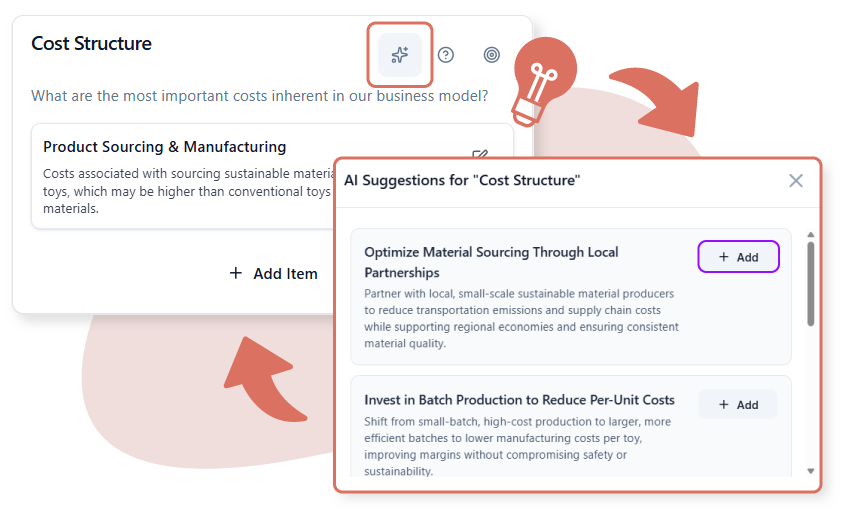
9. Cost Structure (What does it cost to run?)
Definition: What are the major costs involved in operating your business?
Key Questions:
-
Are your costs fixed (rent, salaries) or variable (materials, packaging)?
-
What are the biggest expenses?
-
Is your model cost-efficient?
📌 Tip: Many startups start with high fixed costs (machines, R&D), but aim to scale and reduce cost per unit.
Now, Let’s Apply It: A Case Study – GreenCycle
Let’s bring the Business Model Canvas to life with a real-world example.
Company: GreenCycle – Sustainable Packaging for E-Commerce
Problem: E-commerce is booming, but so is plastic waste. Consumers want sustainable packaging, but eco-friendly options are often expensive or hard to find.
Solution: GreenCycle produces 100% compostable, plant-based packaging made from recycled food waste and cornstarch. It’s affordable, biodegradable, and customizable.
They serve eco-conscious brands and small businesses looking to reduce their environmental impact.
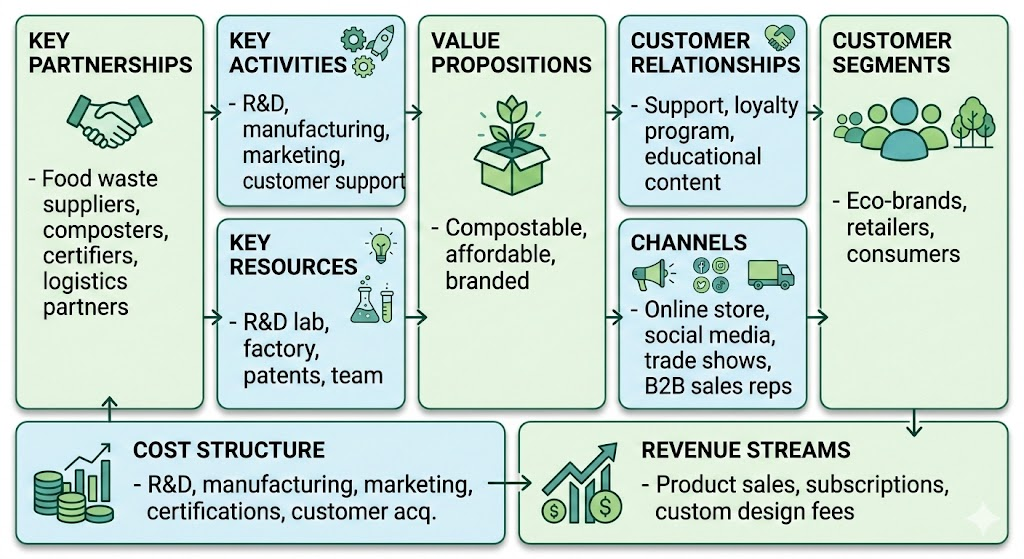
Applying the 9 Blocks – GreenCycle’s Business Model Canvas
| Block | GreenCycle’s Answer |
|---|---|
| 1. Customer Segments | – Small to medium e-commerce brands (B2B) – Eco-conscious consumers (B2C, via custom orders) – Retailers seeking sustainable packaging |
| 2. Value Propositions | – 100% compostable & biodegradable packaging – Made from recycled food waste (reduces landfill) – Customizable with branding – 30% cheaper than competitors – Eco-certified and carbon-neutral shipping |
| 3. Channels | – Online marketplace (Shopify, Etsy) – Direct B2B sales via website – Social media (Instagram, LinkedIn) – Trade shows (sustainability expos) |
| 4. Customer Relationships | – Dedicated customer service (email/chat) – Loyalty program for repeat B2B clients – Educational content (blog, videos on sustainability) – Feedback surveys to improve products |
| 5. Revenue Streams | – One-time sales of packaging kits – Subscription model (monthly delivery) – Custom design fees – Bulk discounts for large orders |
| 6. Key Resources | – R&D lab for material innovation – Manufacturing facility (in California) – Patents on compostable formula – Skilled team (scientists, designers, marketers) |
| 7. Key Activities | – Research and development of new materials – Manufacturing and quality control – Marketing and brand building – Customer onboarding and support – Supply chain management |
| 8. Key Partnerships | – Local food waste suppliers (e.g., restaurants, farms) – Composting facilities (to verify breakdown) – Eco-certification bodies (e.g., B Corp, USDA Bio-based) – Logistics partners for eco-friendly shipping |
| 9. Cost Structure | – High R&D costs (material science) – Manufacturing costs (equipment, labor) – Marketing and advertising – Certification and compliance fees – Customer acquisition (digital ads) |
Visual Representation
Why This Works: Key Takeaways from GreenCycle
- Clear Problem-Solution Fit: GreenCycle solves a real environmental issue with a scalable product.
- Multiple Revenue Streams: They’re not dependent on one income source—this reduces risk.
- Sustainable & Scalable: By using recycled food waste, they reduce cost and environmental impact.
- Strong Partnerships: They don’t just make packaging—they collaborate with composters and suppliers.
- Customer-Centric: They focus on building trust and long-term relationships.
How to Use the Business Model Canvas: Step-by-Step for Beginners
- Start with a blank canvas.
- Answer each block one by one, using real data and research.
- Validate your assumptions with customers—don’t just guess.
- Iterate! Your BMC will evolve as you learn more.
- Use it for brainstorming new products or business ideas.
🚀 Pro Tip: Revisit your BMC every 3–6 months. Markets change, customers evolve, and so should your model.
Common Mistakes to Avoid
❌ Too many customer segments – Focus on 1–3 primary ones.
❌ Vague value propositions – “We’re better” isn’t enough. Be specific.
❌ Ignoring costs – Underestimating expenses kills startups.
❌ No customer feedback – Your assumptions may be wrong. Test early.
❌ Copying others – Use the BMC to innovate, not just replicate.
Final Thoughts: Why the Business Model Canvas is Your Best Friend
The Business Model Canvas is not just a template—it’s a thinking tool. It forces you to ask the right questions, challenge assumptions, and build a business that truly matters.
Whether you’re launching a side hustle, pitching to investors, or rethinking your startup, the BMC gives you a clear, structured way to think strategically.
💬 “The best way to predict the future is to create it.” – Peter Drucker
With the Business Model Canvas, you’re not just predicting—you’re building.
Ready to Build Your Own?
Grab a pen, a blank sheet, and start answering:
👉 Who are your customers?
👉 What value do you offer?
👉 How will you make money?
Your next big idea is just one canvas away.
You’ve now got the tools to turn ideas into impact. Go build something amazing. 🌱💼🚀
- Complete Guide to the Business Model Canvas (BMC) – Visual Paradigm: This thorough guide explains the nine building blocks of the framework and provides real-world examples for business innovation.
- Business Model Canvas Guide with Examples – Visual Paradigm: A practical resource featuring step-by-step instructions and expert tips for effective business planning.
- What Is the Business Model Canvas? Why Use Visual Paradigms & AI Tools: This article details the core components of the canvas and how AI-powered tools enhance strategic planning.
- AI-Powered Business Model Canvas Builder – Instant Strategy Design: This automated tool leverages machine intelligence to generate canvases and provide strategic insights instantly.
- Comprehensive Tutorial: Visual Paradigm Model Canvas Tool: A step-by-step technical guide for mastering the tool for effective modeling and innovation planning.
- Business Model Canvas Software – Visual Paradigm Online: A cloud-based platform designed for visualizing strategy with real-time collaboration features.
- Business Model Canvas Tool – Visual Paradigm: A structured framework that enables teams to design, analyze, and iterate on business models visually.
- Business Model Canvas Templates – Visual Paradigm Online: A library of professionally designed templates created to accelerate strategy development for startups and enterprises.
- Visual Paradigm Canvas – Collaborative Strategy Tool: A modern web-based platform for creating and sharing canvases and lean startup frameworks in real time.
- Mastering the Business Model Canvas with AI: Step-by-Step Guide: This guide demonstrates how to use AI capabilities to optimize and customize canvases efficiently.
This post is also available in Deutsch, Español, فارسی, Français, English, Bahasa Indonesia, 日本語, Polski, Portuguese, Ру́сский, Việt Nam, 简体中文 and 繁體中文.