


Introduction to Intelligent Modeling
In the rapidly evolving landscape of systems design and business architecture, the Visual Paradigm AI chatbot has emerged as a transformative tool. It functions as an intelligent modeling partner designed to bridge the gap between abstract ideas and concrete technical documentation. Unlike generic AI generation tools that often produce static images or unstructured text, this specialized chatbot interprets plain-text descriptions through the strict lens of industry-standard frameworks, ensuring that the output is not only visually coherent but technically accurate.
How the Transformation Process Works
The transition from a mental concept to a rigorous diagram involves a sophisticated, multi-stage process. By leveraging deep learning models trained on formal standards, the AI ensures logical consistency throughout the modeling lifecycle.
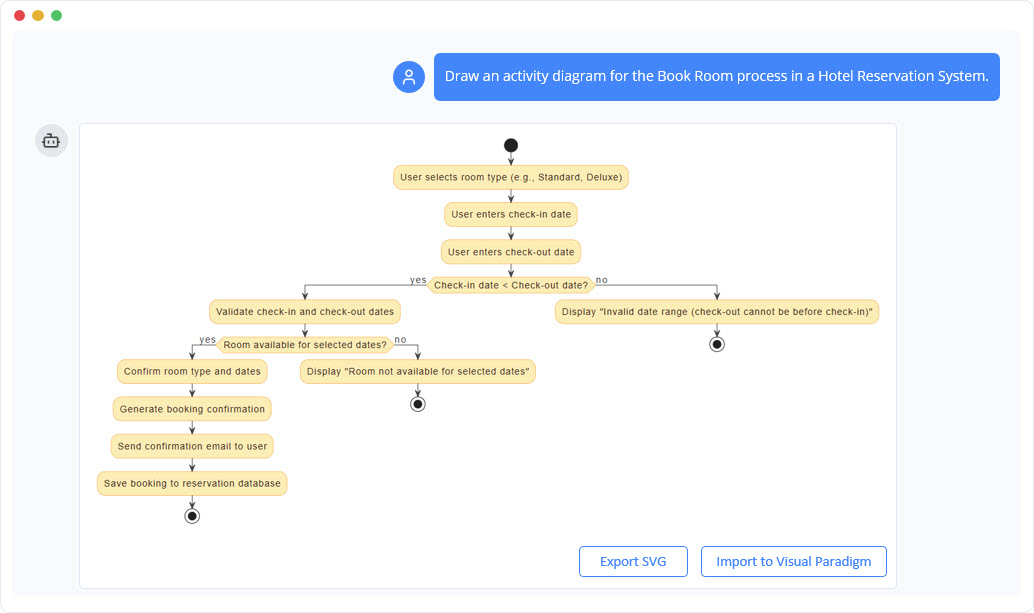
1. Interpretation of Natural Language
The process begins with the user describing a system, strategy, or business process in plain English. There is no requirement for the user to understand specific modeling syntax like UML notation or ArchiMate symbology. The AI analyzes the input to parse key components:
- Entities: Identifying actors, classes, components, or process steps.
- Relationships: Determining how these entities interact, such as data flows, associations, or sequence hierarchies.
For instance, if a user describes a secure login flow, the AI automatically recognizes “User” as an actor and “Database” as a participating lifeline in a sequence diagram.
2. Standard-Based Generation
Once the intent is parsed, the AI does not merely guess at a drawing; it reasons based on established modeling standards. It maps the extracted entities to specific diagram types, handling complex layout requirements and technical symbols automatically. The chatbot supports a diverse range of domains:
| Domain | Supported Standards |
|---|---|
| Software Engineering | UML (Class, Sequence, Use Case, Activity), SysML, and C4 Models |
| Enterprise Architecture | ArchiMate (supporting over 20 distinct viewpoints) |
| Business Strategy | SWOT Analysis, PESTLE, Ansoff Matrix, Eisenhower Matrix |
3. Conversational Refinement
Modeling is rarely perfect on the first draft. The Visual Paradigm AI facilitates an iterative, conversational process. After the initial diagram is rendered, users can issue natural language commands to refine the model in real-time. Examples of these modification commands include:
- “Add a payment gateway to the process flow.”
- “Rename the Customer entity to Buyer.”
- “Make the activity loop tighter for better readability.”
- “Add an inheritance relationship between Student and Person.”
Beyond Drawing: Analysis and Integration
The capabilities of the AI extend beyond visual generation into analytical reasoning and workflow integration.
Intelligent Analysis and Documentation
Because the AI understands the semantic logic behind the diagram, it provides contextual understanding of the model. Users can query the chatbot for insights, asking questions such as “What are the security risks in this deployment?” or requesting the generation of full technical specifications based on the visual data. This feature turns the diagram from a passive image into an active source of documentation.
Integration with Professional Tools
To ensure the output serves professional workflows, generated diagrams are not locked within the chat interface. Users can import generated diagrams directly into the Visual Paradigm desktop application. This critical step converts the AI’s output into a fully editable format, enabling advanced modeling features, version control, and team collaboration.
Conclusion: The Master Architect Analogy
To understand the value of this technology, consider the AI chatbot as a master architect seated at a drafting table. You, the client, do not need to know how to use a protractor or memorize building codes. You simply describe your vision in plain words. The architect listens, applies structural requirements (the modeling standards), and instantly sketches a blueprint that is technically sound. If a wall needs moving, you simply ask, and the blueprint is redrawn immediately. This synergy between human intent and AI precision represents the future of professional modeling.
This post is also available in Deutsch, Español, فارسی, Français, English, Bahasa Indonesia, 日本語, Polski, Portuguese, Ру́сский, Việt Nam, 简体中文 and 繁體中文.