


“A business process consists of a set of activities that are performed in coordination in an organizational and technical environment. These activities jointly realize a business goal.”
🎯 Purpose of BPMN
The primary goal of Business Process Model and Notation (BPMN) is to provide a standardized, universally understandable notation for all business stakeholders:
-
Business Analysts: Create initial process drafts
-
Technical Developers: Implement technology to execute processes
-
Business Managers: Monitor and manage operational processes
Key Characteristics:
-
✅ Based on familiar flowcharting techniques
-
✅ Graphical objects represent activities and flow controls
-
✅ Shapes are distinguishable and intuitive for modelers
-
✅ Bridges the gap between process design and executable implementation (BPEL4WS)
Three Application Levels:
| Level | Description |
|---|---|
| Descriptive Process Models | High-level modeling; comfortable for flowchart users |
| Analytic Process Models | Contains concepts commonly covered in BPMN training |
| Common Executable Process Models | Focuses on elements required for executable processes |
📜 Evolution of BPMN
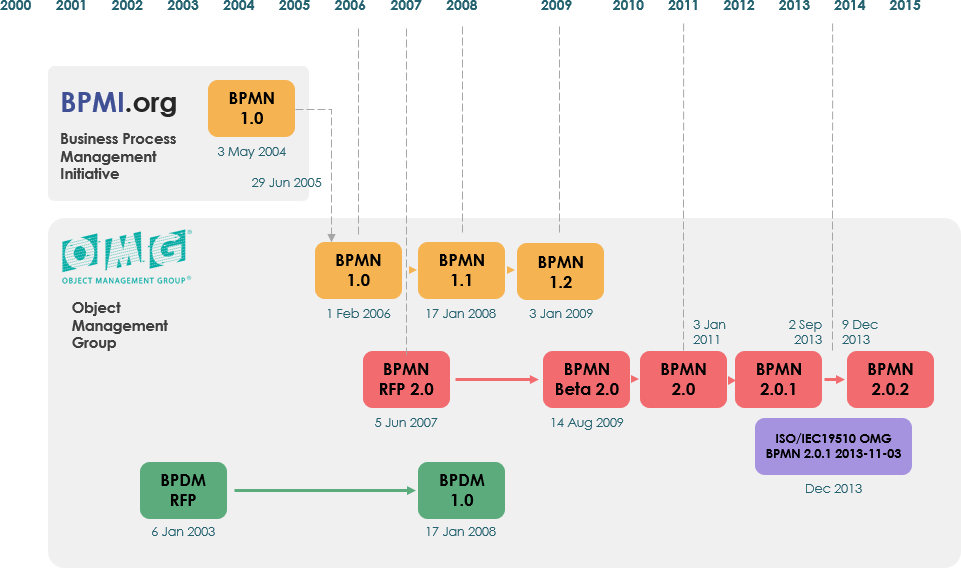
| Version | Date | Organization |
|---|---|---|
| BPMN 1.0 | May 2004 | Business Process Management Initiative (BPMI) |
| BPMN 1.x | Feb 2006 | Object Management Group (OMG) |
| BPMN 2.0 | 2010 | OMG |
| BPMN 2.0.2 | Dec 2013 | ISO/IEC 19510:2013 Standard |
🔷 BPMN Core Elements
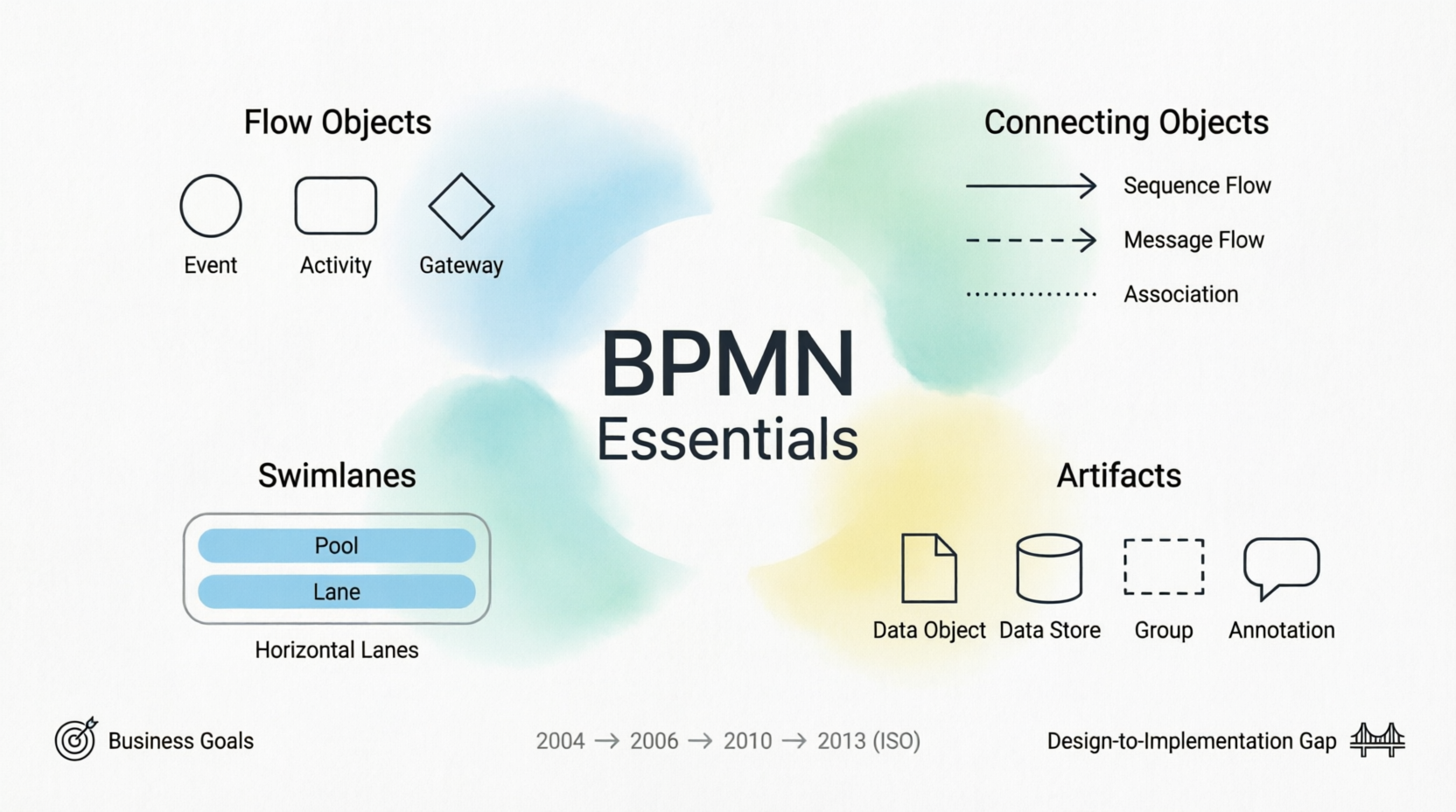
BPMN organizes graphical notation into four fundamental categories to balance simplicity with expressive power:
-
Flow Objects ⚙️
-
Connecting Objects 🔗
-
Swimlanes 🏊
-
Artifacts 📎
⚙️ Flow Objects
The three foundational building blocks of any Business Process Diagram (BPD):
Event ○
Something that happens during a business process, affecting flow with a trigger or result.
-
Represented by a circle with an open center for internal markers
-
Three Types:
-
Start Event: Triggers process initiation
-
Intermediate Event: Occurs between start and end
-
End Event: Indicates process completion
-
Activity ▭
Generic term for work performed by the organization.
-
Represented by a rounded-corner rectangle
-
Two Types:
-
Task: Atomic unit of work
-
Sub-Process: Compound activity (marked with + sign)
-
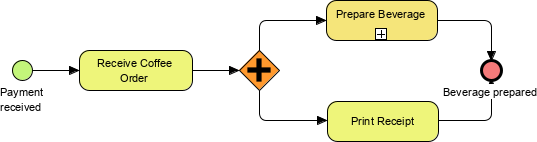
Gateway ◇
Controls divergence and convergence of Sequence Flow (decisions, forks, merges, joins).
-
Represented by a diamond shape with internal markers indicating behavior
| Gateway Type | Symbol | Behavior |
|---|---|---|
| Exclusive | ✕ | Follow only one path (XOR logic) |
| Inclusive | ○ | Follow one or more paths (OR logic) |
| Parallel | + | Follow all paths simultaneously (AND logic) |
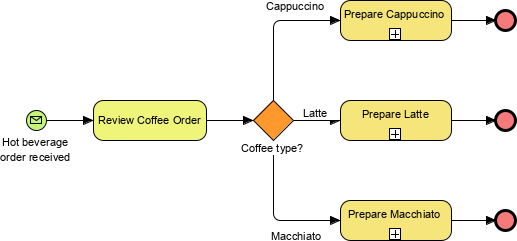
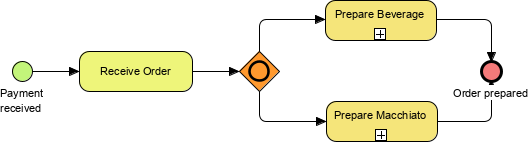
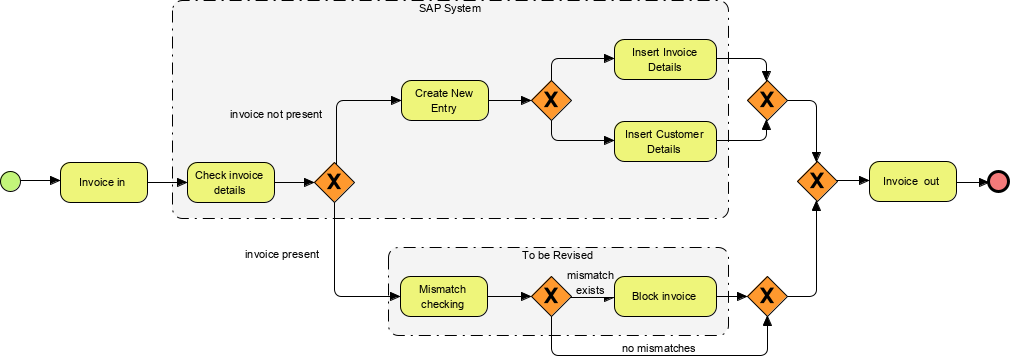
📊 Flow Object Summary Visual Reference



🔗 BPMN Connecting Objects
Connect flow objects to create the skeletal structure of business processes:
| Connector | Symbol | Purpose |
|---|---|---|
| Sequence Flow | ➤ Solid line with arrow | Shows order of activity execution (not called “control flow” in BPMN) |
| Message Flow | ⇢ Dashed line with open arrowhead | Represents information flow across organizational boundaries; may include envelope icon |
| Association | Dotted line | Links artifacts (annotations, data) to flow objects for documentation |

🏊 BPMN Swimlanes
Organize activities by responsibility or functional capability:
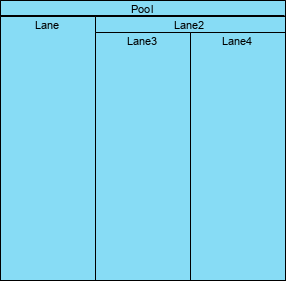
Pool 🏢
-
Represents a Participant in a process (e.g., organization, system, role)
-
Acts as a graphical container separating activities from other participants
-
Commonly used in B2B process modeling
Lane 🛣️
-
Sub-partition within a Pool
-
Extends full length of Pool (vertically or horizontally)
-
Used to categorize activities by department, role, or system
📎 BPMN Artifacts
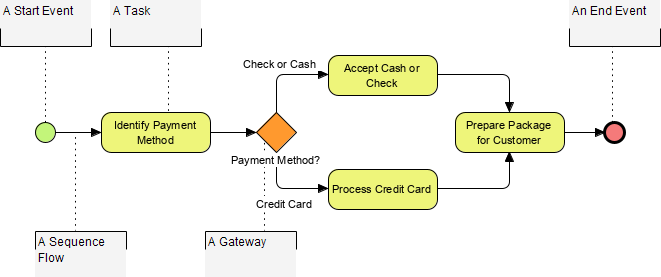
Extend diagrams with contextual information without altering process flow:
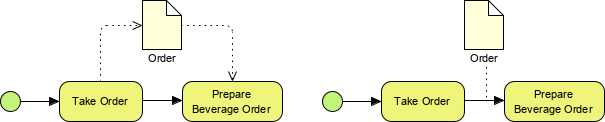
Data Object 📄
-
Shows data required or produced by activities
-
Connected via Associations
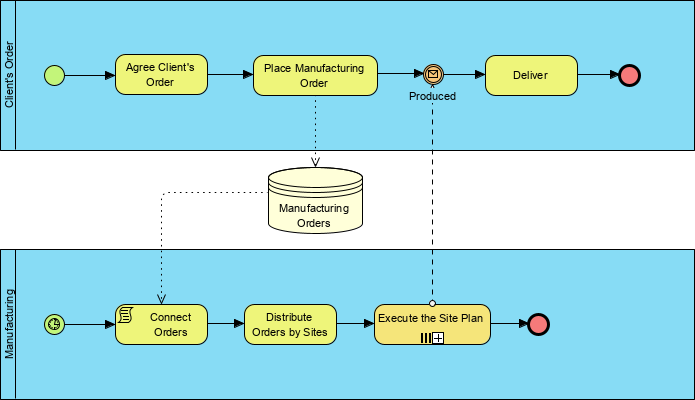
Data Store 🗄️
-
Represents persistent storage accessible by the process
-
Data survives beyond process scope
Group ⧉
-
Rounded rectangle with dashed border
-
Used for documentation or analysis; does not affect Sequence Flow
Annotation 💬
-
Provides explanatory text for diagram readers
-
Connected via Association to relevant elements
🎨 BPMN Notation: Simple or Complex?
BPMN achieves an elegant balance: simple core elements enhanced with modular variations to handle complexity without disrupting visual consistency.
Event Complexity Matrix
Events combine base shapes with internal/external markers to represent triggers, results, and timing:
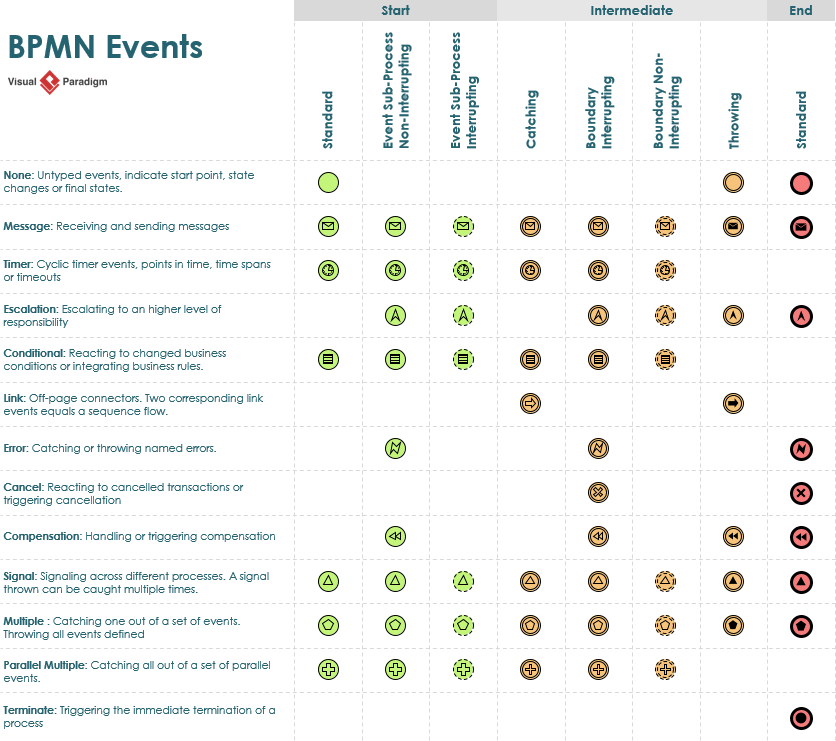
✅ Key Insight: Learn the 4 core categories first. Add complexity markers only as needed for your use case.
🔗 Reference List
BPMN Notation Overview: Comprehensive introduction to BPMN graphical notation, core philosophy, and foundational concepts for business process modeling.
Purpose of BPMN: Explains BPMN’s goal of bridging business and technical stakeholders through intuitive, standardized process diagrams across descriptive, analytic, and executable modeling levels.
Evolution of BPMN: Historical timeline from BPMI’s 2004 BPMN 1.0 release through OMG stewardship to ISO/IEC 19510:2013 standardization of BPMN 2.0.2.
BPMN Core Elements: Introduces the four foundational categories—Flow Objects, Connecting Objects, Swimlanes, and Artifacts—that structure all BPMN diagrams.
Flow Objects: Details the three essential flow elements: Events (circles), Activities (rounded rectangles), and Gateways (diamonds) that drive process logic.
Flow Object Summary: Visual reference guide consolidating Events, Activities, and Gateways with representative icons and usage contexts.
Events: Explores Start, Intermediate, and End Events—the triggers and outcomes that initiate, interrupt, or conclude process flows.
Activities: Covers Tasks and Sub-Processes as representations of work units, including atomic and compound activity modeling.
Gateways: Explains decision and synchronization points—Exclusive, Inclusive, and Parallel Gateways—for controlling process branching and merging.
BPMN Connecting Objects: Describes Sequence Flow, Message Flow, and Association connectors that define order, communication, and documentation links.
BPMN Swimlanes: Details Pools (participants) and Lanes (sub-partitions) for organizing responsibilities and visualizing cross-functional processes.
BPMN Artifacts: Covers Data Objects, Data Stores, Groups, and Annotations—supplementary elements that enrich diagrams without altering execution logic.
BPMN Notation: Simple or Complex?: Discusses BPMN’s scalable design philosophy: maintaining visual simplicity while supporting advanced modeling through modular event markers and extensions.
BPMN (Business Process Model and Notation) is a standardized, flowchart-based graphical language designed to model business processes in a way that is intuitive for business analysts yet precise enough for technical implementation. It organizes diagrams into four core element categories—Flow Objects (Events, Activities, Gateways), Connecting Objects (Sequence/Message Flows, Associations), Swimlanes (Pools/Lanes), and Artifacts (Data Objects, Annotations)—enabling scalable complexity while preserving visual clarity. From high-level descriptive models to executable workflows, BPMN bridges the gap between business strategy and system execution, evolving since 2004 into an ISO-standardized notation trusted globally for process optimization and digital transformation.
This post is also available in Deutsch, Español, فارسی, Français, English, Bahasa Indonesia, 日本語, Polski, Portuguese, Ру́сский, Việt Nam, 简体中文 and 繁體中文.
Related posts:
 How Project Managers Can Use Business Process Model and Notation to Reduce Scope Creep
 Avoiding the “Spaghetti Diagram”: How to Keep Business Process Model and Notation Readable at Scale
 Business Process Model and Notation in Agile Teams: Integrating Models into Sprint Planning and Retrospectives
 Business Process Model and Notation: A Guide to Handling Exception Flows Without Breaking Logic