
Introduction
Visual Paradigm Community Edition stands as the #1 FREE Sequence Diagram Tool in the market, providing powerful UML modeling capabilities for non-commercial use since 2004. This comprehensive guide will walk you through everything you need to know about sequence diagrams and how to leverage this free tool effectively.

What is Visual Paradigm Community Edition?
Visual Paradigm Community Edition was launched in 2004 with a mission to provide free UML software for non-commercial purposes. It supports users taking their first steps in UML modeling and those who need a free, cross-platform UML modeling solution for personal use, such as student projects.
Key Features:
-
Completely Free for all non-commercial purposes
-
Supports all 13 UML 2.x diagrams plus ERD diagrams
-
Cross-platform compatibility
-
Over 1 million installations worldwide and growing

Understanding Sequence Diagrams
What is a Sequence Diagram?
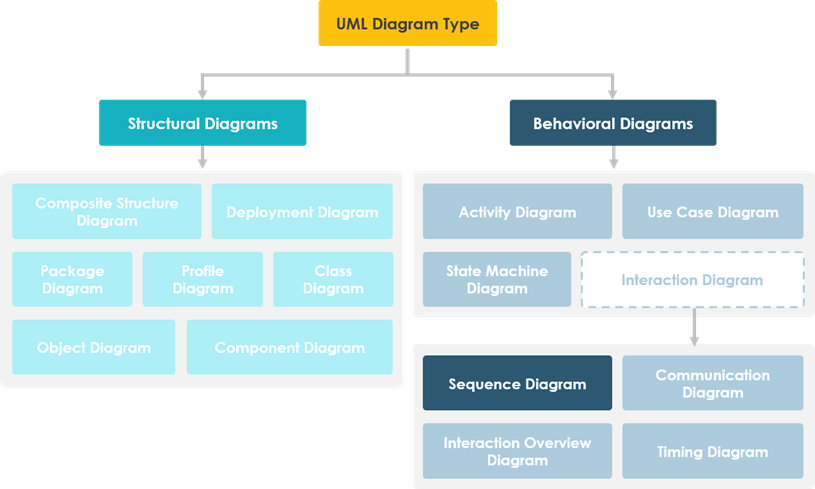
A Sequence Diagram is an interaction diagram that describes how groups of objects collaborate in some behavior over time. It captures the behavior of a single use case by showing:
-
Objects and the messages passed between them
-
The chronological order of interactions
-
How operations are carried out within a specific use case
Key Characteristics:
-
A model describing how groups of objects collaborate in some behavior over time
-
Captures the behavior of a single use case
-
Shows objects and the messages passed between these objects for a particular use case
Sequence Diagrams are interaction diagrams that detail how operations are carried out. They model important runtime interactions between the parts that make up the system.
Absolute Beginner’s Guide to Sequence Diagrams
Getting Started with Sequence Diagrams
If you’re new to sequence diagrams, here’s what you need to know:
1. Basic Concepts
-
Objects: Represented at the top of the diagram, arranged from left to right
-
Lifelines: Vertical dashed lines showing an object’s existence over time
-
Messages: Horizontal arrows showing communication between objects
-
Time Flow: Progresses from top to bottom
2. Reading a Sequence Diagram
-
Time moves downward on the page
-
Objects are listed from left to right based on when they participate
-
Messages show what is communicated and when
3. Creating Your First Diagram
-
Identify the objects involved in your scenario
-
Determine the sequence of messages
-
Arrange objects in order of participation
-
Draw messages in chronological order
-
Add activation bars to show when objects are processing
4. Common Elements
-
Actors: External entities interacting with the system
-
Synchronous Messages: Solid arrowheads (caller waits for response)
-
Asynchronous Messages: Open arrowheads (caller continues without waiting)
-
Return Messages: Dashed lines showing responses
Sequence Diagram Applications
Modeling General Interaction
Sequence diagrams serve multiple purposes in system design:
-
Model high-level interaction between active objects in a system
-
Model interaction between object instances within a collaboration that realizes a use case
-
Model interaction between objects within a collaboration that realizes an operation
-
Model generic interactions (showing all possible paths) or specific instances (showing one path)
-
Capture interactions in collaborations that realize use cases or operations
-
Capture high-level interactions between:
-
Users and the system
-
The system and other systems
-
Between subsystems (system sequence diagrams)
-
Practical Example: Hotel System
Sequence Diagrams are interaction diagrams that detail how operations are carried out—what messages are sent and when. They are organized according to time, with time progressing as you go down the page. The objects involved in the operation are listed from left to right according to when they take part in the message sequence.
Below is a sequence diagram for making a hotel reservation. The object initiating the sequence of messages is a Reservation window.
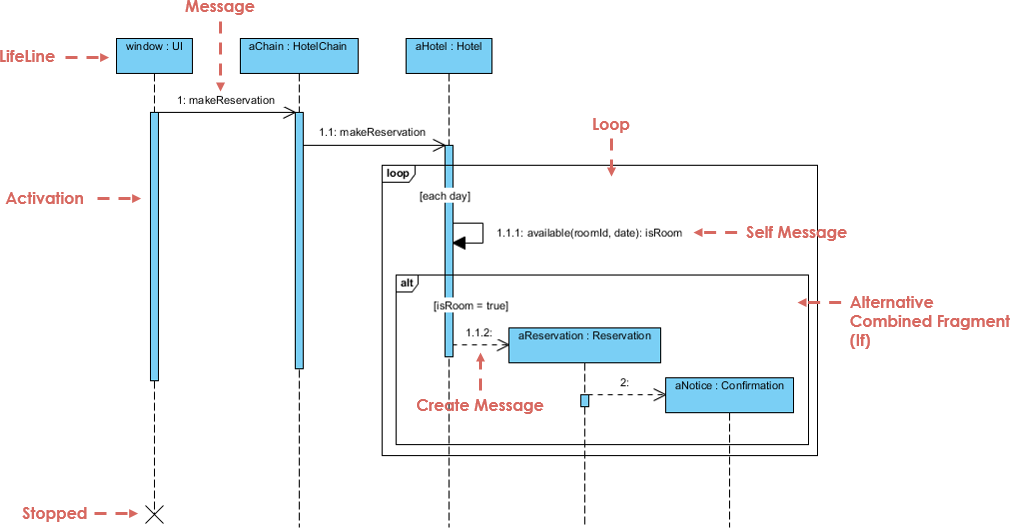
Important Note: Class and object diagrams are static model views, while interaction diagrams are dynamic. They describe how objects collaborate.
Modeling Use Case Scenarios
Understanding Use Cases and Scenarios
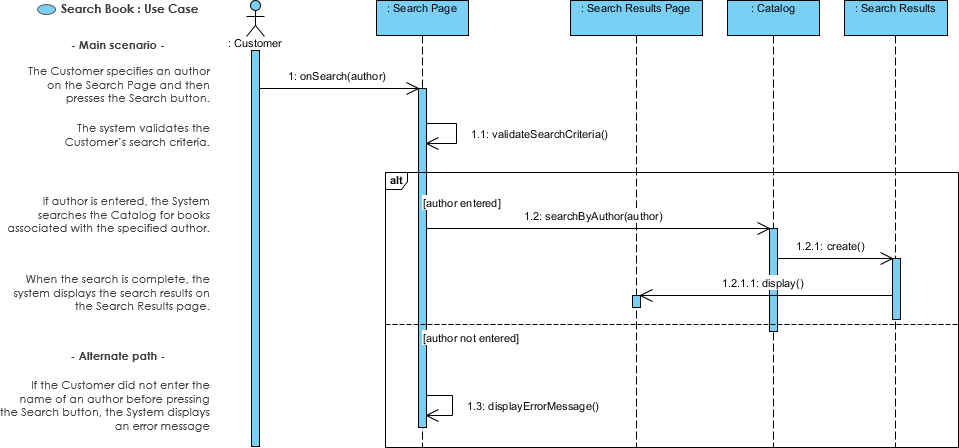
A scenario is one path or flow through a use case that describes a sequence of events occurring during one particular execution of a system. Sequence diagrams are often used to assist in elaborating use cases by emphasizing message exchange.
Use Case vs Scenarios
Use Case:
-
A collection of interactions between external actors and a system
-
In UML: “the specification of a sequence of actions, including variants, that a system (or entity) can perform, interacting with actors of the system”
-
Typically includes:
-
One primary scenario (main course of events)
-
Zero or more secondary scenarios (alternative courses of events)
-
Scenario:
-
One specific path or flow through a use case
-
Describes a sequence of events during one particular execution
-
Often represented by a sequence diagram
Representing Use Case Scenarios
User requirements are captured as use cases that are refined into scenarios. The various scenarios of a use case can be depicted by sequence diagrams. The representation is restricted to the message exchange within each business use case.
Generally, the level of detail for these sequence diagrams is higher than for sequence diagrams spanning use cases.
Why Model Before Code?
Sequence diagrams can be close to the code level, so why not just code the algorithm rather than drawing it as a sequence diagram? Here are compelling reasons:
Advantages of Sequence Diagrams:
-
Abstraction Level: A good sequence diagram is still above the level of real code, providing better overview
-
Language Neutral: Sequence diagrams are not tied to any specific programming language
-
Accessibility: Non-coders can create and understand sequence diagrams
-
Collaboration: Easier to create sequence diagrams as a team
-
Versatility: Can be used for:
-
Testing
-
Documentation
-
Communication with stakeholders
-
User Experience Sharing Journey
Real-World Adoption
Visual Paradigm is trusted by over 230,000 people in companies ranging from small businesses to Fortune 500 companies, universities, and government units worldwide.
User Journey Stages
Stage 1: Discovery
-
Students and professionals discover the free Community Edition
-
Download and installation process
-
Initial exploration of features
Stage 2: Learning
-
Understanding UML basics
-
Creating first sequence diagrams
-
Exploring different diagram types
Stage 3: Application
-
Applying to academic projects
-
Using for personal learning
-
Collaborating with team members
Stage 4: Mastery
-
Advanced modeling techniques
-
Integration with development workflows
-
Mentoring others
Success Stories
Academic Users:
-
Students use VP Community for coursework and thesis projects
-
Universities integrate it into curriculum
-
Research projects benefit from professional-grade modeling
Professional Users:
-
Developers create documentation before coding
-
Teams use diagrams for system design discussions
-
Architects model complex system interactions
Community Benefits
-
Free Forever: No hidden costs for non-commercial use
-
Cross-Platform: Works on Windows, macOS, and Linux
-
Regular Updates: Continuous improvement since 2004
-
Active Community: Support from millions of users worldwide
Getting Started
But even with all these benefits above, Visual Paradigm Community is free for all sorts of non-commercial use, since 2004, and for now & forever!
Download Now
Download Visual Paradigm Community
Other Editions Available
If you need commercial features or advanced capabilities, Visual Paradigm offers several editions:
Visual Paradigm Enterprise
End-to-End Enterprise Architecture tool suite that supports TOGAF, ArchiMate, PMBOK process map and more
Read More ❯
Visual Paradigm Professional
Agile development tools like user story map and sprint, Customer Journey Map and a wide range of project management diagrams
Read More ❯
Visual Paradigm Standard
Essential development tools for modeling (UML, BPMN, ERD, DFD, etc), wireframing, code and DB engineering tools, etc
Read More ❯
Visual Paradigm Modeler
An award-winning modeling software that features UML, BPMN, ERD, DFD and more. Visual Paradigm Modeler makes modeling easy and fast.
Read More ❯
Reference List
-
Download Visual Paradigm Community: Free download page for Visual Paradigm Community Edition, the #1 free UML and sequence diagram tool for non-commercial use
-
UX Design and Wireframe Tools: Features and tools for UX wireframing and design that can be integrated with sequence diagram modeling
-
Visual Paradigm Enterprise Edition: End-to-end enterprise architecture tool suite supporting TOGAF, ArchiMate, PMBOK process map and more
-
Visual Paradigm Professional Edition: Agile development tools including user story map, sprint planning, Customer Journey Map and project management diagrams
-
Visual Paradigm Standard Edition: Essential development tools for UML, BPMN, ERD, DFD modeling, wireframing, code and database engineering
-
Visual Paradigm Modeler Edition: Award-winning modeling software featuring UML, BPMN, ERD, DFD and more for easy and fast modeling
Conclusion
Visual Paradigm Community Edition provides an exceptional opportunity for students, educators, and hobbyists to access professional-grade UML modeling tools at no cost. With comprehensive support for sequence diagrams and all 13 UML 2.x diagrams, it serves as an ideal platform for learning system design, documenting software architecture, and collaborating on projects.
Whether you’re creating your first sequence diagram or modeling complex enterprise systems, Visual Paradigm Community Edition offers the tools and flexibility you need to succeed. Start your modeling journey today!