
Case Study: Spotify’s Freemium Strategy – From Startup to Industry Leader
1. Introduction
Spotify, founded in 2006 by Daniel Ek and Martin Lorentzon, revolutionized music consumption by introducing a freemium business model in the digital music era. Unlike traditional models that relied on one-time purchases or subscription-only access, Spotify offered free access with ads, while charging for premium ad-free listening. This dual-tier model enabled rapid user acquisition, scalable growth, and eventual profitability—making it a textbook example of successful freemium strategy.
2. Step-by-Step Case Study
Step 1: Market Context (2006–2008)
-
Problem: Illegal music downloads were rampant (e.g., Napster, LimeWire), hurting artists and labels.
-
Opportunity: Consumers wanted legal, affordable, and convenient access to music.
-
Spotify’s Vision: Create a legal, user-friendly platform that offered vast music libraries with flexible access.
Step 2: Launch of Freemium Model (2008)
-
Free Tier: Ad-supported, limited features (e.g., shuffle-only, lower audio quality).
-
Premium Tier: Ad-free, high-quality audio, offline listening, and advanced features.
-
Pricing: Free; Premium at €9.90/month (later $9.99 USD).
Key Insight: The freemium model attracted users who were unwilling to pay but open to ads, while converting high-engagement users to premium.
Step 3: User Acquisition & Viral Growth (2009–2013)
-
Free users became the primary acquisition channel—users could invite friends via email.
-
Social sharing features (e.g., “Share on Spotify”) drove organic growth.
-
Data-driven personalization (e.g., Discover Weekly, Daily Mix) increased engagement and retention.
Result: By 2013, Spotify had 20 million monthly active users, with 1 million premium subscribers—a 10:1 ratio.
Step 4: Monetization & Scaling (2014–2018)
-
Revenue Streams:
-
Premium subscriptions (75% of revenue)
-
Advertising (25% of revenue)
-
-
Revenue Model: Ad revenue is shared with rights holders (labels, artists).
-
Expansion: Launched in 60+ countries, with localized content and playlists.
Key Metric: 2018 saw 100 million monthly users (60 million premium), proving the freemium model scales.
Step 5: Profitability & IPO (2018)
-
Spotify went public in 2018 (NYSE: SPOT), valued at $23 billion.
-
Achieved first-ever profitable quarter in Q4 2017.
-
Continued to grow: 500 million users (2023), 200 million premium subscribers (2023).
Step 6: Innovation & Diversification (2019–Present)
-
Podcasts: Acquired Gimlet, Anchor, and PodcastOne to expand into audio content.
-
AI & Personalization: AI-curated playlists (e.g., Daily Mix, Release Radar) enhance user stickiness.
-
Family Plans & Student Discounts: Expand affordability and penetration.
Today, Spotify is a global audio entertainment platform, not just a music streamer.
3. Business Model Canvas Analysis
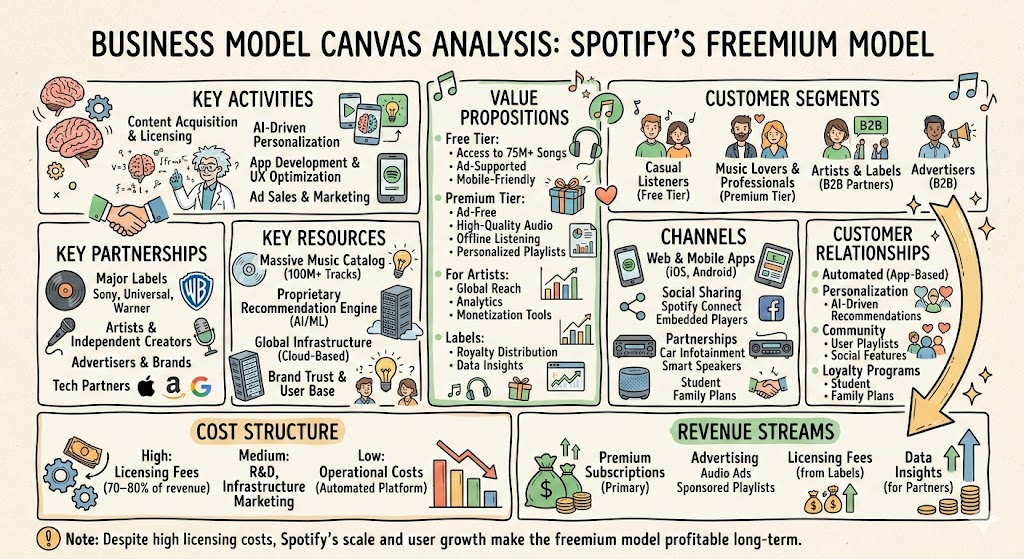
| Component | Spotify’s Freemium Model |
|---|---|
| Customer Segments | – Casual listeners (Free tier) – Music lovers & professionals (Premium tier) – Artists & labels (B2B partners) – Advertisers (B2B) |
| Value Propositions | – Free Tier: Access to 75M+ songs, ad-supported, mobile-friendly – Premium Tier: Ad-free, high-quality audio, offline listening, personalized playlists – For Artists: Global reach, analytics, monetization tools – For Labels: Royalty distribution, data insights |
| Channels | – Web & mobile apps (iOS, Android) – Social sharing (Spotify Connect, embedded players) – Partnerships (car infotainment, smart speakers) |
| Customer Relationships | – Automated (app-based) – Personalization (AI-driven recommendations) – Community (user playlists, social features) – Loyalty programs (student, family plans) |
| Revenue Streams | – Premium Subscriptions (primary) – Advertising (audio ads, sponsored playlists) – Licensing Fees (from labels) – Data Insights (for partners) |
| Key Resources | – Massive music catalog (100M+ tracks) – Proprietary recommendation engine (AI/ML) – Global infrastructure (cloud-based) – Brand trust & user base |
| Key Activities | – Content acquisition & licensing – AI-driven personalization – App development & UX optimization – Ad sales & marketing |
| Key Partnerships | – Major labels (Sony, Universal, Warner) – Artists & independent creators – Advertisers & brands – Tech partners (Apple, Amazon, Google) |
| Cost Structure | – High: Licensing fees (70–80% of revenue) – Medium: R&D, infrastructure, marketing – Low: Operational costs (automated platform) |
Note: Despite high licensing costs, Spotify’s scale and user growth make the freemium model profitable long-term.
4. Key Concepts in Freemium Strategy
1. The Freemium Model Defined
A business strategy where a basic product is offered for free, while premium features are monetized through subscriptions or in-app purchases.
2. Core Principles of Spotify’s Freemium Success
| Principle | How Spotify Implements It |
|---|---|
| Freemium Hook | Free access lowers entry barrier; users experience value before paying. |
| Freemium Conversion Funnel | Free → Engaged → Premium (e.g., 10–20% conversion rate). |
| Network Effects | More users → more data → better recommendations → higher retention → more users. |
| Data Monetization | User behavior data fuels personalization and ad targeting. |
| Scalable Infrastructure | Cloud-based platform supports millions of concurrent users. |
| Low Switching Cost | Free users can easily upgrade; no long-term contracts. |
| Perceived Value | Premium offers tangible benefits (ad-free, quality, offline). |
3. Psychological Triggers in Freemium
-
Foot-in-the-Door Effect: Free access builds trust.
-
Loss Aversion: Users fear losing curated playlists if they don’t upgrade.
-
Scarcity & FOMO: Limited-time features (e.g., exclusive releases) push upgrades.
-
Social Proof: Seeing friends’ playlists increases desire to join.
5. Guidelines for Implementing a Successful Freemium Strategy (Based on Spotify)
✅ Do’s
-
Offer Real Value in the Free Tier
– Don’t just offer a crippled version. Let users experience core functionality (e.g., full music library, shuffle, playlists). -
Create a Clear Conversion Path
– Use UI cues (e.g., “Upgrade to Premium”) and feature highlights to guide users. -
Leverage Data & AI for Personalization
– Deliver unique experiences (e.g., Discover Weekly) to increase engagement and retention. -
Monetize Through Multiple Streams
– Combine subscriptions, ads, and data insights to diversify revenue. -
Focus on User Retention, Not Just Acquisition
– A 1% conversion rate with 100M users is better than 10% with 10M users. -
Build Network Effects
– More users → more data → better recommendations → more users. -
Localize and Adapt
– Offer region-specific content, pricing, and partnerships (e.g., India’s ₹99/month plan).
❌ Don’ts
-
Don’t Over-Police the Free Tier
– Too many restrictions kill user experience. Balance is key. -
Don’t Ignore the Cost of Licensing
– High royalty payments can erode profits. Negotiate smartly. -
Don’t Ignore Ad Quality
– Poor or intrusive ads drive users to premium. -
Don’t Underestimate the Power of Social Features
– Sharing playlists and listening stats boost virality.
6. Conclusion: Why Spotify’s Freemium Model Works
Spotify’s freemium strategy is a masterclass in user-centric monetization. By offering free access to a vast library, it built a massive user base. Then, by leveraging data, personalization, and social features, it converted users into paying subscribers. The model turned users into assets, data into currency, and free access into profit.
Spotify’s success proves that freemium isn’t just about giving something away—it’s about building a sustainable ecosystem where free users fuel the growth of premium users, creating a virtuous cycle of value creation.
7. Final Takeaway
“Give freely, but earn wisely.”
Spotify’s freemium model shows that free access is not a cost—it’s a growth engine. The key is to design the free tier to hook users, deliver value, and convert them through experience, not pressure.