


In today’s fast-paced product and engineering environments, clarity, speed, and precision matter more than ever. Yet, translating abstract ideas—especially complex system architectures, business processes, or software designs—into visual models remains a time-consuming, error-prone bottleneck. Enter Visual Paradigm’s AI-Powered Visual Modeling Chatbot: not just another chat interface, but a domain-specialized intelligent co-pilot that fundamentally rethinks how professionals design, document, and collaborate.
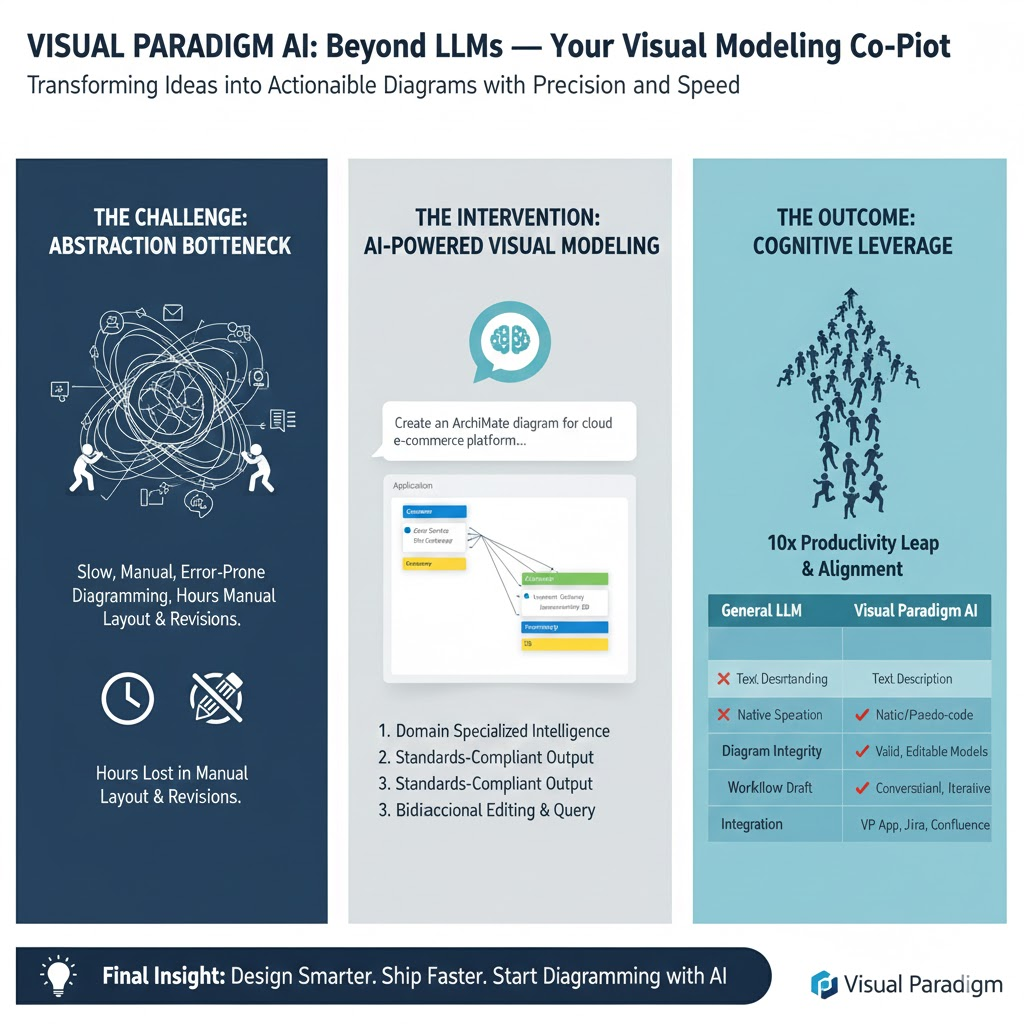
Here’s how it’s transforming productivity—and why it goes far beyond what even the most advanced general-purpose LLMs (like GPT-4, Claude, or Gemini) can offer.
🚀 A 10x Productivity Leap: From Minutes to Seconds
Imagine this:
“Create an ArchiMate diagram for a cloud-based e-commerce platform with customer, order, payment, and inventory domains, including application and technology layers.”
Within seconds, you get a semantically correct, standards-compliant diagram—fully structured, with proper relationships, layering, and notation.
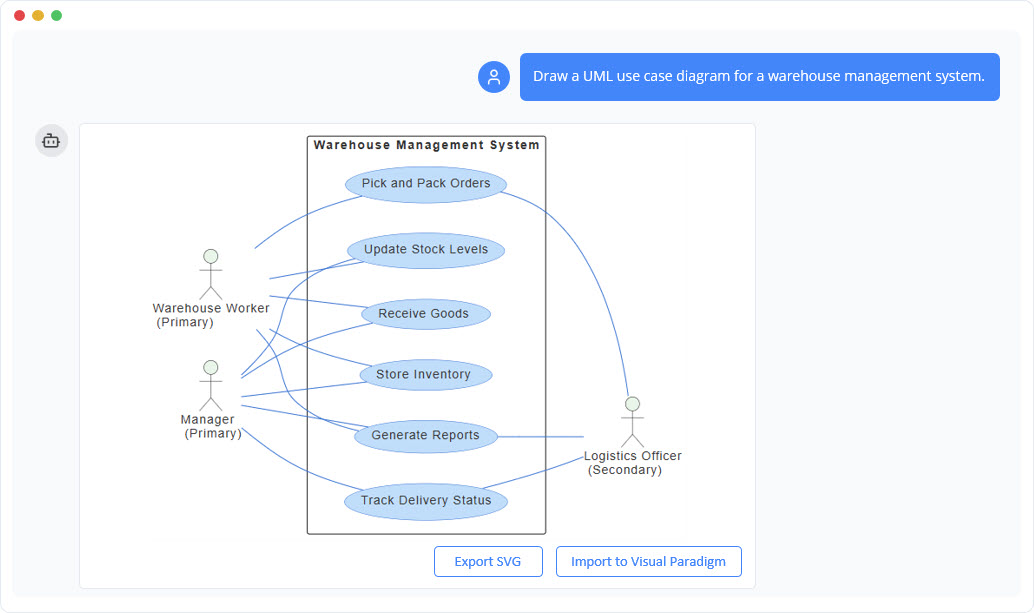
✅ No more hunting for stencils
✅ No more manual alignment or formatting
✅ No more back-and-forth in meetings trying to sketch on a whiteboard
What used to take hours—a rough draft, stakeholder feedback, revisions, documentation—is now done in under a minute, with professional-grade output ready for presentation or engineering handoff.
For product managers, solution architects, and business analysts, this means reclaiming dozens of hours per quarter—time better spent on strategy, user research, and cross-functional alignment.
🔧 Precision Over Prompts: Why This Isn’t Just “LLM + Diagrams”
It’s tempting to think: “Can’t I just ask ChatGPT to describe a diagram and draw it myself?”
Technically—yes. Practically? Not even close.
Here’s why Visual Paradigm’s AI stands apart:
|
Capability
|
General LLM (e.g., GPT-4)
|
Visual Paradigm AI
|
|---|---|---|
|
Domain Understanding
|
Knows about UML/ArchiMate—but doesn’t speak it natively
|
Trained on thousands of real-world models; understands syntax, semantics, and best-practice constraints of 20+ modeling standards
|
|
Diagram Integrity
|
Outputs prose or Mermaid-like pseudocode; no structural validation
|
Enforces modeling rules (e.g., “A Use Case must be associated with an Actor”)—prevents invalid or ambiguous constructs
|
|
Interactive Refinement
|
Static output; edits require full re-prompting
|
Full bidirectional editing: “Move ‘Payment Service’ into the backend layer” → AI restructures the diagram, preserving relationships
|
|
Knowledge Extraction
|
Can summarize text about a diagram
|
Treats the diagram as a live knowledge graph: “What components depend on the Auth Service?” → answers with visual + textual traceability
|
|
Export & Integration
|
No native tooling integration
|
One-click export to VP desktop app, enabling version control, team collaboration, simulation, and code generation
|
In short:
🔹 General LLMs give you ideas.
🔹 Visual Paradigm AI gives you executable artifacts.
🔄 Transforming the Work Process: A New Design Workflow
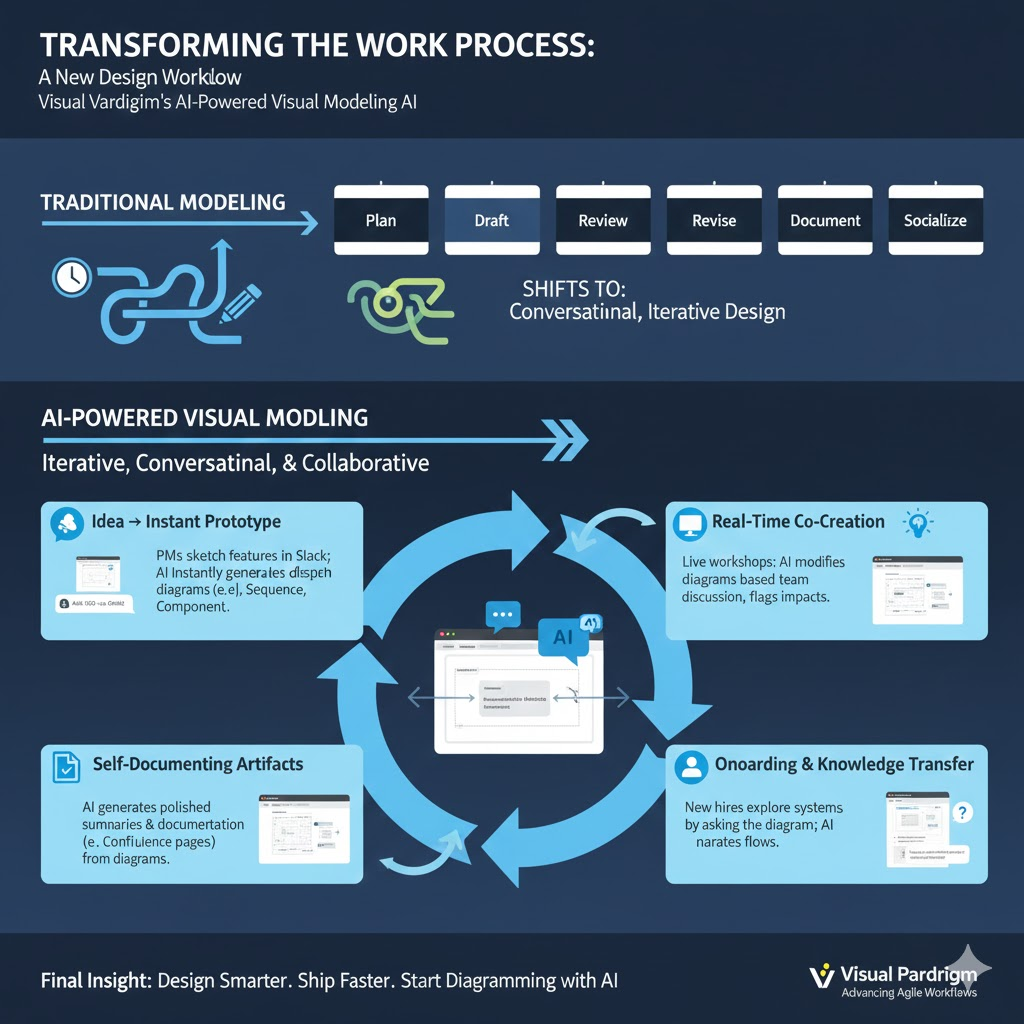
Traditional modeling is linear: Plan → Draft → Review → Revise → Document → Socialize.
With AI-powered visual modeling, it becomes iterative, conversational, and collaborative:
- Idea → Instant Prototype
A PM sketches a feature in Slack: “Let’s add SSO via OAuth2.” Paste that into VP AI — boom, an updated sequence and component diagram. - Real-Time Co-Creation in Workshops
During a sprint planning session, the team says: “What if we decouple recommendation engine?” The AI adds a new microservice, updates dependencies, and flags potential latency impacts—all live on screen. - Self-Documenting Artifacts
Need a Confluence page? Ask: “Generate a project overview for stakeholders based on this architecture.” The AI produces a polished summary with visuals, risks, and next steps—no copy-paste gymnastics. - Onboarding & Knowledge Transfer
New hires explore the system by asking the diagram: “How does user registration work end-to-end?” → AI narrHow Visual Paradigm’s AI-Powered Visual Modeling Is Redefining Productivity for Product Managers, Architects, and Engineers
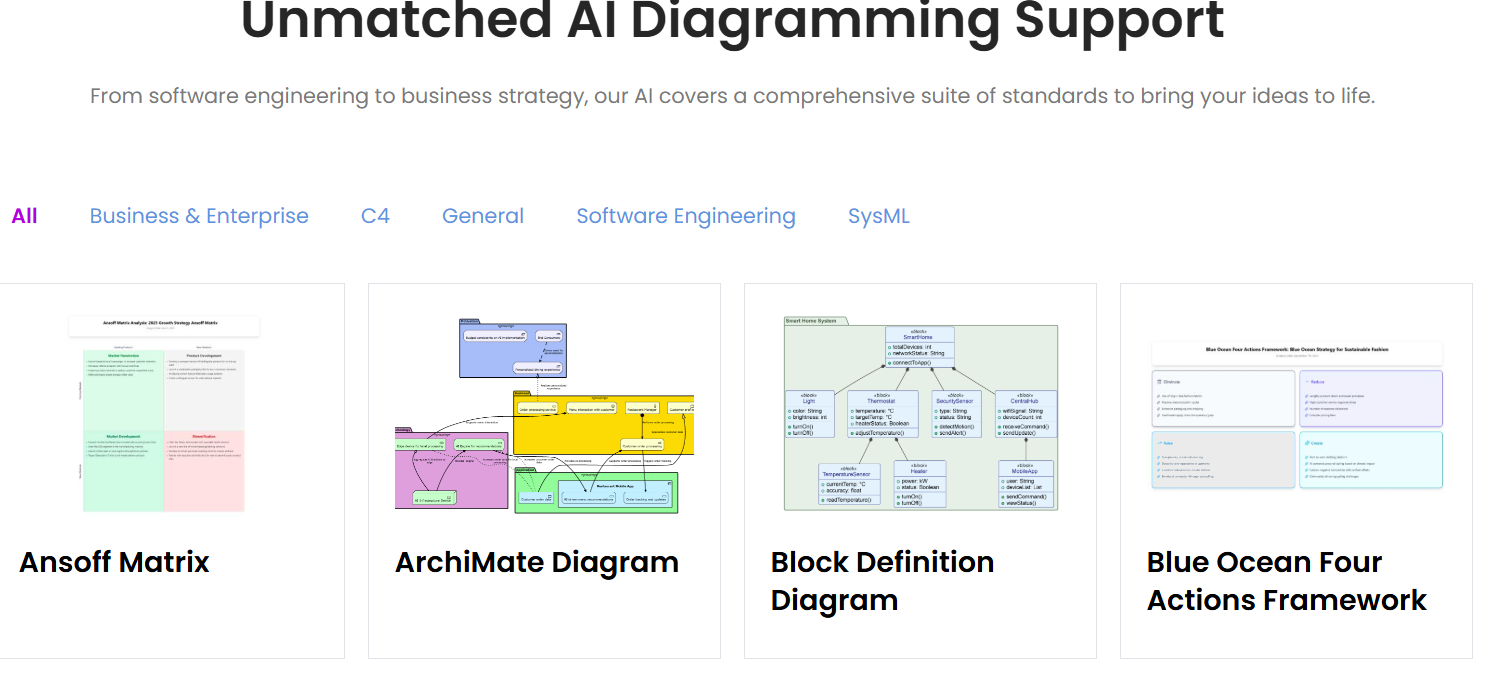
In an era where speed, clarity, and alignment are non-negotiable, professionals across product, engineering, and strategy domains face a shared bottleneck: translating abstract ideas into structured, actionable visual models. Traditional diagramming tools require deep expertise in modeling standards (UML, ArchiMate, SysML, C4, etc.), manual layout effort, and significant time—especially when diagrams evolve with feedback and iteration.
Enter Visual Paradigm’s AI-Powered Visual Modeling Chatbot—a purpose-built, domain-aware AI assistant that turns natural language into precise, standards-compliant diagrams in seconds, and evolves them through conversation. This isn’t just another wrapper over a general-purpose LLM. It’s a vertical AI deeply embedded in the semantics, syntax, and best practices of visual modeling—and it’s transforming how teams design, document, and deliver complex systems.
🚀 Supercharging Productivity: Real-World Impact
Consider a Senior Product Manager at a cloud platform company (like Acme Cloud, for example) scoping a new microservices architecture:
- Before AI:
- Spend 2–4 hours drafting a C4 context diagram in a diagramming tool.
- Manually align components with stakeholders’ mental models.
- Re-draw repeatedly as requirements shift.
- Export to docs, only to find inconsistencies during engineering handoff.
- With Visual Paradigm AI:
- Type: “Create a C4 container diagram for a SaaS analytics platform with frontend, API gateway, auth service, data ingestion service, and PostgreSQL.”
- → Instantly get a clean, layered diagram.
- Refine: “Add Kafka between ingestion and processing. Make auth service use OAuth 2.0.”
- Ask: “What are the security risks in this design?” → Get analysis based on the structure of the diagram.
- Export: “Generate a PRD summary for engineering kickoff.”
✅ Result: High-fidelity alignment in minutes—not days. Documentation stays synchronized with design. Cognitive load shifts from how to draw to what to build.
🔍 Why This Isn’t Just “Another LLM”
While large language models (LLMs) like GPT-4 or Claude excel at prose, code, and open-domain reasoning, they lack structural intelligence—the ability to understand and generate formal models with precise semantics, constraints, and relationships.
Visual Paradigm’s AI goes far beyond text generation:
|
Capability
|
General LLM
|
Visual Paradigm AI
|
|---|---|---|
|
Understands Modeling Standards
|
❌ Treats UML as “ASCII art”
|
✅ Knows ArchiMate layering, C4 abstraction levels, SysML port semantics
|
|
Generates Editable, Valid Diagrams
|
❌ Outputs static images or pseudo-code
|
✅ Outputs native, manipulable model elements (not just shapes)
|
|
Bidirectional Sync: Diagram ⇄ Text
|
❌ One-way (text → image)
|
✅ Edit diagram → update underlying model → regenerate documentation
|
|
Domain-Specific Reasoning
|
❌ Generic advice
|
✅ “This BDD violates SysML best practices: missing flow ports” or “Add a decision node here per BPMN 2.0”
|
|
Context-Aware Suggestions
|
❌ Generic prompts
|
✅ “You have a REST API—would you like to add OpenAPI spec stubs or error use cases?”
|
It’s not replacing LLMs—it’s augmenting them with model-driven intelligence.
🔄 Transforming the Workflow: From Linear to Conversational Design
Traditional modeling is linear:
Idea → Sketch → Tool → Iterate → Document → Present → Revise
Visual Paradigm AI makes it conversational and iterative:
Idea ⇄ AI Diagram ⇄ Refine ⇄ Query ⇄ Document ⇄ Export ⇄ Collaborate
Key shifts:
- No blank-canvas paralysis: Start anywhere—even vague prompts yield scaffolded diagrams.
- Living diagrams: Your model isn’t static—it answers questions, suggests improvements, and explains itself.
- Democratized expertise: Junior PMs can produce enterprise-grade ArchiMate views; architects ensure consistency without policing every box-and-arrow.
🛠️ Real-World Use Cases Where It Shines
|
Role
|
Use Case
|
Time Saved
|
|---|---|---|
|
Product Managers
|
Rapidly prototype system context for stakeholder alignment
|
60–80%
|
|
Solutions Architects
|
Generate compliant SysML or ArchiMate blueprints for RFPs
|
~50%
|
|
Engineering Leads
|
Convert RFCs into C4 diagrams + deployment topology
|
70%+
|
|
Business Analysts
|
Auto-generate BPMN from meeting notes (“When user submits order, validate, charge, notify”)
|
~75%
|
Bonus: Export to Visual Paradigm Desktop unlocks team collaboration, version control, traceability matrices, and integration with Jira, Confluence, and CI/CD pipelines—bridging AI ideation and enterprise-grade delivery.
✅ The Bottom Line: Precision at the Speed of Thought
General AI helps you write about systems.
Visual Paradigm’s AI helps you build and understand them—visually, correctly, and collaboratively.
It’s not just a chatbot. It’s your co-pilot for systems thinking—turning ambiguity into architecture, one intelligent diagram at a time.
➡️ Ready to go from prompt to production-ready model in seconds?
Start Diagramming with AI
Design smarter. Ship faster.
This post is also available in Deutsch, Español, فارسی, Français, English, Bahasa Indonesia, 日本語, Polski, Portuguese, Ру́сский, Việt Nam, 简体中文 and 繁體中文.