
Welcome to From Zero to Unicorn – your beginner-friendly guide to understanding how Airbnb revolutionized the hospitality industry using the Business Model Canvas (BMC). Whether you’re an aspiring entrepreneur, a student, or just curious about startups, this step-by-step tutorial will walk you through the power of the BMC to analyze and build a disruptive business like Airbnb.
🎯 What You’ll Learn
- What the Business Model Canvas is and why it matters
- How Airbnb started from zero and became a $100B+ unicorn
- A step-by-step breakdown of Airbnb’s BMC
- How you can use this framework to build your own startup idea
🔧 Step 1: Understand the Business Model Canvas (BMC)
✅ What is the Business Model Canvas?
The Business Model Canvas is a strategic tool created by Alexander Osterwalder to help entrepreneurs and businesses visualize, design, and innovate their business models. It consists of 9 building blocks that answer the essential questions of any business.
📌 “A canvas is a blank slate. Your idea is the paint.” – Alexander Osterwalder
🧩 Step 2: The 9 Blocks of the Business Model Canvas
Let’s break down each block and apply it to Airbnb’s journey.
1. Customer Segments
Who are your customers?
Airbnb’s Segments:
- Budget travelers (backpackers, students)
- Business travelers seeking local experiences
- Tourists wanting unique stays (e.g., treehouses, tiny homes)
- Hosts (property owners looking to earn extra income)
💡 Key Insight: Airbnb didn’t just target one group — it served both guests and hosts, creating a two-sided marketplace.
2. Value Propositions
What problem do you solve? What value do you offer?
Airbnb’s Value Propositions:
- Affordable, unique, and authentic accommodations
- Stay in local neighborhoods (not just hotels)
- Personalized experiences (e.g., “Airbnb Experiences”)
- Easy booking and secure payments
- Trust and safety via reviews and verified IDs
💡 Why it worked: Instead of competing with hotels, Airbnb offered local, unique, and affordable stays — a new kind of travel experience.
3. Channels
How do you reach your customers?
Airbnb’s Channels:
- Website and mobile app (primary)
- Search engines (SEO/SEM)
- Social media marketing
- Partnerships (e.g., airlines, travel agencies)
- Referral programs (e.g., “Give $40, Get $125”)
💡 Pro Tip: Airbnb grew through organic search and word-of-mouth, not big ad budgets.
4. Customer Relationships
How do you build trust and keep customers?
Airbnb’s Strategies:
- Review and rating system (builds trust)
- 24/7 customer support
- Verified ID and identity verification
- Host and guest messaging system
- Loyalty programs (e.g., Airbnb Plus, Superhost status)
💡 Why it matters: In a peer-to-peer platform, trust is everything. Reviews and verification reduced fraud and boosted confidence.
5. Revenue Streams
How does the business make money?
Airbnb’s Revenue Streams:
- Service fees (charged to guests: ~3% of booking total)
- Host fees (charged to hosts: ~3%)
- Premium listings (e.g., Airbnb Luxe)
- Experiences (booking fees for local tours and activities)
💡 Key Insight: Airbnb earns money without owning property — it’s a platform business.
6. Key Resources
What do you need to run the business?
Airbnb’s Key Resources:
- Technology platform (website & app)
- Brand reputation and trust
- Data and analytics (to match guests with hosts)
- Customer support team
- Legal and compliance team (for global regulations)
💡 No physical assets? No problem. Airbnb’s biggest asset was its digital ecosystem.
7. Key Activities
What must you do to make the business work?
Airbnb’s Key Activities:
- Platform development and maintenance
- Marketing and user acquisition
- Host onboarding and education
- Managing trust and safety
- Building partnerships (e.g., with cities, airlines)
💡 Fun Fact: In 2008, the founders were so broke they sold “Obama O’s” cereal to fund the company — showing how resourcefulness and focus are key.
8. Key Partnerships
Who helps you do what you can’t do alone?
Airbnb’s Partnerships:
- Payment processors (Stripe, PayPal)
- Travel platforms (e.g., Expedia, Booking.com — for exposure)
- Local governments (to navigate regulations)
- Insurance providers (for host protection)
- Tech partners (for cloud hosting, security)
💡 Even unicorns need allies. Airbnb’s partnerships helped scale globally and stay compliant.
9. Cost Structure
What are your major costs?
Airbnb’s Cost Structure:
- Technology (servers, app development)
- Customer support and operations
- Marketing and advertising
- Legal and compliance (especially with global laws)
- Salaries for employees
💡 Surprise? Airbnb has low fixed costs compared to hotels. It doesn’t own property — so no real estate costs.
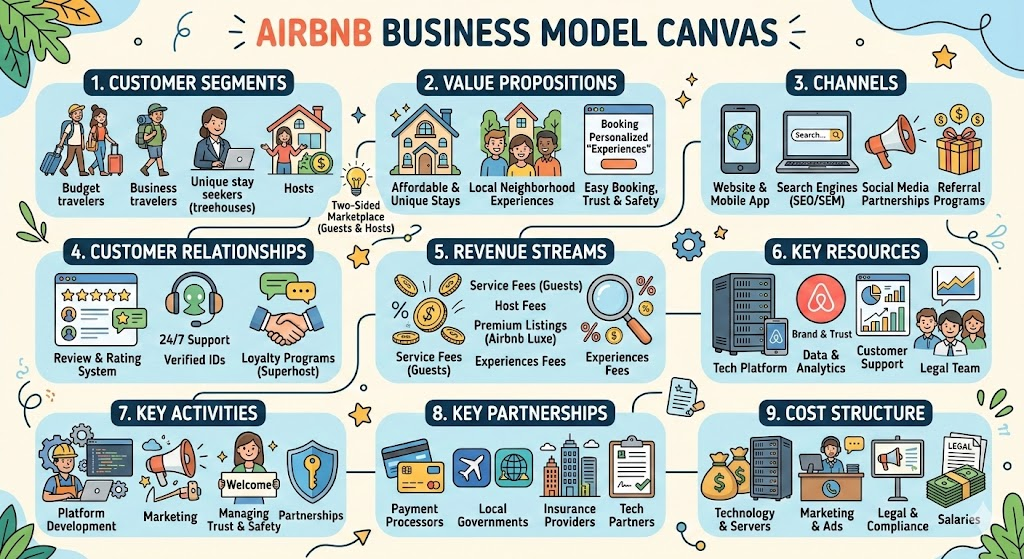
🔄 Step 3: Visualize Airbnb’s BMC (Template)
Here’s a simplified version of Airbnb’s Business Model Canvas:
| Block | Airbnb’s Answer |
|---|---|
| Customer Segments | Budget travelers, business travelers, tourists, hosts |
| Value Propositions | Unique, affordable, local stays; trust via reviews; experiences |
| Channels | Website, app, SEO, referrals, social media |
| Customer Relationships | Reviews, verified IDs, messaging, support |
| Revenue Streams | Guest fees, host fees, premium listings, experiences |
| Key Resources | Platform, brand, data, support team |
| Key Activities | Platform dev, marketing, onboarding, safety |
| Key Partnerships | Stripe, governments, insurers, travel platforms |
| Cost Structure | Tech, support, marketing, legal, salaries |
🖼️ Pro Tip: Draw this on paper or use a free tool like Canva or Miro to create your own visual canvas.
🚀 Step 4: Learn from Airbnb – Apply the BMC to Your Own Idea
Now that you’ve seen how Airbnb used the BMC, let’s apply it to your idea.
✅ Try This: Build Your Own Business Model Canvas
-
Pick a simple idea (e.g., “A local bike rental service for tourists”)
-
Fill in each of the 9 blocks using the Airbnb example as inspiration
-
Ask questions:
- Who are my customers?
- What problem am I solving?
- How will I make money?
- What resources do I need?
💡 Example:
- Customer Segments: Tourists visiting your city
- Value Propositions: Affordable, eco-friendly, easy bike rentals
- Channels: Tourist info centers, Instagram, Google Maps
- Revenue Streams: Hourly/daily rental fees
✅ You’ve just created a mini-business plan in 9 boxes!
🌟 Step 5: Why Airbnb’s Model Was Disruptive
Airbnb didn’t just create a better hotel — it redefined travel by:
- Turning everyday people into hosts
- Creating a peer-to-peer marketplace
- Leveraging technology and trust systems
- Focusing on experiences, not just places to sleep
They disrupted the $200B+ hotel industry by connecting people, not buildings.
🎓 Final Tips for Beginners
-
Start small. You don’t need millions to begin — just a great idea and the BMC.
-
Test your model. Run a pilot (e.g., rent out your couch on Airbnb).
-
Focus on trust. In sharing economies, reputation is currency.
-
Use free tools: Canva, Miro, Google Slides, or even pen and paper.
-
Iterate. The BMC is not set in stone — revise it as you learn.
🏁 Conclusion: From Zero to Unicorn
Airbnb’s journey from a $1,000 idea (selling cereal!) to a $100B+ company proves that a powerful idea + the right business model = disruption.
By using the Business Model Canvas, you can:
-
Understand how startups grow
-
Build your own idea from scratch
-
Think like a founder — even if you’re just starting
🌟 Your Turn: Draw your own BMC today. What’s your idea? What problem will you solve? The next unicorn might start with your sketch.
✨ You don’t need to be rich to build something big. You just need to think like a founder — and the Business Model Canvas is your first step.
Now go build your unicorn. 🦄
Resource
- Complete Guide to the Business Model Canvas (BMC) – Visual Paradigm: This thorough guide explains the nine building blocks of the framework and provides real-world examples for business innovation.
- Business Model Canvas Guide with Examples – Visual Paradigm: A practical resource featuring step-by-step instructions and expert tips for effective business planning.
- What Is the Business Model Canvas? Why Use Visual Paradigms & AI Tools: This article details the core components of the canvas and how AI-powered tools enhance strategic planning.
- AI-Powered Business Model Canvas Builder – Instant Strategy Design: This automated tool leverages machine intelligence to generate canvases and provide strategic insights instantly.
- Comprehensive Tutorial: Visual Paradigm Model Canvas Tool: A step-by-step technical guide for mastering the tool for effective modeling and innovation planning.
- Business Model Canvas Software – Visual Paradigm Online: A cloud-based platform designed for visualizing strategy with real-time collaboration features.
- Business Model Canvas Tool – Visual Paradigm: A structured framework that enables teams to design, analyze, and iterate on business models visually.
- Business Model Canvas Templates – Visual Paradigm Online: A library of professionally designed templates created to accelerate strategy development for startups and enterprises.
- Visual Paradigm Canvas – Collaborative Strategy Tool: A modern web-based platform for creating and sharing canvases and lean startup frameworks in real time.
- Mastering the Business Model Canvas with AI: Step-by-Step Guide: This guide demonstrates how to use AI capabilities to optimize and customize canvases efficiently.