
Business Process Modeling and Notation (BPMN) is the global standard for modeling business processes. It is a fundamental part of business process management (BPM). BPMN diagrams allow stakeholders to visualize business processes, making it easier to streamline workflows.
Originally developed by the Business Process Management Initiative (BPMI), BPMN is a precise, graphical notation for documenting business processes. It resolves the ambiguities of textual process specifications by visually depicting the sequence of business activities and information flows needed to complete a specific process. In recent years, BPMN is increasingly referred to as Business Process Model and Notation.
visual-paradigm.com
The Object Management Group (OMG) has maintained BPMN since 2005. This open consortium helps ensure that business process diagrams can be easily exchanged in a standardized format across different modeling tools. BPMN 2.0 is part of the OMG “triple crown” of process improvement standards, which also includes Case Management Model and Notation (CMMN) and Decision Model and Notation (DMN). The standards differ from the Unified Modeling Language (UML) used in software design. OMG’s BPMN 2.0.1 specification has been published as International Standard ISO/IEC 19510.
What is BPMN?
The Value of BPMN
BPMN provides a common business process modeling language that’s readily understandable by all business stakeholders—the business process analysts who create and refine processes, the technical developers responsible for implementing business processes, and the business users who monitor and manage them.
The BPMN specification helps organizations:
-
Reach faster agreement on current and future processes through unambiguous models.
-
Encourage stakeholder participation through graphically expressive notations.
-
Facilitate the analysis and improvement of operations through business process reengineering.
-
Create a library of process flows, case definitions, and business rules to train new employees.
-
Close communication gaps with a common language between business analysts, developers, and other stakeholders.
-
Inform business process automation efforts.
-
Coordinate business process outsourcing strategies.
In addition, BPMN diagrams help teams create the Extensible Markup Language (XML) documents needed to run various processes, such as contract approvals or reminders for monthly financial reports. A related XML standard is the Business Process Execution Language (BPEL) for web services.
Key Concepts: How BPMN Works
The BPMN language is based on flowcharts and graphical notations. Elements fall into clear categories for diagramming.
Flow Objects These define the process: events, activities, and gateways.
-
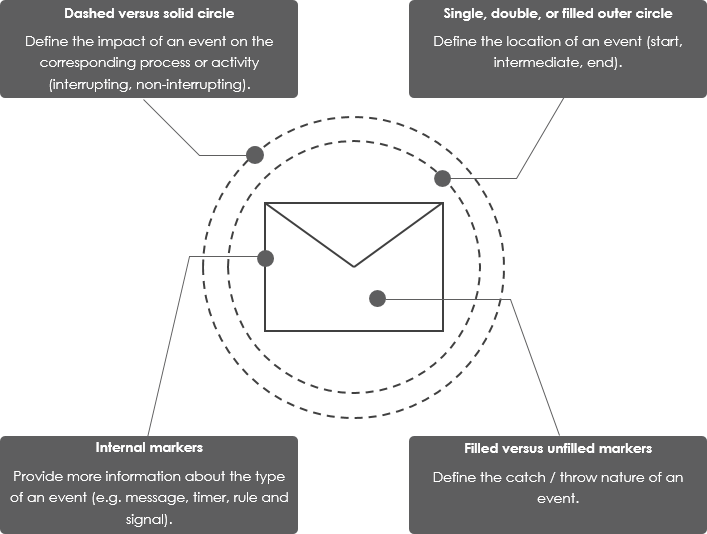
Events: Triggers that start, alter, or conclude a process. Start events initiate a process (single thin circle), intermediate events occur during a process (double thin circle), and end events conclude a process (thick circle). Events can include messages, timers, errors, escalations, and more. BPMN depicts events as circles with specific symbols. Throwing events initiate actions; catching events respond to them. Boundary events attach to activities (solid line for interrupting, dashed for non-interrupting).
visual-paradigm.com
Learning BPMN Events
-
Activities: Actions or tasks performed during the business process. Shown as rounded rectangles. They can be simple tasks or complex subprocesses (expandable into their own diagrams). As processes automate, many activities trigger automatically.
-
Gateways: Decision points (diamonds) requiring choices before progressing.
-
Exclusive (XOR): Diamond with X — only one path taken.
-
Inclusive: Diamond with circle — one or more paths.
-
Parallel: Diamond with + — splits into simultaneous paths.
-
Parallel event-based: Diamond with + in circle.
-
Complex: Diamond with asterisk — for intricate logic.
-
Event-based and exclusive event-based variants handle event-driven decisions.
-
Connecting Objects Shown as lines with arrows to link flow objects.
-
Sequence flows: Solid lines with arrows showing the order of activities (default or conditional).
Visual Paradigm fully supports BPMN 2.0, including pools and lanes for participants (swimlanes), data objects, groups, and annotations for complete, professional diagrams.
Use Cases and Real-World Examples
BPMN excels in scenarios requiring clear visualization and optimization:
-
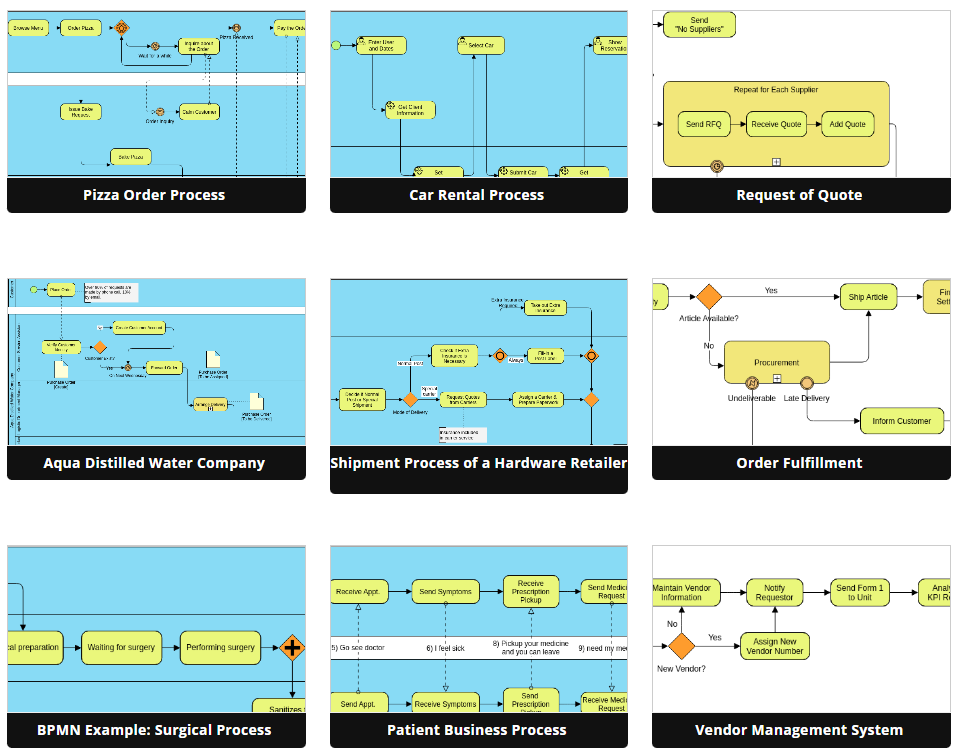
Streamlining order fulfillment (checking availability, procurement, shipping, financial settlement).
-
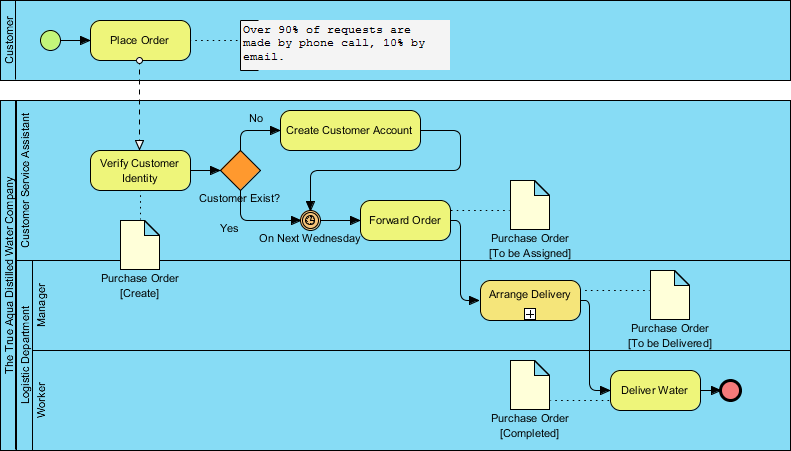
Handling customer service processes (e.g., distilled water delivery with identity verification and scheduling).
-
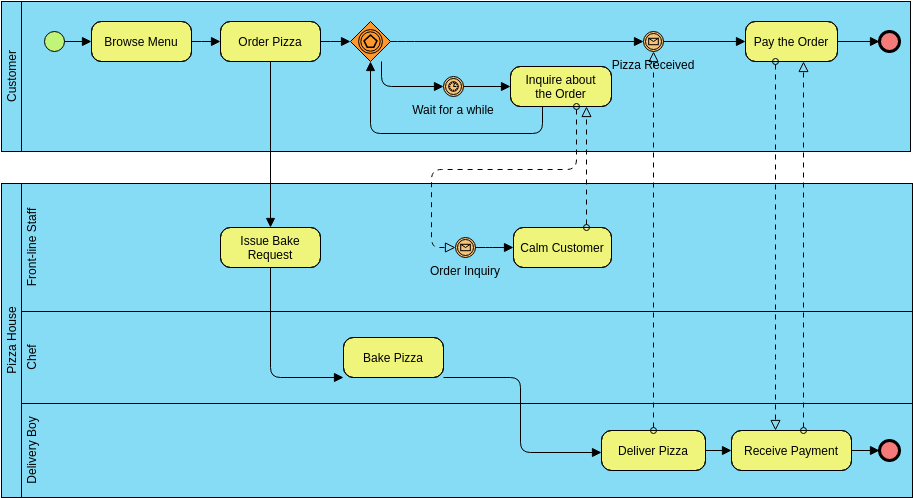
Managing approvals and parallel tasks (e.g., pizza ordering or car rental workflows with decisions and concurrent steps).
-
Training new employees via reusable process libraries.
-
Supporting automation (exporting to BPEL/XML) and outsourcing coordination.
-
Business process reengineering for efficiency gains or competitive advantage.
online.visual-paradigm.com
blog.visual-paradigm.com
Modeling BPMN Diagrams with Visual Paradigm
Visual Paradigm offers an intuitive, award-winning BPMN 2.0 modeler (available in Desktop and VP Online editions) that lets you create professional diagrams quickly. It includes drag-and-drop Resource Catalog, context menus for triggers, and seamless export options.
Step-by-Step: How to Draw a BPMN Diagram in Visual Paradigm (Order Fulfillment Example)
-
Go to Diagram > New > Select Business Process Diagram > Name it (e.g., “Order Fulfillment”) > OK.
-
Place a Start Event from the toolbar; right-click > Trigger > Message > Name it “Order Received.”
-
Drag from the Resource Catalog to add a Task (“Check Availability”).
-
Add a Gateway (“Article Available”); label outgoing flows “Yes” and “No.”
-
Continue with tasks (“Ship Article”), subprocesses (“Procurement,” “Financial Settlement”), intermediate events (Error/Escalation triggers), and End Events.
-
Use sequence flows to connect everything; double-click to label conditional flows.
The editor automatically handles layout, validation, and advanced features like subprocess expansion or data associations.
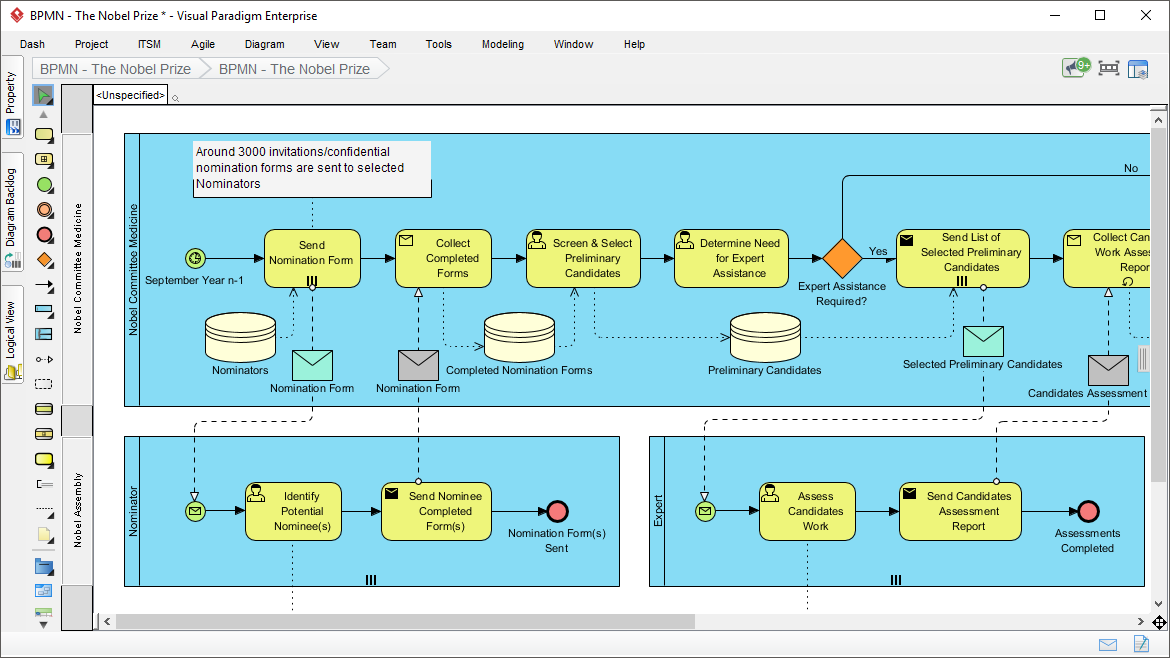
guides.visual-paradigm.com
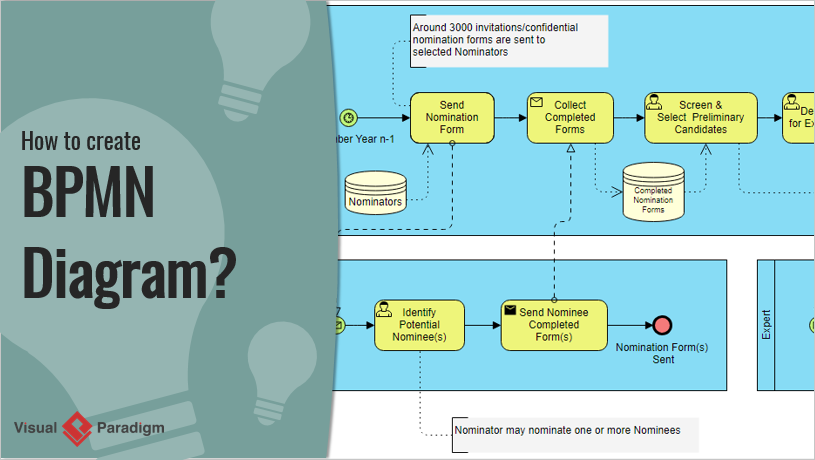
visual-paradigm.com
With Visual Paradigm, you can generate reports, simulate processes, and collaborate in real time—turning BPMN models into actionable improvements. Start with the free trial or online edition to explore these capabilities today.
This guide combines BPMN fundamentals with practical modeling in Visual Paradigm, empowering you to document, analyze, and optimize business processes effectively.