


The UML Component Diagram is essential for architecting modern, distributed software applications. It provides a “physical” view, modeling the system as a collection of modular, replaceable, and deployable components. Crucially, it defines the communication contracts between these components using Provided Interfaces (the services a component offers) and Required Interfaces (the services a component needs).
This case study demonstrates how a solutions architect uses the Visual Paradigm AI Chatbot to define the components and contractual relationships within a secure Online Banking System.
Phase 1: Idea to Foundation – The Initial Prompt
The architect starts by defining the two critical, internally developed service components.
The Initial AI Prompt:
“Generate a UML Component Diagram for an online banking application. I need components for
User AuthenticationandAccount Management. TheAccount Managementcomponent requires the security services provided byUser Authentication.”
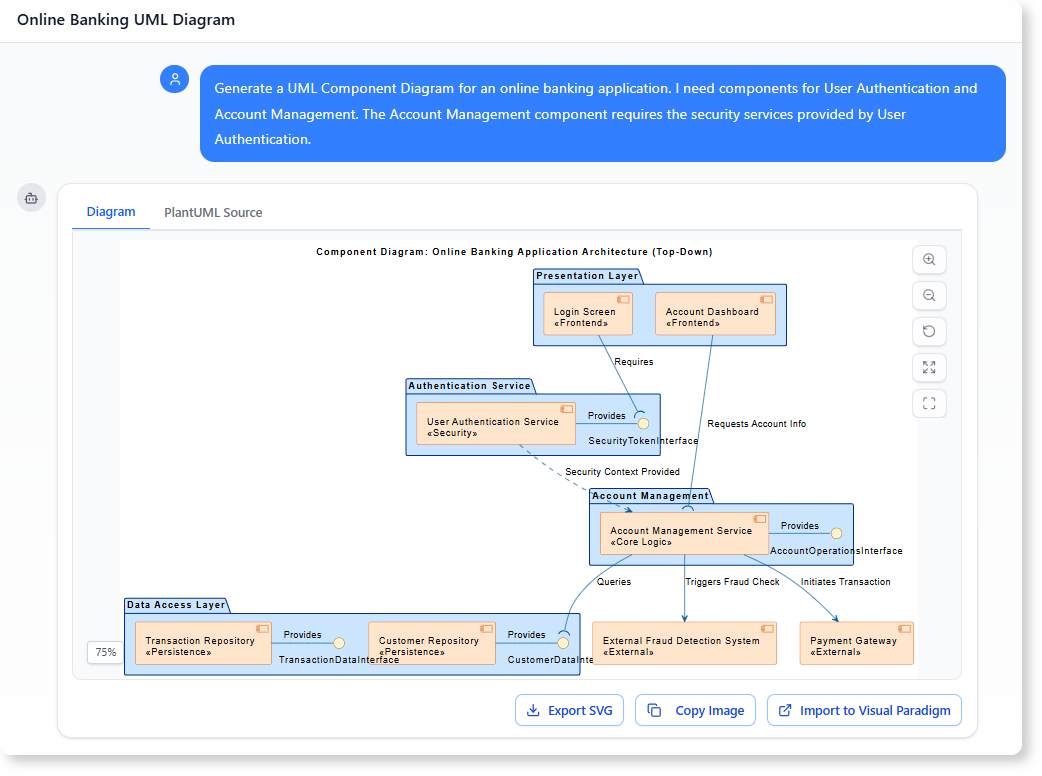
The AI Chatbot responded with a multi-layered, realistic architecture, including Presentation, Authentication Service, and Data Access Layer. It correctly modeled the initial requirement by having the User Authentication Service provide the SecurityTokenInterface and showed the required dependency on the Account Management Service. The AI proactively added several components (like Customer Repository) and external systems, instantly creating a robust design foundation.
Phase 2: Conversational Refinement – Adding External Dependencies and Contract Details
The initial diagram is robust, but the architect needs to formalize contracts with existing external services and enforce naming standards for internal APIs.
The Refinement Prompts:
- Formalizing External Contract: The
Account Management Servicecurrently shows a dependency to thePayment Gateway. We need to define the contractual interface for this critical external system.
“Show the
Account Management Servicerequiring an interface calledIPayProcessfrom thePayment Gatewaycomponent to initiate transactions.”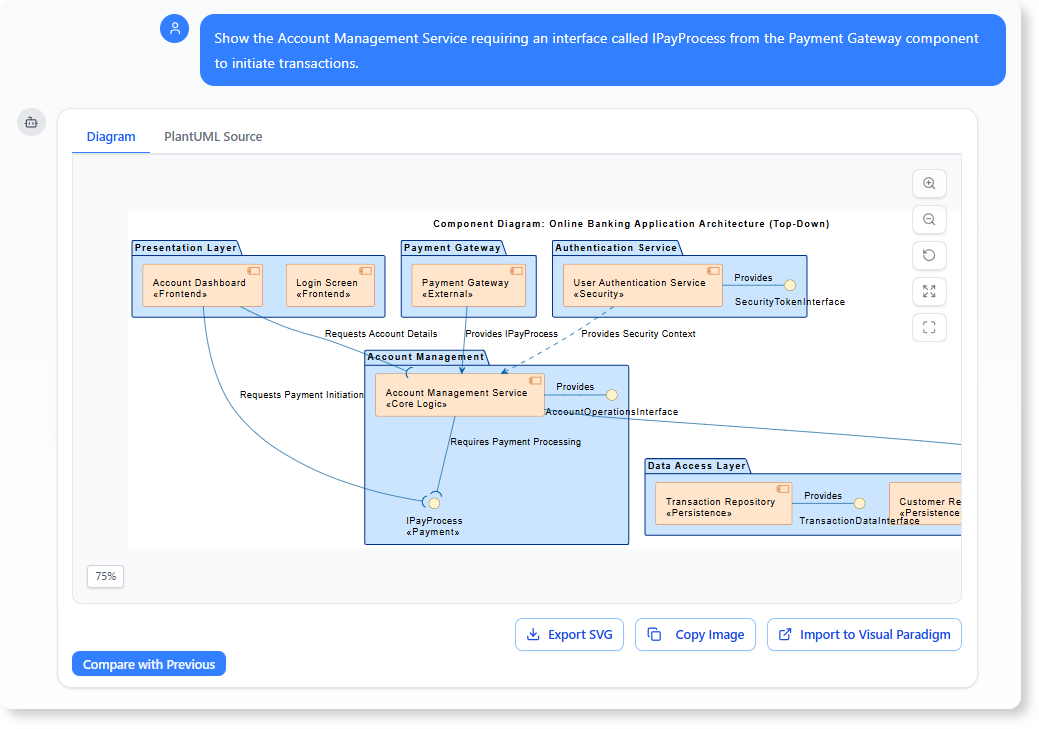
- Renaming and Standardizing an Interface: The current security contract needs to adhere to a specific naming convention.
“Rename the provided interface
SecurityTokenInterfacetoIAuthServiceto standardize the API contract.”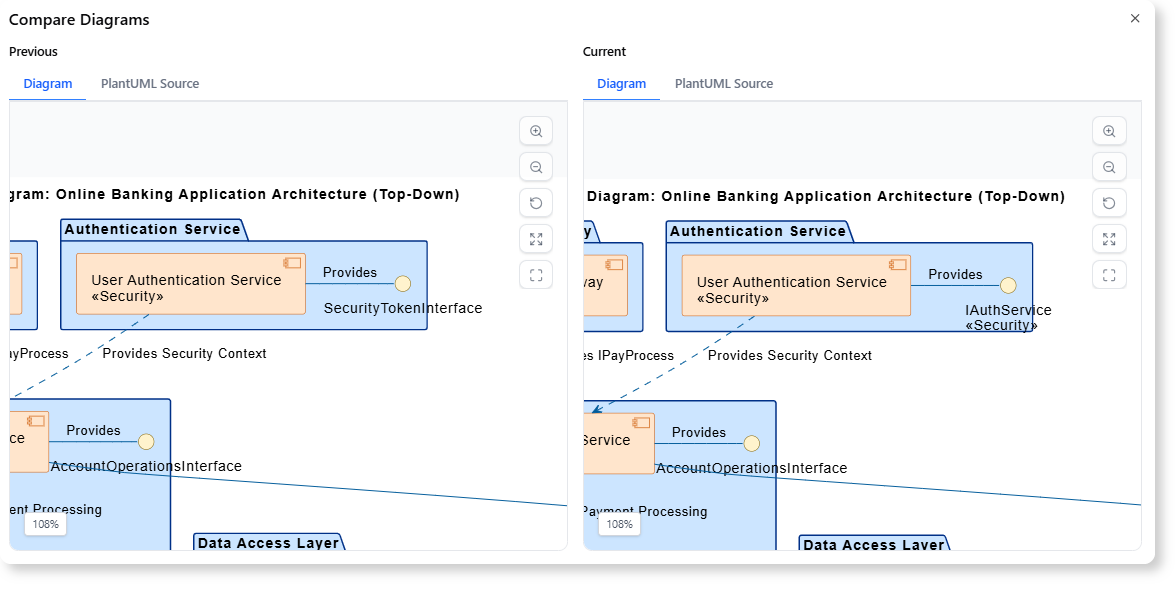
Benefit: This demonstrates the AI’s ability to model the interaction with third-party components (external boundaries) and rapidly enforce architectural standards (interface naming) using simple language. The final model is a precise contract map ready for implementation.
Phase 3: Analysis and Documentation – Leveraging the Finalized Diagram
The finalized Component Diagram is the definitive contract for development teams. The AI is used to translate this visual map into crucial operational and risk documentation.
A. Generating the Service Inventory Document
Deployment teams require a formal list of every component and its exposed services.
The Analysis Prompt:
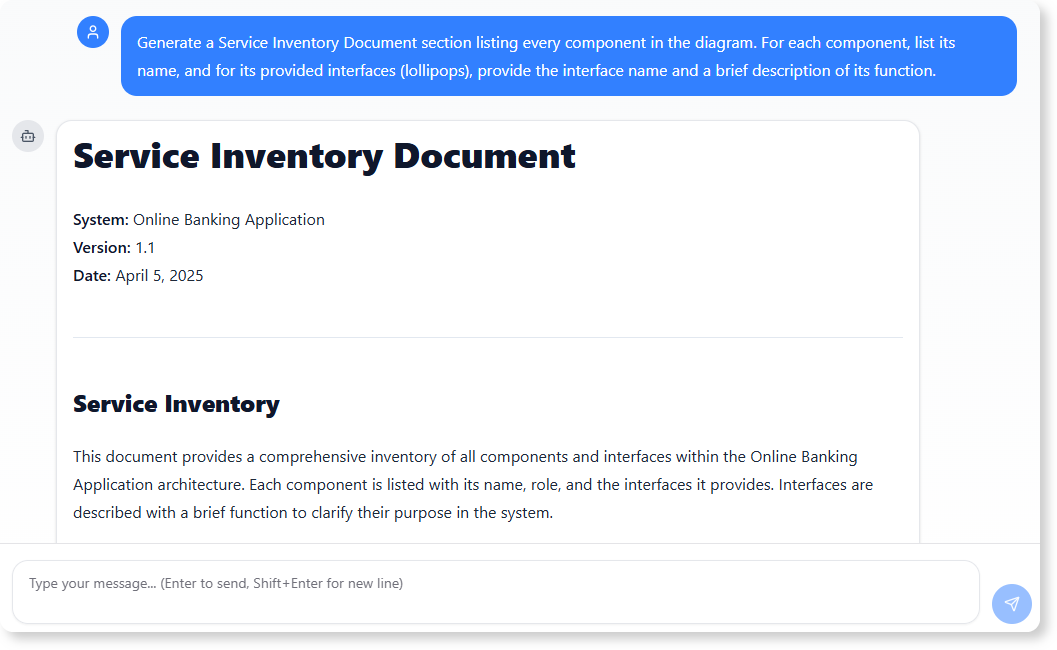
“Generate a Service Inventory Document section listing every component in the diagram. For each component, list its name, and for its provided interfaces (lollipops), provide the interface name and a brief description of its function.”
Benefit: This task converts the visual contracts into a formal, structured document, ensuring clarity for deployment, API management, and service discovery teams.
B. Generating an Interface Impact Analysis Report
Component diagrams are vital for change management. The AI can analyze dependencies to predict the impact of changing a contract.
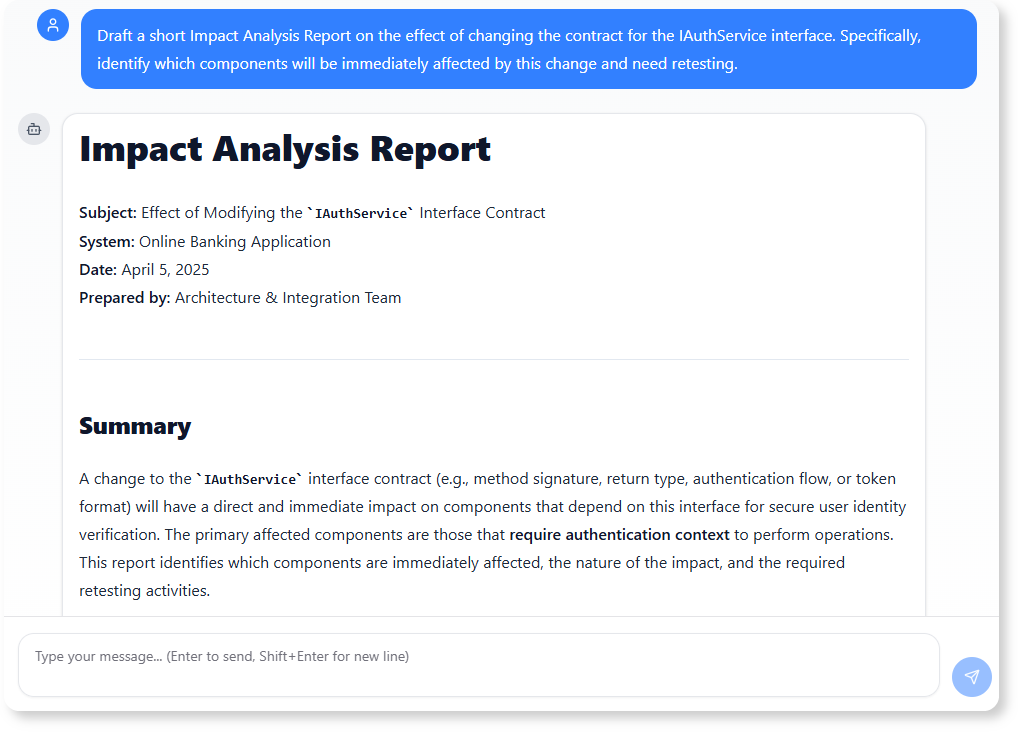
The Analysis Prompt:
“Draft a short Impact Analysis Report on the effect of changing the contract for the
IAuthServiceinterface. Specifically, identify which components will be immediately affected by this change and need retesting.”
Benefit: The AI identifies the Account Management component (and components like the Login Screen) as consumers of the interface and therefore the components requiring immediate attention. This instantly provides the project manager with a risk assessment for any proposed change.
Explore additional resources on UML diagrams and the advanced AI modeling techniques at our UML resource hub.
This post is also available in Deutsch, Español, فارسی, Français, English, Bahasa Indonesia, 日本語, Polski, Portuguese, Ру́сский, Việt Nam, 简体中文 and 繁體中文.