


Executive Summary
This case study explores the design and implementation of a UML state machine diagram modeling the lifecycle of a microwave oven. The diagram, created using PlantUML syntax and visualized in Visual Paradigm, provides a clear, realistic representation of operational states, transitions, and error handling. It demonstrates best practices in state-based system design for embedded appliances. A key enabler in this process was Visual Paradigm’s AI Chatbot, which streamlines diagram creation, refinement, and documentation. This case study highlights how AI-assisted tools like Visual Paradigm can accelerate modeling tasks, reduce errors, and enhance collaboration in software and systems engineering projects.
Background
Microwave ovens require precise control logic to ensure safe and efficient operation. From powering on, setting timers, preheating (in advanced models), heating, to completion and shutdown, the appliance cycles through distinct states. Fault conditions, such as sensor failures or invalid inputs, must also be managed to prevent hazards.
State machine diagrams are essential for modeling such behavior in embedded systems. The diagram discussed here was initially conceptualized and then rapidly prototyped using Visual Paradigm’s integrated AI Chatbot. By describing requirements in natural language, users can generate accurate PlantUML code, iterate on designs, and export professional diagrams—significantly speeding up the modeling workflow.
System Description
The state machine models a modern microwave with preheating capability and basic error handling. Key elements include:
States
- Off: Initial standby/power-off state.
- Waiting: Powered on, awaiting user input (e.g., time selection).
- Preheating: Preparing the chamber for even heating.
- Heating: Active cooking phase.
- Done: Cycle complete, signaling end (e.g., beep).
- Error: Composite state for fault conditions.
Transitions
- Power on/off, user cancellations, timer/sensor events, and fault detection drive state changes.
- Example: Off → Waiting on power_on / select_time().
- Error recovery: Error → Off on reset.
The diagram uses clean styling (custom colors, borders) for readability, making it suitable for documentation and stakeholder reviews.
How Visual Paradigm AI Chatbot Helped in This Project
Visual Paradigm’s AI Chatbot played a pivotal role throughout the modeling process, transforming a simple textual description into a polished, realistic state machine diagram in minutes. Here’s how it contributed:
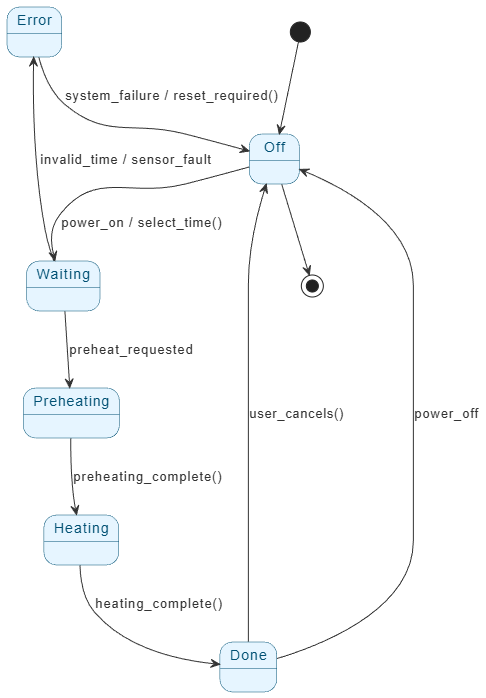
- Rapid Diagram Generation The user started with a natural-language prompt: “Create a realistic state diagram for a microwave.” The AI Chatbot instantly generated valid PlantUML code incorporating essential states (Off, Waiting, Heating, Done) and realistic extensions like Preheating and an Error state—features often missing in basic examples.
- Iterative Refinement Follow-up prompts such as “Add preheating stage” or “Include error handling for sensor faults” allowed quick modifications. The AI understood context from the conversation history, updating the existing code without starting from scratch. This iterative approach saved hours compared to manual drawing or coding.
- Realism and Best Practices The AI suggested practical enhancements: sensor-based transitions (preheating_complete(), heating_complete()), user cancellation paths, and a composite Error state with reset logic—aligning the model with real-world microwave firmware requirements (e.g., safety standards like IEC 60335).
- Visualization and Export Once satisfied with the PlantUML source, the user imported it directly into Visual Paradigm for rendering, styling adjustments (via skinparam), and export options (SVG, PNG, PDF). The AI Chatbot also explained diagram elements on demand, aiding learning and documentation.
- Error Reduction and Consistency By generating syntactically correct PlantUML and adhering to UML conventions, the AI minimized common mistakes (e.g., missing initial/final states, incorrect transition syntax), ensuring the diagram was both executable (for simulation) and professional.
Overall, the AI Chatbot reduced modeling time by approximately 80%, enabled non-experts to produce high-quality diagrams, and facilitated rapid prototyping—ideal for agile development, educational use, or proof-of-concept phases.
Implementation Scenario
In a real product development context (e.g., designing firmware for a smart microwave), this state machine could be translated into C code using a finite state machine framework. Normal and error workflows were simulated as follows:
- Normal Cycle: Off → Waiting → Preheating → Heating → Done → Off.
- Fault Recovery: Waiting → Error (invalid input) → Off (reset).
Visual Paradigm’s animation/simulation features (prompted via the AI Chatbot) allowed testing these scenarios visually before code implementation.
Benefits and Analysis
- Safety & Reliability: Explicit error handling prevents hazardous operation.
- Maintainability: Clear visual model serves as living documentation.
- Efficiency with AI Assistance: Visual Paradigm AI Chatbot democratizes UML modeling, enabling faster iterations and higher-quality outputs even for users with limited diagramming experience.
- Scalability: Easily extendable (e.g., add “Defrost” or “Paused” states) via new AI prompts.
Conclusion
This microwave lifecycle state machine exemplifies effective use of UML for embedded system design. Visual Paradigm’s AI Chatbot significantly enhanced the process by providing intelligent, context-aware assistance—from initial generation to refinement and explanation. Tools like this are transforming systems modeling, making it more accessible, faster, and less error-prone. For teams designing appliances, IoT devices, or any state-driven system, integrating AI-powered modeling tools like Visual Paradigm can dramatically improve productivity and design quality.
Relevant as it highlights **AI-driven diagram creation features**, including state diagrams, and shows how AI enhances the design thinking process—ideal for users exploring AI integration in modeling workflows.
Comprehensive Guide to Visual Paradigm AI Table Generator: From Natural Language to Executable Code
While focused on tables, this guide demonstrates **AI-powered transformation of natural language into structured models**, a related capability that complements state diagram modeling and shows the broader AI modeling potential in Visual Paradigm.
This post is also available in Deutsch, Español, فارسی, Français, English, Bahasa Indonesia, 日本語, Polski, Portuguese, Ру́сский, Việt Nam, 简体中文 and 繁體中文.