
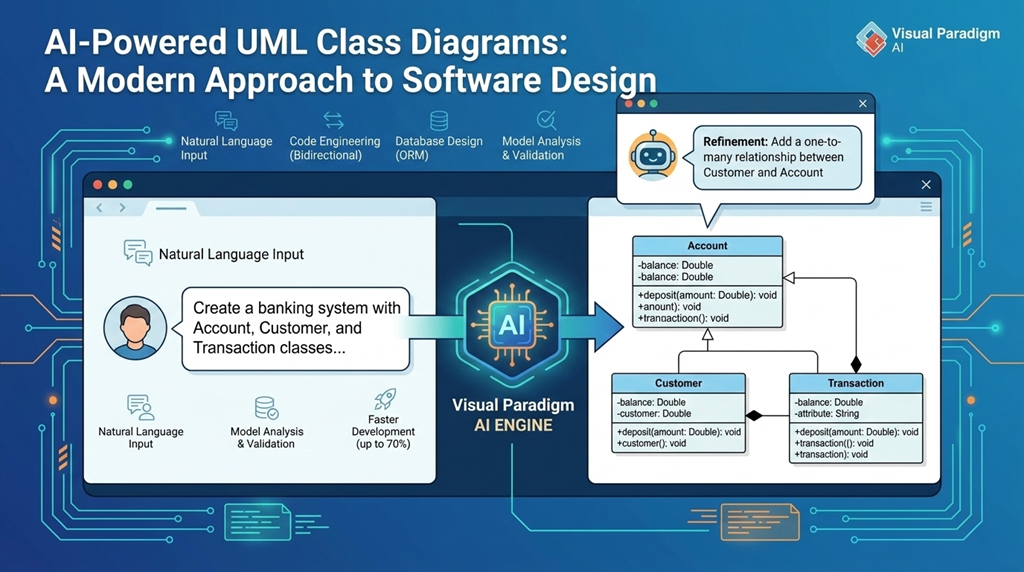
Creating accurate, maintainable software models is essential for successful system development. UML class diagrams, a cornerstone of object-oriented design, provide a clear blueprint of a system’s structure—showing classes, their attributes, methods, and the relationships between them. Traditionally, this process has been time-consuming and required deep knowledge of UML syntax. Today, tools like Visual Paradigm are transforming this workflow with AI-driven capabilities that make modeling faster, smarter, and more accessible.
What Is a UML Class Diagram?
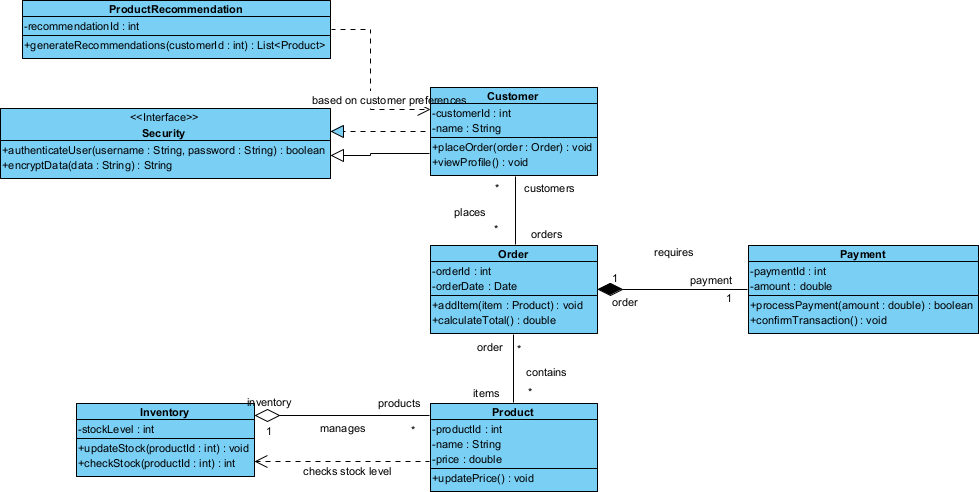
A UML (Unified Modeling Language) class diagram is a static structure diagram that visualizes the structure of a system. It shows the classes, their attributes (data fields), operations (methods), and the relationships among them—such as inheritance, association, and composition. These diagrams are widely used in software engineering to plan and document systems before coding begins.
Class diagrams help teams align on system design, reduce ambiguity, and ensure consistency across development phases. They are especially valuable in large-scale projects where collaboration and clarity are critical.
The Role of Visual Paradigm in Modern Modeling
Visual Paradigm is a leading modeling platform that supports a wide range of UML diagrams, including class, sequence, state, and use case diagrams. It’s used by architects, developers, and analysts to design, document, and manage software systems. Beyond basic diagramming, Visual Paradigm offers powerful features that streamline the development lifecycle.
One of its standout capabilities is code engineering—generating source code (Java, C++, Python, etc.) directly from class diagrams, and reverse-engineering existing code into models. This bidirectional integration ensures that the model and code remain synchronized, reducing errors and rework.
Additionally, Visual Paradigm supports database design through Object-Relational Mapping (ORM). It can map class models to relational databases, enabling developers to generate database schemas from UML models and vice versa. This integration is especially useful in full-stack development, where the same model serves both the application layer and the persistence layer.
How AI Is Transforming UML Modeling
Visual Paradigm’s AI ecosystem redefines how users create and interact with UML diagrams. Instead of manually drawing every class and relationship, users can now describe their system in natural language and let AI generate a structured model.
VP Desktop Text-to-Diagram Generation
With the AI-Assisted UML Class Diagram Generator, users can input a simple description like:
“Create a banking system with Account, Customer, and Transaction classes. Accounts have a balance and owner; Customers have a name and email. Transactions link to accounts and have a date and amount.”
The AI parses the input, identifies entities, attributes, and relationships, and generates a complete class diagram. This drastically reduces the time needed to draft a model from hours to minutes.
AI Chatbot Assistant
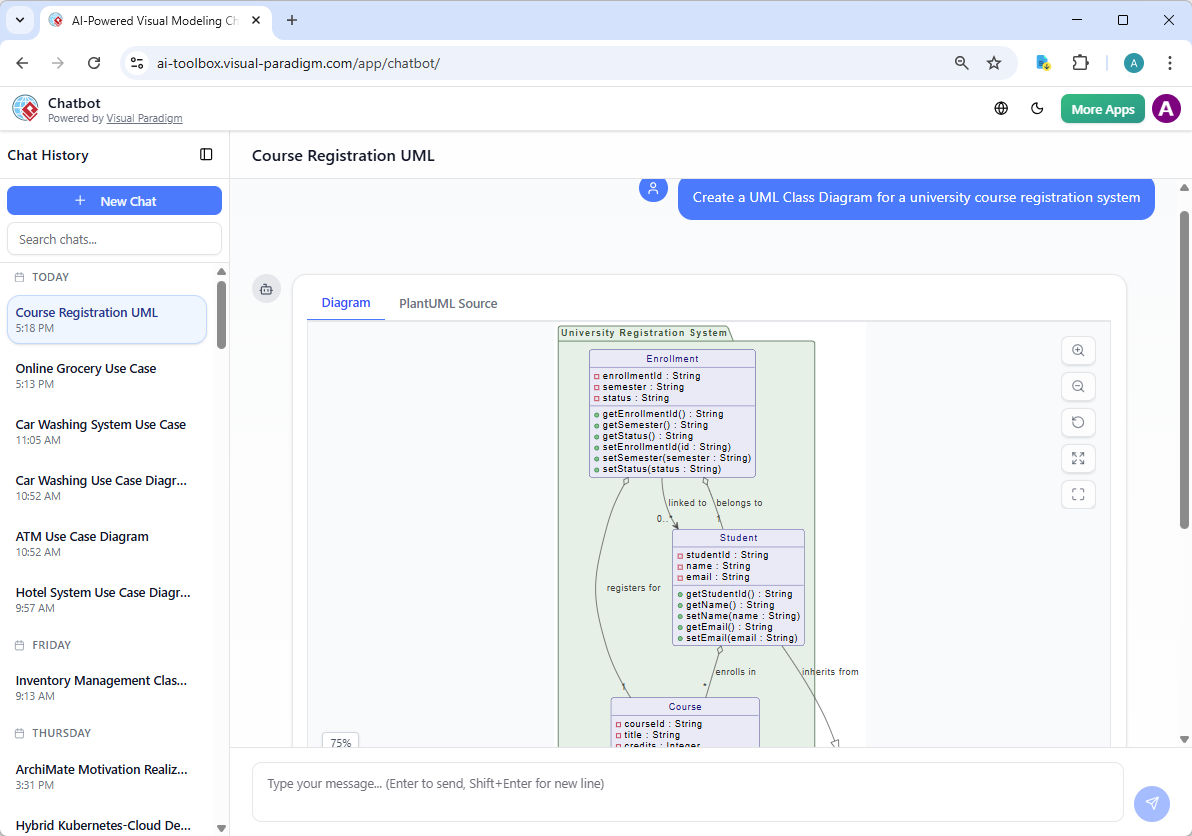
An embedded AI chatbot enables real-time refinement. Users can ask questions like:
- “Add a login method to the User class.”
- “Show an inheritance relationship between Admin and User.”
- “Make the Customer class have a one-to-many relationship with Account.”
The chatbot processes these requests and updates the diagram instantly, allowing for iterative design without switching tools or workflows.
Step-by-Step AI Wizard
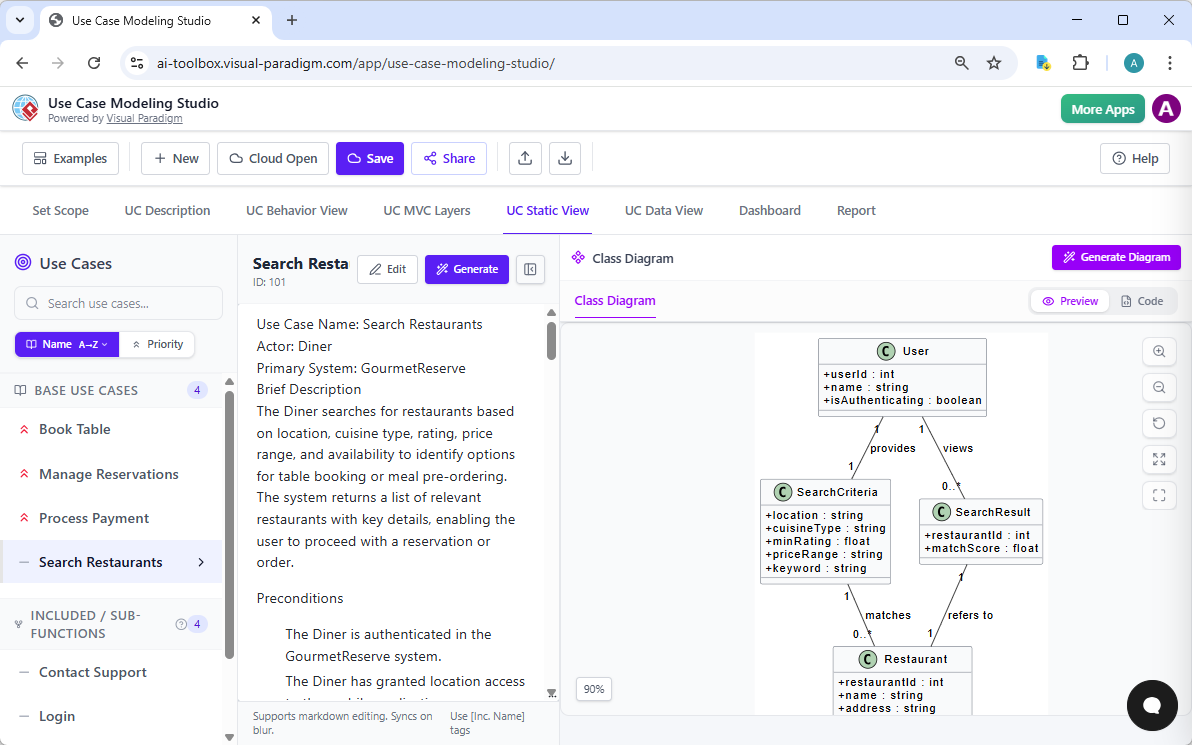
For users new to modeling, Visual Paradigm provides an automated step-by-step wizard. The AI guides users through the modeling process—from defining the system’s purpose to identifying key entities and relationships—offering suggestions based on best practices and domain context.
OpenDocs for Knowledge Management
OpenDocs is an AI-powered knowledge management platform developed by Visual Paradigm that functions as a “Visual Knowledge Engine”. It is designed for teams to centralize, organize, and share technical documentation, wikis, and architectural models within a single collaborative workspace.
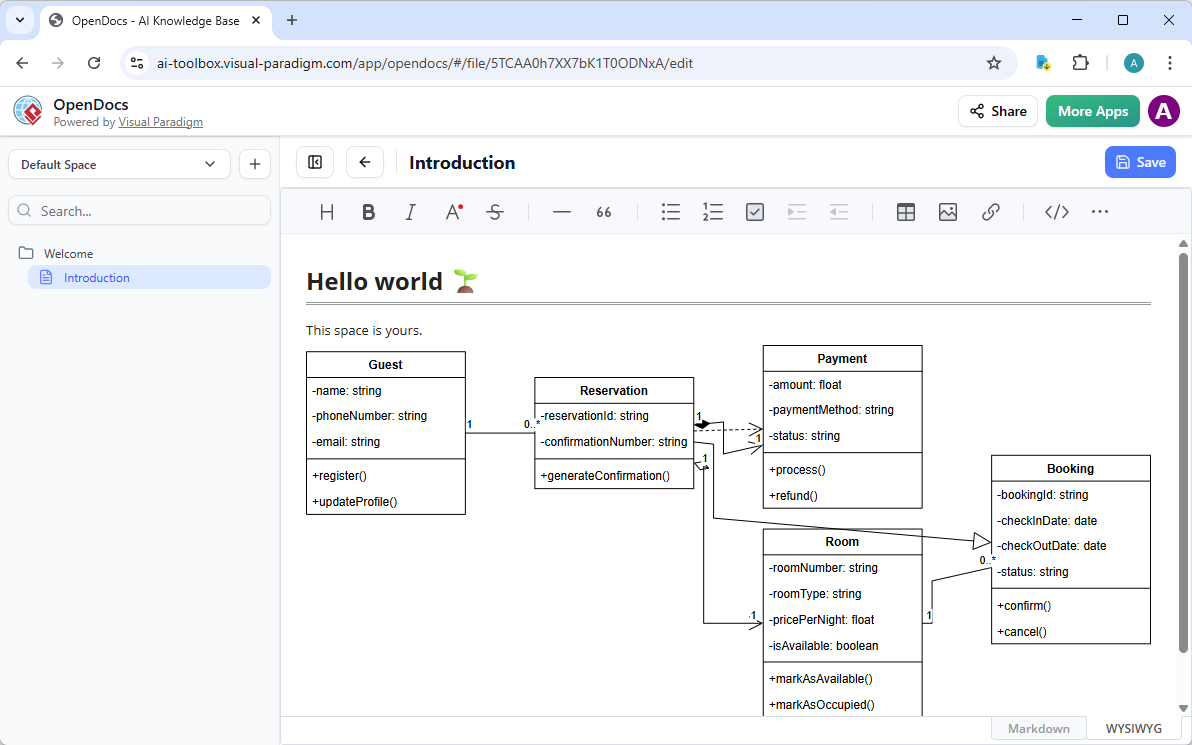
Benefits of AI-Powered UML Modeling
The integration of AI into UML modeling brings several tangible benefits:
- Faster Development: Projects can save up to 70% of modeling time by generating initial drafts from natural language.
- Lower Learning Curve: Even non-experts can create professional-grade class diagrams without needing to memorize UML notation.
- Higher Accuracy: AI-driven validation reduces human errors, especially in complex relationships like composition vs. aggregation.
- Living Models: Unlike static diagrams, Visual Paradigm’s models remain editable and connected to code and databases. Changes propagate across the system, ensuring consistency.
These advantages make AI-powered modeling ideal for agile teams, startups, and enterprises alike—enabling rapid prototyping and iteration.
Use Case Example: Building a Library Management System
Let’s say you want to model a library system. Instead of drawing classes by hand, you could use the AI assistant with this prompt:
“Design a library management system with Book, Member, and Loan classes. Books have a title, author, and ISBN. Members have a name and ID. Loans link a book to a member with a borrow date and return date. A member can have multiple loans, but a book can only be loaned to one member at a time.”
The AI would generate a class diagram with:
- Classes: Book, Member, Loan
- Attributes: title, author, isbn, name, memberID, borrowDate, returnDate
- Relationships: One-to-many between Member and Loan; One-to-one between Loan and Book
- Optional: Add a method to check availability or calculate overdue fees
You can then refine it using the chatbot—adding a “searchBooks” method or adjusting multiplicities.
Conclusion
AI is reshaping how developers and architects design software systems. With tools like Visual Paradigm, creating UML class diagrams is no longer a bottleneck. The shift from manual drawing to conversational modeling allows teams to focus on design logic rather than syntax, accelerating development while improving accuracy.
For those looking to adopt modern modeling practices, AI-powered UML tools offer a practical, efficient path forward—especially in fast-paced, collaborative environments.
Reference List
- AI-Assisted UML Class Diagram Generator – Visual Paradigm: Browser-based wizard that generates editable UML class diagrams from natural language or step-by-step inputs, identifying classes, attributes, operations, relationships, and validations; includes AI suggestions, PlantUML code previews, SVG exports, critique reports, and collaborative project saving—no syntax knowledge required.
- Comprehensive Guide: Creating & Refining Class Diagrams with Visual Paradigm AI – ArchiMetric: Step-by-step walkthrough covering text-to-diagram generation, iterative AI chat refinements (add/remove classes, adjust relationships/multiplicity), guided wizard workflow, quality checks, ecosystem integration (e.g., embedding in docs), and tips for clear prompts and validation.
- What is a Class Diagram? – Visual Paradigm UML Guide: In-depth explanation of UML class diagrams as static structure models, detailing components (classes, attributes, operations), notation (visibility, multiplicity), relationships (inheritance, association, aggregation, composition, dependency), perspectives (conceptual/specification/implementation), and practical examples for software architecture and design.
- Class Diagram vs. Other UML Diagrams: Key Differences and Uses – Visual Paradigm AI: Compares class diagrams (static structure: classes, attributes, relationships for OO design/database mapping) with use case (functional requirements/actors), sequence (dynamic interactions/messages over time), and activity diagrams (workflows/control flows), emphasizing synergies when combined for complete system modeling.
- Step-by-Step Class Diagram Tutorial Using Visual Paradigm: Hands-on tutorial demonstrating creation in Visual Paradigm: starting a new diagram, adding classes/attributes/operations, establishing associations/inheritance, defining multiplicity/roles, layout refinement, and optional documentation generation via Document Composer.
- Mapping UML Class Models to Relational Databases via ORM – Visual Paradigm: Explains Object-Relational Mapping (ORM) features for bidirectional mapping: entities to persistent classes, columns to attributes, relationships to associations (including many-to-many via junction entities), automatic data type/primary key handling, and code generation while preserving business logic and integrity.
- Benefits of Model-Driven Development in Visual Paradigm: Highlights advantages of model-driven approaches, including UML/ERD-based modeling, automatic persistence layer generation, reverse engineering from databases, synchronized model-code updates, and improved development efficiency/quality through executable models.
- Visual Paradigm AI Diagram Generator: Comprehensive Guide – Cybermedian: Broad overview of AI-powered generation across 14+ UML diagrams (including class), ERD, DFD, SysML, and more; covers text-prompt input, chatbot assistance, validation, iterative refinement, and time-saving benefits for standards-compliant modeling in various domains.
- AI-Powered UML Class Diagram Creation in Visual Paradigm – Cybermedian: Technical exploration of AI automation for class diagrams: natural language generation, real-time chatbot refinements, multi-platform access (desktop/online), collaboration via shared links, integration with broader ecosystem (e.g., MVC/DB mapping), and up to 70% reduction in design time.
- Mastering UML State Machine Diagrams with Visual Paradigm AI – Cybermedian: Guide to modeling dynamic system behaviors (states, transitions, events, guards) using AI for instant generation from text, iterative refinements, and accurate representation of lifecycle changes.
- What Makes Visual Paradigm’s AI Chatbot Different from Other AI Diagram Tools? – Visual Paradigm Blog: Breakdown of unique strengths: training on formal modeling standards (UML/SysML/ArchiMate), contextual/iterative editing in a unified workspace, standards-compliant outputs, and superior quality over generic text-to-diagram tools.
- Comprehensive Guide: UML Sequence Diagrams in Visual Paradigm with AI-Powered Generation – ArchiMetric: Detailed walkthrough on AI-assisted creation of sequence diagrams, focusing on message flows, lifelines, interactions, and refinements for capturing dynamic scenarios.
- Use Case Modeling Studio – Visual Paradigm: AI-powered platform for generating use case specifications, diagrams (use case/activity/sequence/class/ERD), test cases, and refinements from high-level goals, bridging requirements to design and testing.
- Comprehensive Guide to Visual Paradigm’s AI-Powered UML & Modeling Ecosystem (2025–2026) – Cybermedian: In-depth overview of AI as a modeling co-pilot: text-to-diagram automation, real-time assistance, code generation, validation across UML standards, and full workflow enhancement from requirements to implementation.