
The Business Model Canvas (BMC), created by Alexander Osterwalder, is a powerful one-page visual framework that helps entrepreneurs, managers, and innovators describe, design, analyze, and pivot their business models. Instead of lengthy business plans, the BMC condenses everything into nine interconnected building blocks arranged on a single canvas. This makes it ideal for quick analysis, spotting misalignments, testing assumptions, and driving strategic decisions.
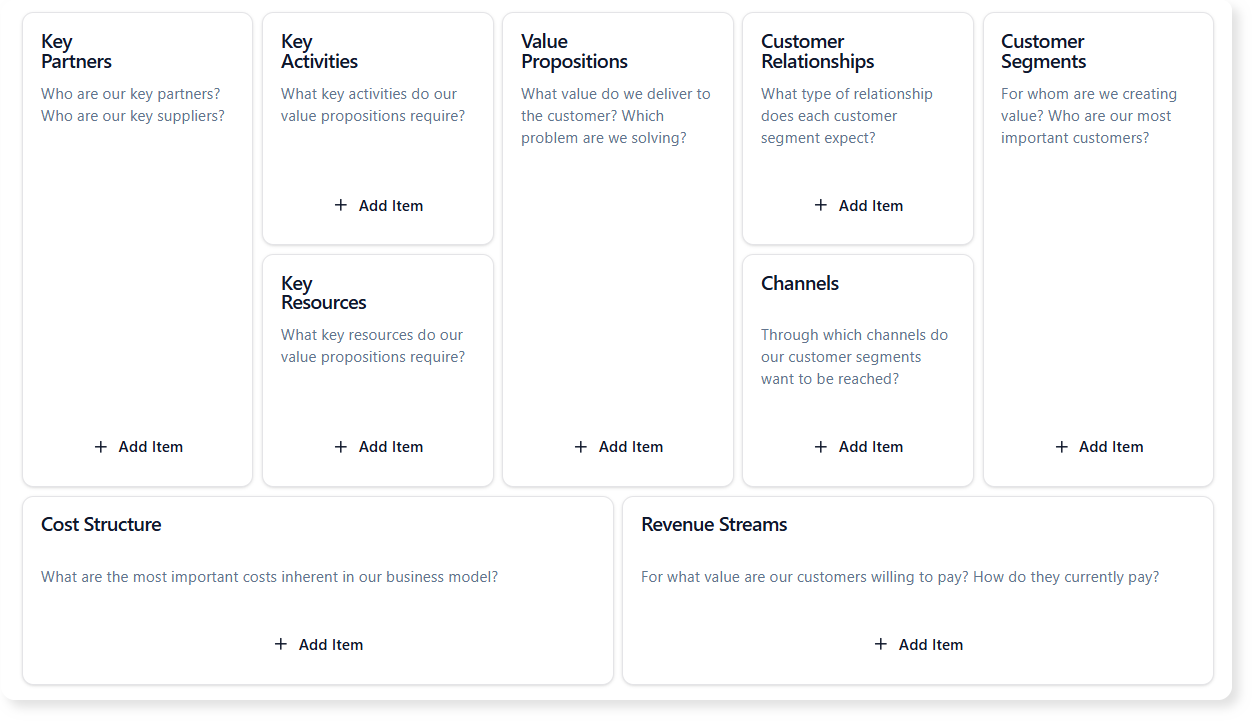
Analyzing with the BMC delivers clarity on how your business creates, delivers, and captures value. It reveals whether your model is desirable (customers want it), feasible (you can deliver it), and viable (it’s profitable). Teams use it for startups, established companies, product launches, competitor benchmarking, or scenario planning. The best part? It’s collaborative, iterative, and works equally well on sticky notes, digital tools like Visual Paradigm’s BMC tools, or even a whiteboard.
The 9 Building Blocks at a Glance
The canvas is divided into four main areas:
-
Right side (customer-focused): Who you serve and how you reach them.
-
Center: The value you deliver.
-
Left side (infrastructure): What you need to operate.
-
Bottom: The financial logic.
Each block includes guiding questions (as shown in the template above) to drive deep analysis.
Preparation Steps Before You Begin Analysis
-
Define scope — Are you analyzing your entire company, a single product line, or a new idea?
-
Gather your team — Include diverse perspectives (sales, operations, finance, marketing).
-
Collect data — Customer interviews, financials, competitor info, market research.
-
Choose your tool — Physical sticky notes (color-code: blue for customer side, green for infrastructure) or free templates in Visual Paradigm
-
Set time — One focused 60–90 minute session for initial mapping, followed by refinement.
Step-by-Step Guide to Filling and Analyzing the Canvas
Follow this proven order (right-to-left flow) to build logical connections as you go. For each block, answer the key questions, add specific evidence (not vague ideas), then immediately analyze for strengths, risks, and gaps.
Step 1: Customer Segments
Who are we creating value for? List distinct groups (e.g., “busy professionals aged 25–40” or “small e-commerce businesses”).
Analysis focus: Are segments too broad or too narrow? Which are most profitable or growing fastest? Prioritize 2–3 primary segments.
Step 2: Value Propositions
What value do we deliver? What pain do we relieve or gain do we create? Be specific (e.g., “convenient same-day delivery + eco-friendly packaging”).
Analysis focus: Does the VP strongly match each segment’s needs? Is it unique compared to competitors? Rate desirability on a 1–10 scale.
Step 3: Channels
Through which channels do customers want to be reached? How are we integrating them (website, app, retail partners, social media)?
Analysis focus: Are channels cost-efficient and aligned with customer habits? Check for bottlenecks or missed touchpoints.
Step 4: Customer Relationships
How do we get, keep, and grow customers? (Self-service, personal assistance, community, automated emails?)
Analysis focus: Are relationships scalable yet personalized enough? Calculate acquisition vs. retention cost.
Step 5: Revenue Streams
For what value are customers really willing to pay? List streams (subscription, one-time fee, freemium, advertising) and pricing tactics.
Analysis focus: Are streams diversified and sustainable? Compare total revenue potential against costs later. Test willingness-to-pay with real customers.
Step 6: Key Resources
What assets do we need (physical, intellectual, human, financial)?
Analysis focus: Which resources are most expensive or critical? Are any owned vs. rented? Identify single points of failure.
Step 7: Key Activities
What must we do to deliver the VP (production, marketing, platform management)?
Analysis focus: Are activities efficient and directly tied to value? Look for automation opportunities.
Step 8: Key Partners
Who are our key suppliers and partners? What activities do they perform?
Analysis focus: Do partnerships reduce risk or cost? Check dependency risks (e.g., single supplier).
Step 9: Cost Structure
What are the most important costs? (Fixed vs. variable; cost-driven vs. value-driven model?)
Analysis focus: Do costs align with revenue? Is the model scalable? Calculate break-even point.
Conducting Holistic Business Model Analysis
Once filled, step back and evaluate the entire canvas:
-
Coherence check: Does everything connect? (Value Propositions → Channels → Revenue; Resources/Activities → Costs.)
-
Viability test: Will revenue exceed costs long-term?
-
Desirability & feasibility: Validate with customer interviews and operational audits.
-
SWOT integration: Turn the canvas into a SWOT (Strengths = strong VPs/partnerships; Weaknesses = high costs or weak channels).
-
Risk & assumption mapping: List hypotheses (e.g., “Customers will pay $9.99/month”) and plan experiments.
-
Innovation scan: Where can you pivot? Try “what if” versions (e.g., add a new segment or remove a costly activity).
Iterate! The BMC is a living document—update it quarterly or after major changes.
Best Practices, Tools & Common Pitfalls
-
Be specific and evidence-based — Avoid “good customer service”; say “24/7 chat support with <2 min response.”
-
Use visuals — Color-code, add icons, or sketch prototypes.
-
Collaborate — Run workshops; different departments spot blind spots.
-
Common pitfalls: Filling left side first (infrastructure bias), staying too high-level, or ignoring external validation.
Happy analyzing! 🚀
-
Complete Guide to the Business Model Canvas (BMC) – Visual Paradigm: This thorough guide explains the nine building blocks of the framework and provides real-world examples for business innovation.
-
Business Model Canvas Guide with Examples – Visual Paradigm: A practical resource featuring step-by-step instructions and expert tips for effective business planning.
-
What Is the Business Model Canvas? Why Use Visual Paradigms & AI Tools: This article details the core components of the canvas and how AI-powered tools enhance strategic planning.
-
AI-Powered Business Model Canvas Builder – Instant Strategy Design: This automated tool leverages machine intelligence to generate canvases and provide strategic insights instantly.
-
Comprehensive Tutorial: Visual Paradigm Model Canvas Tool: A step-by-step technical guide for mastering the tool for effective modeling and innovation planning.
-
Business Model Canvas Software – Visual Paradigm Online: A cloud-based platform designed for visualizing strategy with real-time collaboration features.
-
Business Model Canvas Tool – Visual Paradigm: A structured framework that enables teams to design, analyze, and iterate on business models visually.
-
Business Model Canvas Templates – Visual Paradigm Online: A library of professionally designed templates created to accelerate strategy development for startups and enterprises.
-
Visual Paradigm Canvas – Collaborative Strategy Tool: A modern web-based platform for creating and sharing canvases and lean startup frameworks in real time.
-
Mastering the Business Model Canvas with AI: Step-by-Step Guide: This guide demonstrates how to use AI capabilities to optimize and customize canvases efficiently.