


In the rapidly evolving landscape of software engineering, the tools used for architectural modeling are undergoing a significant transformation. Visual Paradigm AI stands at the forefront of this shift, addressing the critical limitations found in generic Large Language Models (LLMs). While generic models typically generate static images or raw text that lack architectural rigor, Visual Paradigm AI leverages specialized “text-to-code” technology. This approach transforms architecture modeling from a static task into the creation of a dynamic, maintainable, and version-controllable asset.
From Static Images to “Living Code”
The traditional output of AI-generated diagrams often results in flat images that are difficult to edit or iterate upon. Visual Paradigm AI fundamentally changes this by treating architectural diagrams as code.
Version Control and Portability
At the core of this system is the utilization of PlantUML for reliable, code-based diagram rendering. This ensures that every architectural view is text-based, offering high technical portability. Key benefits include:
- Git Integration: Because the diagrams are fundamentally text, they are version-controllable via Git. This allows teams to track changes, manage branches, and handle architectural evolution just like source code.
- CI/CD Compatibility: Users can export PlantUML code or JSON files to be integrated directly into version control systems and Continuous Integration/Continuous Deployment (CI/CD) pipelines.
The Era of Living Documentation
This technology facilitates the creation of “Living Documentation“—documentation that remains in sync with the actual codebase. In traditional workflows, diagrams often become obsolete the moment they are drawn. However, because Visual Paradigm AI handles the complex syntax of diagramming languages, developers can update a model in seconds following a refactor. By simply providing a new text description, the visual representation is updated instantly, ensuring accuracy and relevance.
The AI Chatbot as an “Active Thinking Partner”
Visual Paradigm AI replaces the tedious manual drag-and-drop actions of legacy modeling tools with a dynamic dialogue managed by an AI Diagramming Chatbot. This chatbot functions not merely as a tool, but as an active thinking partner in the design process.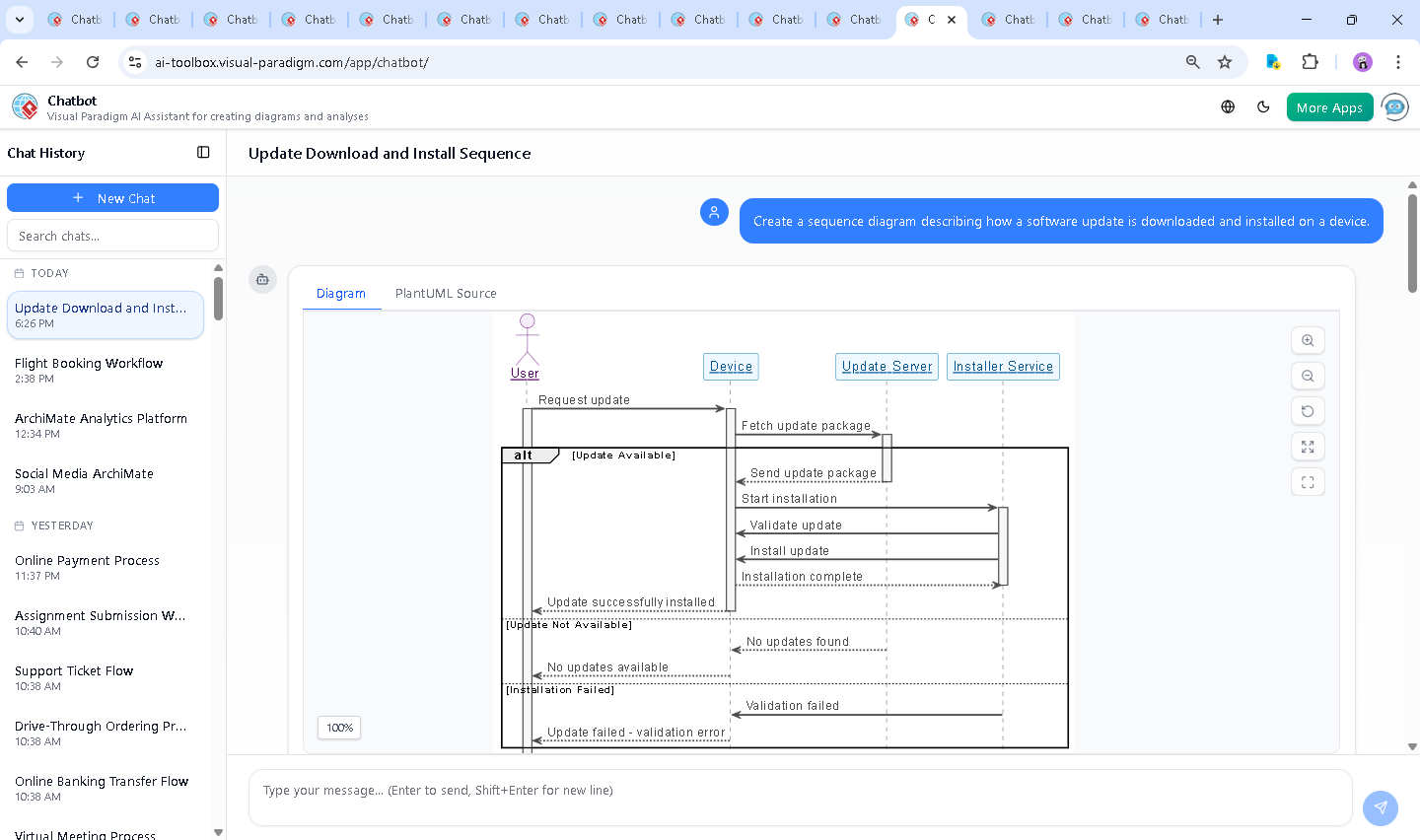
Conversational Refinement
Users can evolve their system designs through natural language commands. Instead of manually searching for icons and drawing lines, architects can issue commands such as “add a payment gateway” or “rename the database to PostgreSQL Cluster.” The system instantly translates these requests into visual updates and the underlying code, streamlining the iterative design process.
Automated Logical Management
A critical advantage of this specialized AI is its ability to automatically maintain logical consistency. Connectivity and relationships are managed intelligently by the system. When elements are removed or restructured, the AI ensures the architectural flow remains intact. For example, if a service is replaced, the AI will re-establish necessary links, ensuring that new components connect appropriately to databases or booking services without manual intervention.
Intelligent Analysis and Standards
Beyond simple editing, the chatbot offers interactive analysis capabilities. Architects can leverage the AI to audit their designs by asking questions like, “What components are missing?” Furthermore, the system can provide design improvement suggestions based on official C4 standards, ensuring that the resulting architecture meets professional industry benchmarks.
Bridge to Professional Modeling
While generic LLMs often produce “one-off” mockups that serve only as temporary visualizations, Visual Paradigm provides a unified modeling environment designed for long-term project lifecycles.
Unified Modeling Environment
Once a design is refined through conversation, it can be imported directly into Visual Paradigm Desktop or Online. This transition is seamless and critical for professional workflows. It allows architects to:
- Maintain absolute manual control over the design for complex, long-term projects.
- Fine-tune visual layouts and add custom attributes specific to the enterprise context.
- Link the generated C4 model to other established modeling standards such as UML (Unified Modeling Language), SysML (Systems Modeling Language), or ArchiMate.
By bridging the gap between rapid AI drafting and professional-grade modeling tools, Visual Paradigm AI ensures that architectural artifacts are not just generated, but are actionable, maintainable, and integrated into the broader engineering ecosystem.
This post is also available in Deutsch, Español, فارسی, Français, English, Bahasa Indonesia, 日本語, Polski, Portuguese, Ру́сский, Việt Nam, 简体中文 and 繁體中文.