


The UML Package Diagram is a high-level view of a large software system. It helps architects and development managers organize the codebase into logical, cohesive units (packages) and define the dependencies between those units. For complex systems like E-commerce, clearly defined packages prevent “spaghetti code” and ensure modular development.
This case study demonstrates how a lead architect uses the Visual Paradigm AI Chatbot to define and manage the architectural layers and dependencies of a modern E-commerce platform.
Phase 1: Idea to Foundation – The Initial Prompt
The architect starts with a very broad goal to get the initial structure.
The Initial AI Prompt:
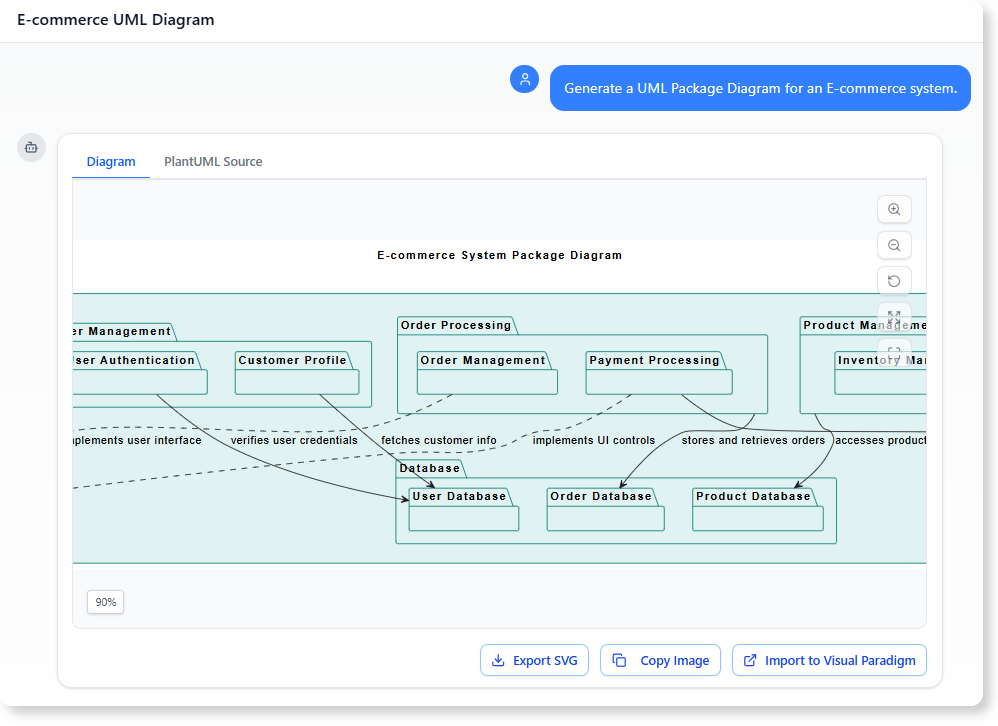
“Generate a UML Package Diagram for an E-commerce system.”
The AI Chatbot responds by creating a detailed, multi-layered architecture instantly. This model includes five major component groups (e.g., Product Management, Order Processing, User Management), ten nested sub-packages, and proactively introduced advanced UML concepts like Generalization and Realization for managing UI components. This rich output accelerates the design process by immediately providing a strong, compliant foundation.
Phase 2: Conversational Refinement – Adding Architectural Detail
The initial structure is robust but needs crucial external integration and enforcement of security constraints. The architect uses simple natural language commands to integrate a new cross-cutting concern and tighten security around sensitive data.
The Refinement Prompts:
- Adding a New Dependency Layer (External Integration): The architect needs to integrate external reporting services into the database layer.
“Add a new package called
Reportingoutside of the mainE-commerce Systempackage. This new package must depend on theOrder Databaseand theProduct Databasepackages.”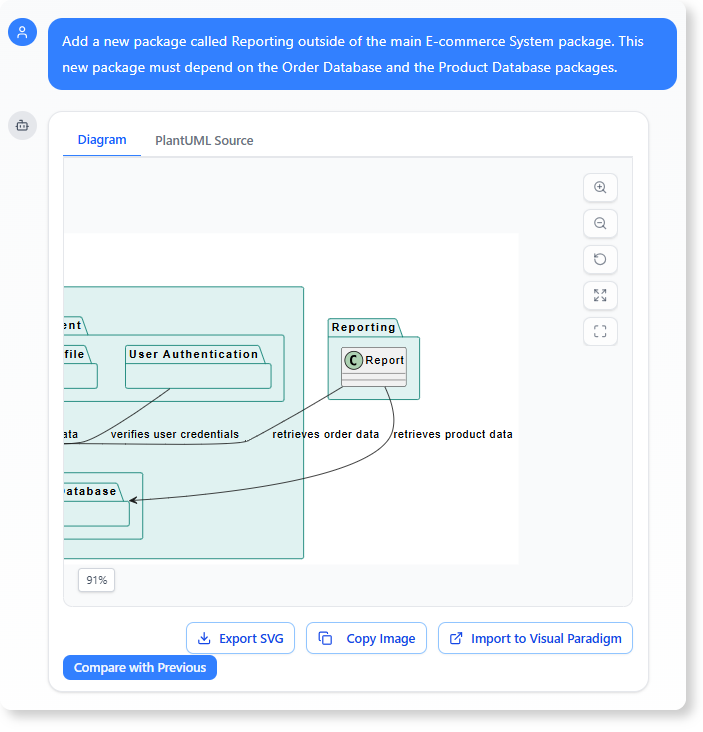
- Enforcing Security Constraints (Cross-Cutting Concern): To standardize credential handling and encryption across the system, a dedicated security package must be injected.
“Introduce a new package called
Security Servicethat both theUser AuthenticationandPayment Processingpackages must explicitly depend on.”
Benefit: This demonstrates the AI’s ability to quickly model architectural adjustments and define formal constraints using simple language, allowing architects to validate high-level design decisions instantly without needing to manually draw complex, non-trivial dependencies.
Phase 3: Analysis and Documentation – Leveraging the Finalized Diagram
The finalized Package Diagram is a map for team structure and risk assessment. The AI is used to directly convert the architectural map into management documentation.
A. Generating the Team Assignment Structure
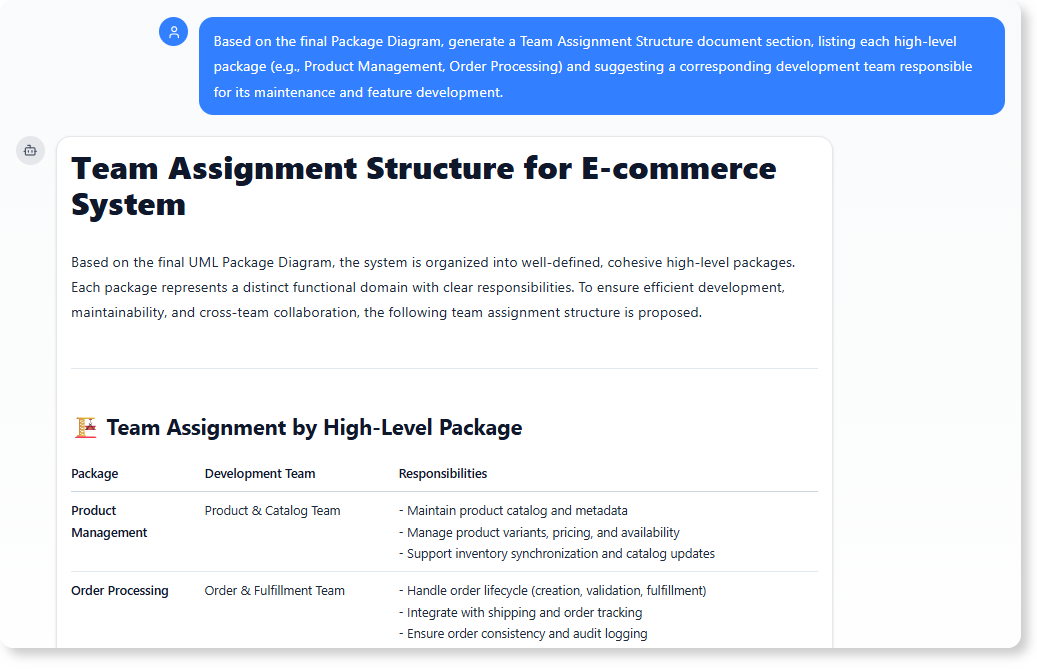
The defined logical packages translate directly into modular ownership within the development team.
The Analysis Prompt:
“Based on the final Package Diagram, generate a Team Assignment Structure document section, listing each high-level package (e.g.,
Product Management,Order Processing) and suggesting a corresponding development team responsible for its maintenance and feature development.”
Benefit: This task converts the technical design into an organizational structure, ensuring that ownership of the codebase aligns with its modular separation.
B. Identifying Critical Coupling Points
Dependencies introduce coupling, which is a source of risk. The AI can analyze the diagram to identify areas of high integration complexity.
The Analysis Prompt:
“Analyze the diagram and identify the critical coupling package in the
Order Processinggroup (e.g.,Order ManagementorPayment Processing). Explain why this package requires the most rigorous integration testing due to its incoming and outgoing dependencies.”
Benefit: The AI correctly analyzes the central components (high fan-in/fan-out) and generates the corresponding risk analysis documentation, prioritizing where QA and integration efforts should be focused.

To gain more clarity on UML and how AI can present it visually, explore our UML resource hub.
This post is also available in Deutsch, Español, فارسی, Français, English, Bahasa Indonesia, 日本語, Polski, Portuguese, Ру́сский, Việt Nam, 简体中文 and 繁體中文.