


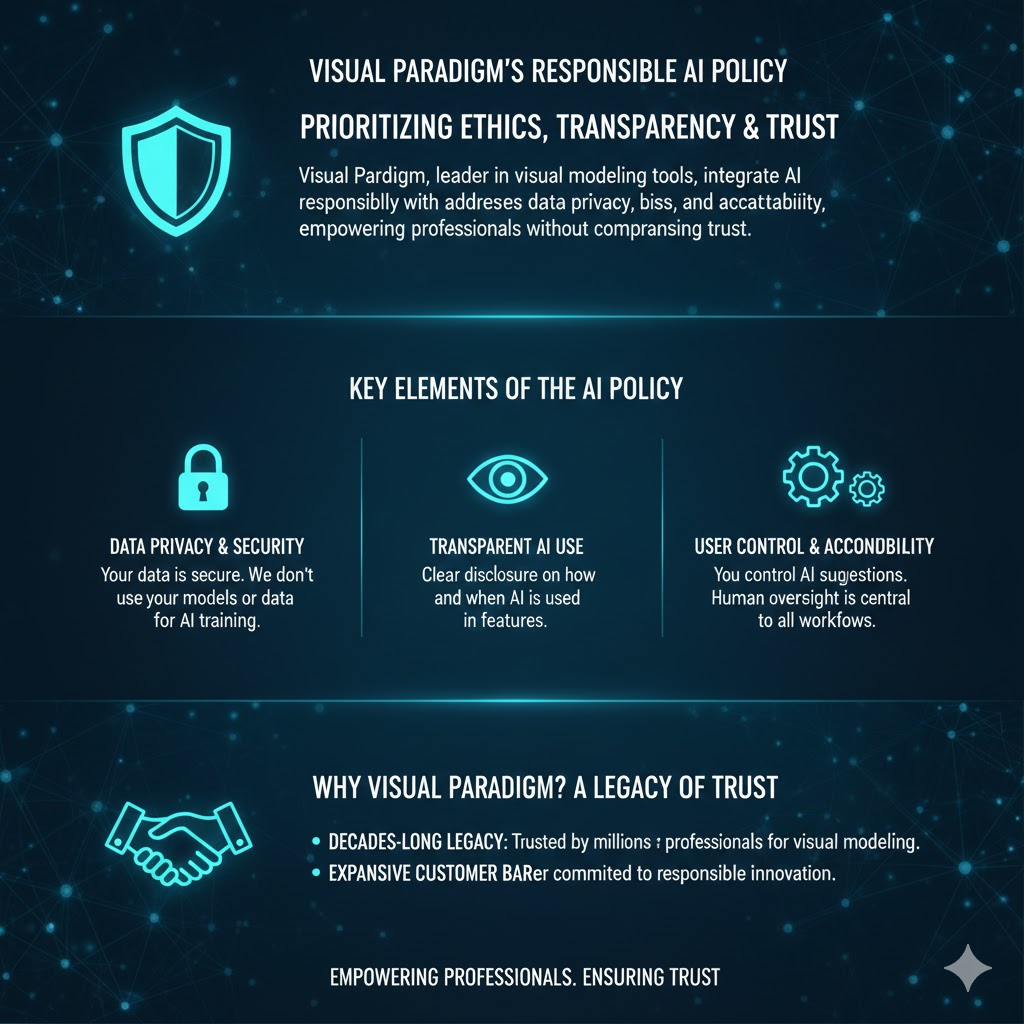
In an age where artificial intelligence is revolutionizing everything from creative brainstorming to complex system modeling, concerns about data privacy, bias, and accountability loom large. Enter Visual Paradigm, a trailblazer in visual modeling and diagramming tools that’s not just riding the AI wave—it’s steering it responsibly. With a robust AI Policy that prioritizes ethics, transparency, and user control, Visual Paradigm isn’t merely a vendor; it’s a partner committed to empowering professionals without compromising trust. This article dives deep into the company’s AI Policy, unpacking its key elements with real-world examples, and explores why Visual Paradigm’s decades-long legacy and expansive customer base make it a trustworthy choice for AI-powered tools.
A Legacy of Excellence: Visual Paradigm’s History
Founded in 2001 by Curtis Tsang in Hong Kong, Visual Paradigm International Ltd. emerged from a simple yet profound vision: to make visual modeling accessible, efficient, and collaborative for software developers, business analysts, and enterprise architects. Tsang, a software engineering expert, recognized the gaps in existing tools—high costs, steep learning curves, and limited integration with agile workflows. What started as a niche UML (Unified Modeling Language) tool has evolved into a comprehensive suite supporting BPMN (Business Process Model and Notation), ERD (Entity-Relationship Diagrams), SysML, and more, all while embracing open standards to foster innovation.
By 2004-2005, Visual Paradigm was already turning heads, clinching five major IT industry awards, including the Asia Pacific ICT Awards for Applications and Infrastructure Tools. Its breakthrough came in 2011 with the prestigious Dr. Dobb’s Jolt Award in the Design, Architecture, and Planning Tools category, cementing its reputation for delivering “faster, better, and cheaper” solutions. Over the years, the company expanded globally, establishing offices across Asia, Europe, and North America, and growing its user base to over 320,000 professionals worldwide.
This evolution mirrors the broader shift in software development—from rigid, waterfall methodologies to agile, iterative processes. Visual Paradigm adapted by integrating AI early on, but always with a human-centered ethos. Today, headquartered in Hong Kong, it remains unfunded and independently owned, allowing it to prioritize long-term user value over short-term investor pressures. This bootstrapped approach has fostered resilience, enabling innovations like AI-driven diagram generation without the ethical shortcuts seen in some venture-backed rivals.
A Global Powerhouse: Customer Base and Real-World Impact
Visual Paradigm’s trustworthiness isn’t abstract—it’s proven in its diverse, blue-chip clientele. Trusted by over 320,000 users, it spans small startups, consultancies, Fortune 500 giants, universities, and government agencies. High-profile adopters include Adobe for creative workflow modeling, Apple for system architecture design, AT&T for telecom process optimization, Intel for hardware-software integration, NASA for mission-critical simulations, Nokia for mobile app development, and Toyota for lean manufacturing diagrams.
This breadth underscores its versatility. In academia, universities like MIT and Stanford use it to teach UML and BPMN, praising its intuitive interface for novice learners. Governments, including the U.S. Department of Veterans Affairs, rely on it for secure, compliant process mapping. Enterprises like Siemens integrate it with Jira for agile project management, reducing development cycles by up to 30% through automated code generation from models.
Testimonials paint a vivid picture of this trust. Daniel Cabin, former Chief Architect at a major bank, called it “the best solution for program planning,” highlighting how it streamlined complex financial system designs. Luis Rodriguez, a project consultant, shared: “In one hour, I captured 90% of user requirements by converting business diagrams to use cases—now handling four projects simultaneously.” On PeerSpot, users rate it 4.1/5 for adaptability and cost-effectiveness, with one reviewer noting: “It supports local and cloud repositories seamlessly, making model management effortless.” Capterra echoes this, with a verified marketing executive stating: “Visual Paradigm follows UML standards, ensuring diagrams look professional—not like amateur sketches.”
These stories aren’t outliers; they’re the norm. With a 4.9% mindshare in business process design tools as of December 2025, Visual Paradigm outperforms competitors like Visio in user satisfaction for collaboration and extensibility. Its free academic edition has empowered thousands of students, fostering a pipeline of skilled professionals who carry this trust into their careers.
Decoding the AI Policy: A Blueprint for Ethical AI
At the heart of Visual Paradigm’s AI trustworthiness is its comprehensive AI Policy, a transparent framework governing all embedded AI features in products like the AI Chatbot and diagram generators. Released to align with evolving regulations like GDPR, it applies universally to data handling, model behavior, and user responsibilities. Let’s break it down comprehensively, with examples illustrating its real-world application.
Purpose and Scope: Guarding the AI Frontier
The policy covers data collection/usage, AI limitations, and client duties across all services. For instance, in Visual Paradigm Online, AI tools like text-to-diagram conversion fall under this—ensuring every interaction is scoped for ethics. This broad reach prevents silos, unlike fragmented policies in some tools where AI features operate in regulatory gray zones.
Principles of Responsible AI: The Ethical North Star
Visual Paradigm’s AI adheres to four pillars:
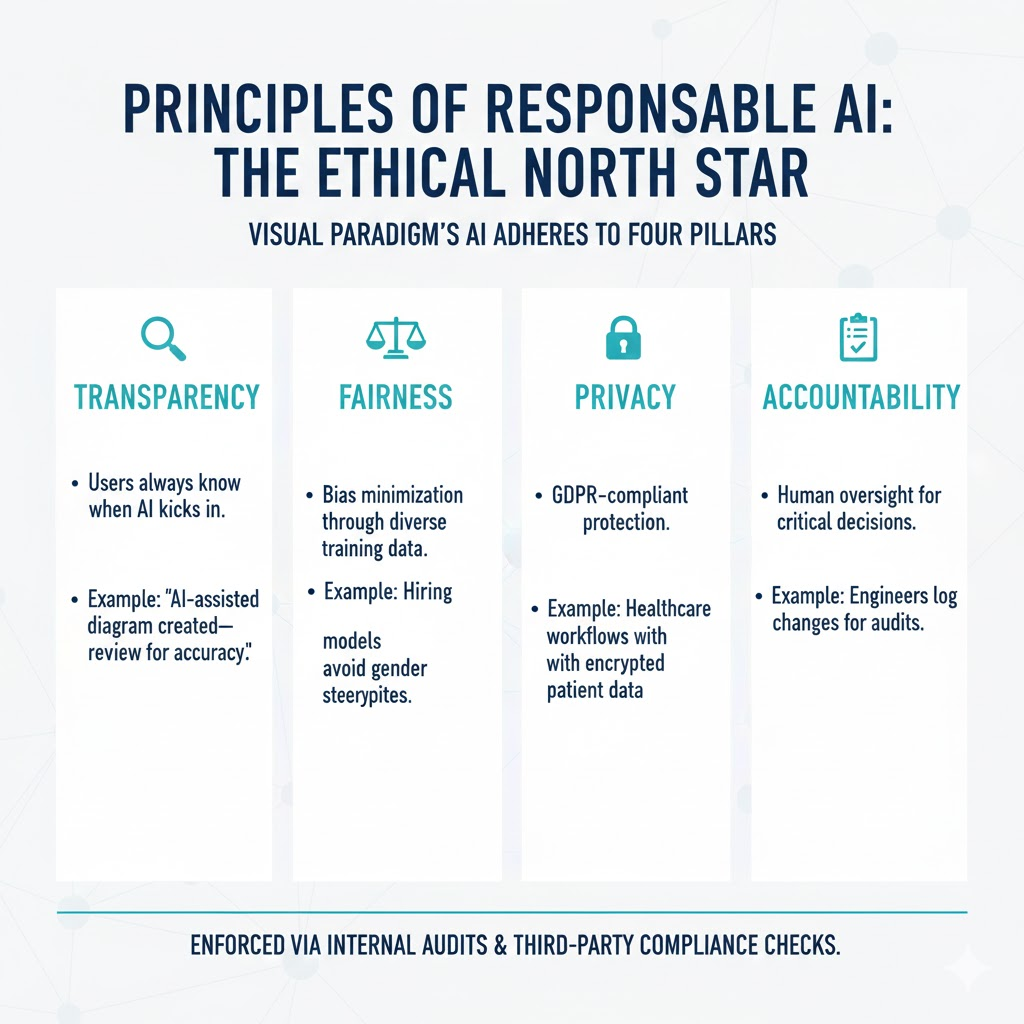
- Transparency: Users always know when AI kicks in. Example: Generating a BPMN flowchart from a prompt like “Model an e-commerce order process” triggers a clear notification: “AI-assisted diagram created—review for accuracy.” This demystifies the “black box,” building confidence.
- Fairness: Bias minimization through diverse training data. In hiring process modeling, AI won’t skew toward gender stereotypes; instead, it draws from balanced datasets, prompting users to verify equitable outcomes.
- Privacy: GDPR-compliant protection. All data is encrypted, with no unauthorized sharing. Imagine a healthcare firm diagramming patient workflows—sensitive details stay locked, accessible only via user credentials.
- Accountability: Human oversight for critical decisions. AI suggests a SysML model for aerospace simulations, but engineers must approve it, logging changes for audits.
These principles aren’t lip service; they’re enforced via internal audits and third-party compliance checks.
AI Capabilities and Limitations: Setting Realistic Expectations
AI outputs are probabilistic—accurate but not infallible. The policy mandates warnings: “Review automated decisions for critical use.” Example: In risk analysis, AI might flag vulnerabilities in a network diagram but overlook edge cases like rare cyber threats; a security expert intervenes. Models, trained on diverse datasets, still carry bias risks—e.g., overemphasizing Western business norms in global supply chain models—so users are urged to diversify inputs.
Data Usage and Privacy: Your Data, Your Castle
Here’s where trust shines: Visual Paradigm does not use client data or prompts for training. Prompts/outputs for general features (e.g., one-off UML generation) delete immediately post-session. For the AI Chatbot, they’re retained until user-deleted, enabling iterative chats like refining a use case over days.
Example: A startup prompts, “Generate ERD for user authentication.” The output vanishes after export, untraceable for training. No third-party sharing without written consent—vital for IP-sensitive firms like Nokia modeling 5G architectures. Clients own their data, requesting deletion anytime via a dashboard button. Encryption follows the Privacy Policy, with logs for breach-proofing.
User Prompt and Output Handling: Transient and Secure
Prompts are “transient data”—not stored, reused, or analyzed beyond the session. Example: Brainstorming a SWOT analysis for market entry? Your “Analyze risks for edtech launch” prompt generates a diagram, then evaporates—no analytics mining. External sharing requires authorization, preventing leaks in collaborative enterprise environments.
Client Responsibilities: A Two-Way Street
Users must comply with laws, avoid harmful uses (e.g., no discriminatory hiring models), and provide feedback. Example: If AI biases appear in a diversity flowchart, flagging it helps refine fairness algorithms.
Updates and Revisions: Evolving with Integrity
The policy updates silently upon posting, urging periodic reviews. This agility—seen in GDPR tweaks—keeps it current without disrupting users.
Why Visual Paradigm Excels as a Trustworthy AI Vendor
Visual Paradigm’s trustworthiness stems from alignment: Its history of award-winning reliability informs its AI ethics, and its customer base validates the results. Unlike hype-driven AI tools that harvest data indiscriminately, Visual Paradigm’s no-training-on-user-data stance protects innovations—e.g., Adobe’s proprietary designs stay safe. The AI Chatbot, fine-tuned on modeling standards like UML, generates compliant diagrams (e.g., state machines with inferred transitions), not generic sketches. Reviewers praise this: “It adheres to engineering practices, reducing errors in complex structures.”
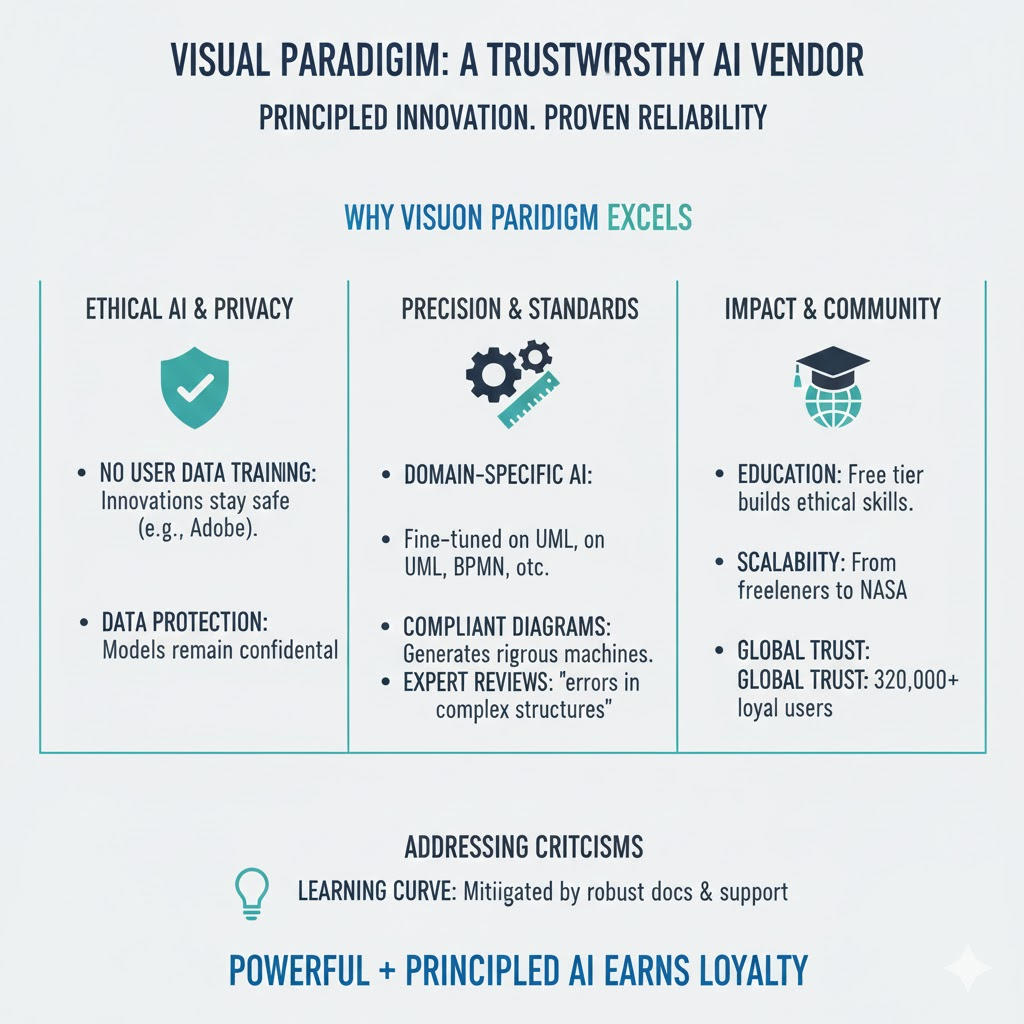
In education, its free tier builds skills ethically, as one professor noted: “It doesn’t hinder teaching OO semantics—students focus on concepts.” Scalability shines too: From solo freelancers diagramming apps to NASA’s simulations, it adapts without compromising privacy.
Critics might note the learning curve for advanced AI features, but robust docs and support (praised for quick responses) mitigate this. Ultimately, Visual Paradigm proves AI can be powerful and principled—earning loyalty from 320,000+ users who value security over speed.
Conclusion: Partner with Purpose
Visual Paradigm isn’t just an AI tool vendor; it’s a steward of responsible innovation. Its policy transforms abstract ethics into tangible safeguards, backed by a 24-year history of excellence and a customer ecosystem that spans innovators like Apple to educators worldwide. Whether you’re modeling a Toyota assembly line or a university curriculum, Visual Paradigm ensures your work is secure, fair, and forward-thinking. In a distrustful AI landscape, it’s the vendor you can bet on—because trust, like a well-crafted diagram, is built to last. Explore their tools today and see why professionals worldwide choose reliability over risk.
This post is also available in Deutsch, Español, فارسی, Français, English, Bahasa Indonesia, 日本語, Polski, Portuguese, Ру́сский, Việt Nam, 简体中文 and 繁體中文.