


While UML (Unified Modeling Language) is the most recognized standard for software design, it is one of many specialized modeling languages. The modern architectural landscape often requires architects and analysts to use complementary standards to address different concerns, from enterprise strategy to business processes.
This article breaks down the primary focus, key features, and optimal use cases for UML, the C4 Model, ArchiMate, and BPMN.
Unified Modeling Language (UML)
UML is the foundational, general-purpose standard for visualizing, specifying, constructing, and documenting the artifacts of a software system.
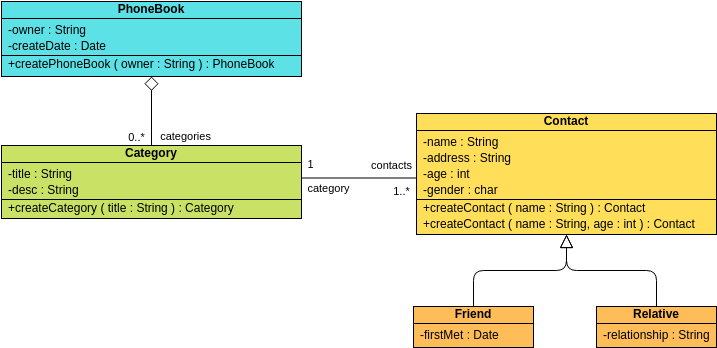
- Primary Focus: Detailed software system design, object-oriented analysis, and implementation-level blueprints.
- Key Diagrams: It offers 14 diagram types categorized into Structural (e.g., Class, Component, Deployment) and Behavioral (e.g., Sequence, Activity, State Machine).
- Level of Abstraction: Varies from high-level use cases to low-level code structure. It excels at the solution architecture and detailed design level.
- Audience: Primarily software developers, system architects, and technical teams.
C4 Model (Context, Containers, Components, Code)
The C4 model, created by Simon Brown, is not a formal standard like UML but a lightweight approach for visualizing and communicating software architecture. It is designed to be simple, easy to learn, and notation-independent (often implemented using simple boxes and arrows).
Learn more: Why the C4 Model Important
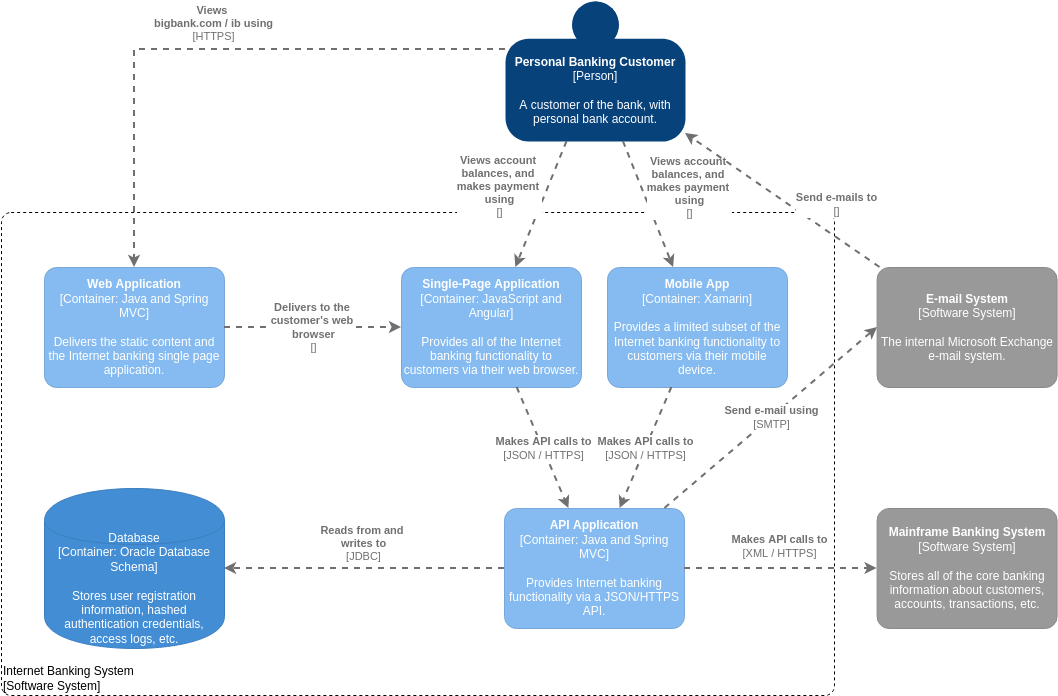
- Primary Focus: Communicating software architecture effectively to mixed audiences through a set of hierarchical, layered diagrams.
- Key Diagrams: C4 is defined by its four core levels of zoom:
- Context: Shows the software system and its users/dependencies within the business landscape. (Highest level)
- Containers: Zooms into the system to show high-level technical decisions (e.g., web application, mobile app, database, microservice).
- Components: Zooms into a single container to show its internal logical structure (e.g., controllers, services, repositories).
- Code: (Optional) Zooms into a single component to show implementation details, often using UML Class Diagrams.
- Level of Abstraction: High to medium. It prioritizes communication over technical completeness.
- Audience: Technical teams, managers, product owners, and non-technical stakeholders.
ArchiMate
ArchiMate is an open standard maintained by The Open Group, specifically designed for Enterprise Architecture (EA). It provides a holistic, structured view of an organization, linking business strategy to the underlying IT infrastructure.
Learn more: What is ArchiMate
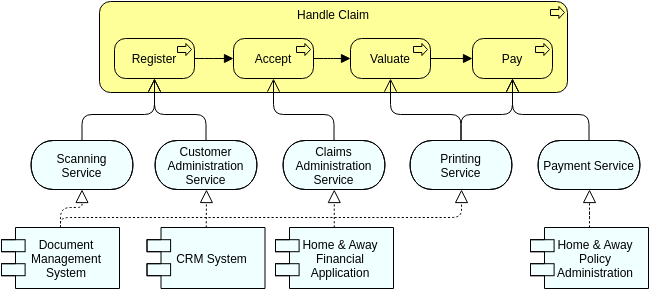
- Primary Focus: Aligning business goals, organizational structure, applications, and technology infrastructure. It models the entire enterprise and supports impact analysis for change.
- Key Layers: ArchiMate structures the enterprise into three main layers:
- Business Layer: Models products, services, processes, and roles.
- Application Layer: Models application components, services, and data objects.
- Technology Layer: Models the hardware, systems software, and networks that support the applications.
- Level of Abstraction: High and strategic. It focuses on the relationships and alignment between different domains, often at a conceptual or logical level.
- Audience: Enterprise Architects, IT Strategists, and Executive Leadership.
Business Process Model and Notation (BPMN)
BPMN is a graphical notation standard for specifying business processes in a workflow. Unlike UML, which focuses on system behavior, BPMN focuses on organizational behavior and process flow.
Learn more: What is BPMN
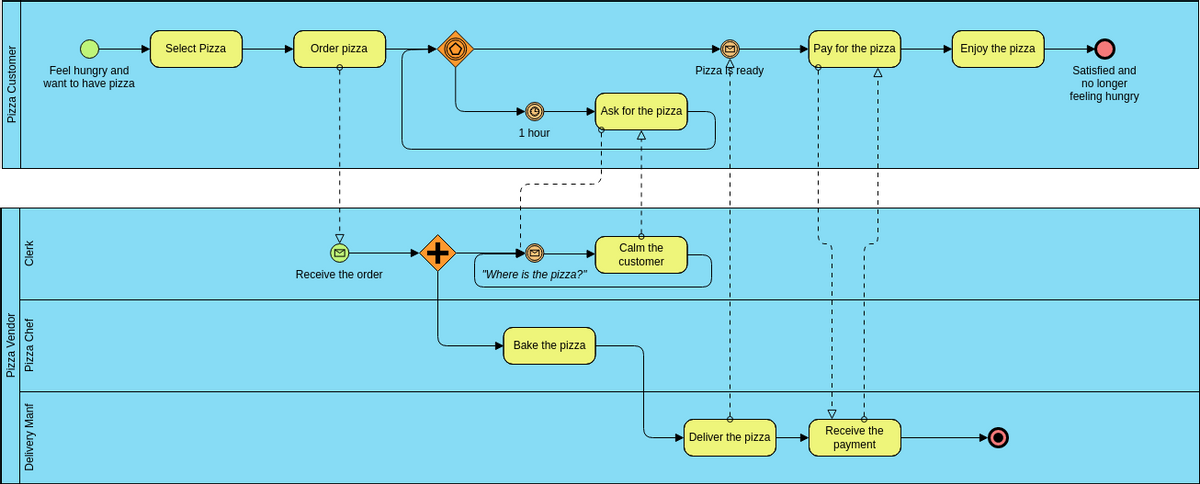
- Primary Focus: Modeling, analyzing, and optimizing end-to-end business processes, workflows, and operations.
- Key Elements:
- Flow Objects: Events (circles), Activities (rounded rectangles), and Gateways (diamonds) that define the flow logic.
- Connecting Objects: Sequence Flow, Message Flow, and Association.
- Swimlanes: Pools (participants/organizations) and Lanes (departments/roles) that show ownership.
- Level of Abstraction: Medium to detailed operational. It is precise enough to be executed by Business Process Management Systems (BPMS).
- Audience: Business analysts, process owners, and operations management.
Comparison Summary: UML vs. Others
The table below summarizes when and why you should choose one standard over another.
| Aspect | UML | C4 Model | ArchiMate | BPMN |
|---|---|---|---|---|
| Primary Goal | Detailed software design & implementation blueprint. | Communicating architecture to diverse stakeholders. | Modeling and analyzing the entire enterprise structure. | Modeling and optimizing business workflows. |
| Core Focus | Objects, classes, components, interactions, and state. | Software systems, containers, and their dependencies. | Business, Application, and Technology layers and their alignment. | Tasks, events, gateways, and the sequence of actions. |
| Abstraction Level | High to Low (Implementation Details) | High to Medium (Architectural View) | High (Strategic & Conceptual) | Medium (Operational Process Flow) |
| Ideal Audience | Developers, Solution Architects | Developers, Stakeholders, Managers | Enterprise Architects, Strategists | Business Analysts, Process Engineers |
| When to Choose | Modeling database schemas (Class Diagrams) or complex component interactions (Sequence Diagrams). | Providing a quick, clear map of a microservices landscape or onboarding new developers. | Tracing the impact of a new regulation (Business Goal) down to the affected servers (Technology Layer). | Mapping out a customer onboarding process or designing an automated fulfillment workflow. |
The Hybrid Approach
In modern large-scale organizations, these standards are often used together to create a full architectural narrative:
- ArchiMate defines the high-level strategy and the structure of the entire enterprise.
- BPMN models the specific business processes that the enterprise runs.
- The software systems required to execute those processes are defined using C4 (for the architectural overview) and UML (for the detailed component design).
This hierarchical approach ensures that documentation is appropriate for every stakeholder, from the CEO reading the strategic overview (ArchiMate) to the developer coding a specific object (UML).
Learn more about UML and discover how AI can visualize it by checking our UML resource hub.
This post is also available in Deutsch, Español, فارسی, Français, English, Bahasa Indonesia, 日本語, Polski, Portuguese, Ру́сский, Việt Nam, 简体中文 and 繁體中文.