


The Unified Modeling Language (UML) has long served as the essential blueprint for software development, providing a standardized visual language for designing and communicating system architecture. However, the manual creation and maintenance of these diagrams can be time-consuming, prone to error, and often lag behind the fast pace of agile development.
Enter Artificial Intelligence. Driven by Large Language Models (LLMs) and advanced natural language processing (NLP), AI is fundamentally changing the modeling process, turning static documentation into dynamic, intelligently generated artifacts.
1. The Shift from Drawing to Description
The most immediate and powerful impact of AI is the transition from a manual “drawing” workflow to a “descriptive” one. Modern AI-powered tools, such as the AI Chatbot provided by Visual Paradigm Online, eliminate the need for developers and analysts to painstakingly drag and drop shapes, manage connectors, and align elements.

Text-to-Diagram Generation
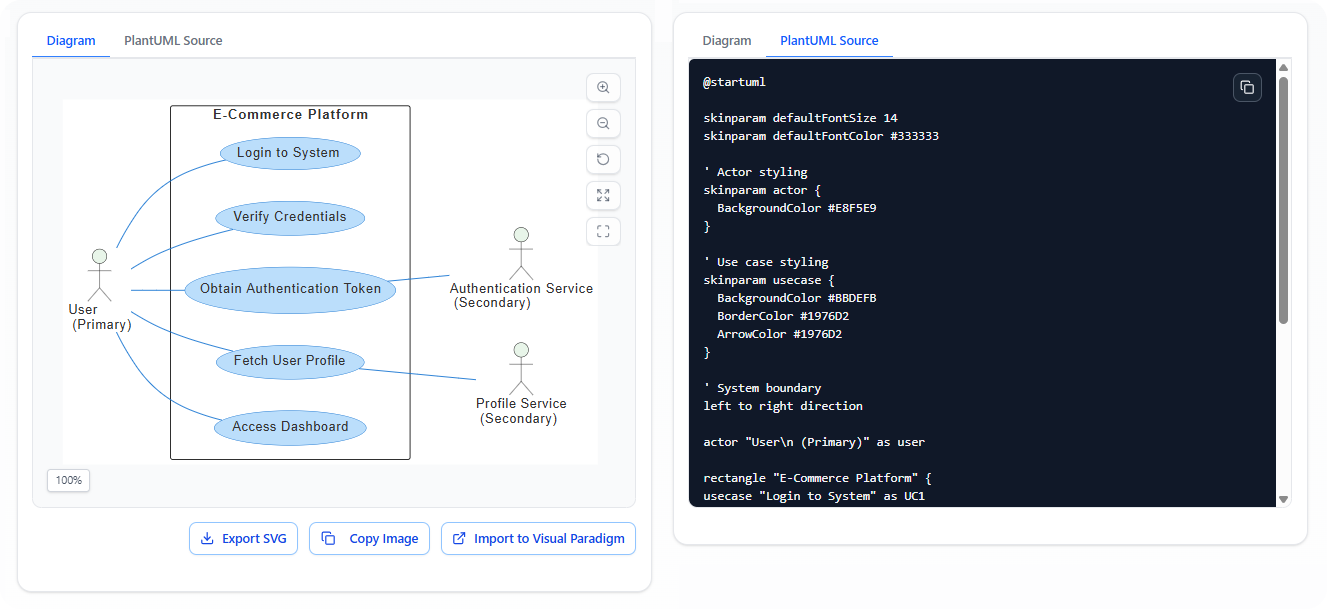
AI models are now capable of interpreting complex natural language requirements and instantly converting them into structured, compliant UML diagrams (e.g., Sequence, Class, Use Case).
For instance, using Visual Paradigm Online, a developer can simply input:
“Generate a sequence diagram for a user logging into an e-commerce platform: The user clicks login, the frontend sends credentials to the Authentication Service, which validates them against the User Database. The Auth Service returns a token to the frontend, which is then passed to the Profile Service to retrieve user data.”
In seconds, the AI Chatbot generates the complete diagram, including lifelines, messages, and synchronous/asynchronous calls, saving hours of manual setup.

2. Intelligent Refinement and Analysis
AI goes beyond simple generation; it acts as an intelligent co-pilot, helping to refine, validate, and optimize the generated models. Tools like the AI Chatbot allow for a conversational design process that mimics working with a human architect.
| AI Feature | Benefit in Modeling Workflow |
|---|---|
| Contextual Refinement | Users can ask conversational questions to modify the diagram, such as “Change the user retrieval from synchronous to asynchronous” or “Add an alternative path for invalid credentials.” The AI Chatbot updates the diagram immediately based on this feedback. |
| Consistency Enforcement | AI analyzes the diagram for adherence to UML standards and project-specific best practices, identifying potential inconsistencies, circular dependencies, or missing relationships (include/extend). |
| Code-to-Diagram Synthesis | Advanced tools can analyze existing source code (e.g., Python or Java classes) and automatically generate a corresponding Class Diagram, ensuring the documentation is always synchronized with the codebase. |
| Error Resolution | For text-based modeling languages like PlantUML or Mermaid, AI can automatically interpret and fix syntax errors, making it easier to maintain and share diagram code. |
3. The Broader Impact on Software Development
The speed and quality of AI-generated UML diagrams have cascading benefits across the entire software development lifecycle.
A. Accelerating Design and Collaboration
AI drastically reduces the time spent on creating the initial architectural blueprint. This allows teams to iterate on design concepts rapidly, explore multiple architectural options, and focus on strategic decisions rather than tedious formatting. Furthermore, by democratizing diagram creation through natural language, non-technical stakeholders (like Product Owners) can contribute directly to the visual documentation.
B. Dynamic, Living Documentation
One of the biggest struggles with traditional UML is maintaining diagrams as the code evolves. AI addresses this through bidirectional synchronization. Diagrams generated from code can be updated automatically when the code changes, and conversely, diagrams can potentially be used in Model-Driven Development (MDD) environments to generate code stubs, ensuring the documentation is a “living” artifact.
C. Reducing the Learning Curve
For junior developers or team members new to system design, AI provides contextual guidance. It explains complex concepts, justifies the structure of the generated diagrams, and suggests follow-up actions, turning the modeling process into an interactive learning experience.
Conclusion: The Future is Conversational
The future of software modeling is not about replacing the human architect, but about augmenting their capability. AI is transforming UML from a specialized, static diagramming task into a dynamic, conversational, and highly automated process.
By bridging the gap between natural language requirements and formal visual models, tools like Visual Paradigm Online’s AI Chatbot enable faster project kickoffs, more consistent design practices, and documentation that finally keeps pace with development. This evolution ensures that UML remains a relevant, strategic tool in the rapidly accelerating world of modern software engineering.
To learn in greater detail how UML works and how AI visualizes it, head to our UML resource hub.
This post is also available in Deutsch, Español, فارسی, Français, English, Bahasa Indonesia, 日本語, Polski, Portuguese, Ру́сский, Việt Nam, 简体中文 and 繁體中文.