LeSS is a lightweight, Agile framework for scaling Scrum to more than one team. Starting in 2005 Bas Vodde and Craig Larman developed the LeSS framework after using Scrum principles and rules on large scale projects. Their goal was to develop large scale projects successfully while staying within the constraints of Scrum.
Continue readingDanh mục: Scrum
Nhóm Agile của bạn: Quá lớn hay quá nhỏ?
Most Agile and Scrum training courses refer to a 7 +/- 2 rule, that is, agile or Scrum teams should be 5 to 9 members. Scrum enthusiasts may recall that the Scrum guide says Scrum teams should not be less than 3 or more than 9. Where does this thumb rule come from? and Why?
Continue readingThực hiện nhiều hơn với LeSS (Khung Scrum quy mô lớn): với minh họa công cụ
LeSS was created by Bas Vodde and Craig Larman from practical experience in scaling up Scrum, founded as the LeSS Company in 2014. The “More with LeSS” principle is at the heart of LeSS (Large Scale Scrum). Complex product development doesn’t require complex solutions. It requires a deep understanding of the essence of the problems, which can then be solved with simpler solutions.
Continue reading
Khi nào nên sử dụng cái nào? Câu chuyện người dùng / Trường hợp sử dụng / Tính năng / Mục tồn đọng
We always come across these terms in software development. Sometimes people a piece of software feature — requirement/ use case, backlog items …. What is the convention of the software people for using that or which?
Continue reading
Ước lượng linh hoạt là gì? Những cạm bẫy phổ biến là gì?
In software development , the usual “estimation” includes a quantitative evaluation of the work required to perform a given development task; this is usually expressed in terms of duration (hour / day) or estimated unit (story point). The purpose is to consolidate a number of such individual estimates in order to obtain an indication of the overall duration, work or cost of the software project.
Continue reading
Lập kế hoạch Sprint: Dự đoán so với Cam kết
In the summer of 2011, Ken Schwaber and Jeff Sutherland revised their Scrum Guide. In it, they removed one long established behavior known to Scrum, which is the commitment the team makes to the product owner and the customers. Commitment was replaced by forecast. They say that teams may forecast their work, but not commit to it.
Continue reading
Sự khác biệt giữa user story và tiêu chí chấp nhận là gì?
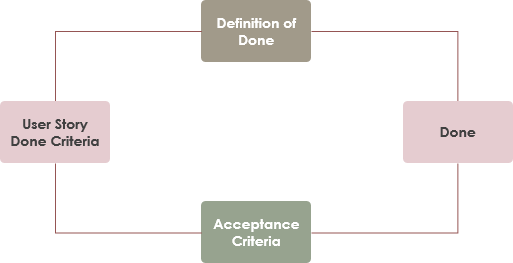
Definition of Done (DoD) is a list of requirements that a user story must adhere to for the team to call it complete. While the Acceptance Criteria of a User Story consist of set of Test Scenarios that are to be met to confirm that the software is working as expected.
Continue reading
Đánh giá Sprint vs Tổng kết Sprint
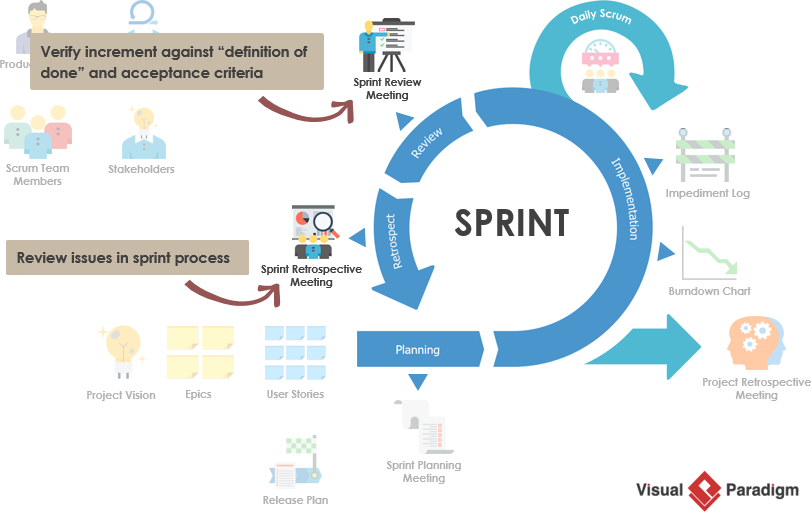
Each sprint ends with a two-part sprint review meeting. Such a meeting starts with a customer review and demonstration and ends with the team retrospective. Both of these components occur on the last day of the sprint. The Sprint Review focuses on the “inspect” and “adapt” of the increment (Potentially shippable), while the Sprint Retrospective give more focus on the “inspect” and “adapt” of the process of the sprint.
Continue reading
Scrum: ĐẦU TƯ vào Câu Chuyện Tốt bằng cách Đạt được Các Nhiệm vụ SMART
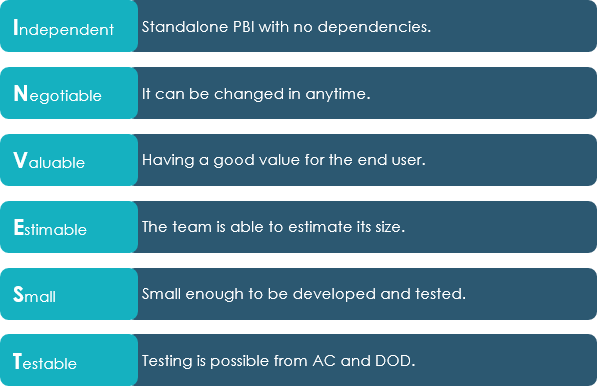
The INVEST as a reminder of the characteristics of a good quality Product Backlog Item (PBI) (or user stories) commonly written in user story format. But what are characteristics of a good user story? The acronym “INVEST” can remind you that good stories should be
Continue reading
Sự thất vọng lớn nhất mà hầu hết các đội Scrum đã trải qua là gì?
What has proven to be the strength of Scrum the past 20 years? What should be the focus of Scrum the upcoming 20 years? What of Scrum frustrated you the most so far? What connects you to Scrum? What is a small improvement that could be added to Scrum?
Continue reading